This year’s US Open was played at Congressional country club. While more of the pre-tournament coverage was focused on the lack of a clear front runner than any other single story, one of the more interesting stories, for me, came from the course itself: the controversy over the par rating of the course. For the members, Congressional plays as a par 72. For Tiger’s AT&T National championship, the course plays as a par 70. For the US Open this year, it played as a par 71. This metamorphosis got me thinking about the value that golfers place on the concept of par.
Par derives its name from Latin, in which “par” means equal. To me, par means the number of strokes that an accomplished golfer should take to complete a given golf hole. This number is usually based on the length of the hole from tee to green. With that basic definition, the concept ends, and of you want to see the variety of interpretations of “accomplished” that this phrase has generated, you need look no further than any two courses designed by different architects. By way of example, the 9th hole at the Davis municipal course that I learned to play this game on is a narrow hole that measures 237 yards from the back tees. That hole plays relatively flat and the prevailing wind is a left to right cross wind. The hole has a relatively small green that is protected by a bunker in front and on on both sides. There is a small run up between the bunkers in the front and on the right. On the other hand, 12th hole at Las Campanas is 247 yards that has a large green that is protected by a lake on the left that runs from the tee to the green and a bunker on the right. There is also a small run up, but the elevated tee prevents lower trajectory shots from being as effective as they may be on other topologies.
Despite these similarities, The 9th at the muni is a par 4, while the 12th at Las Campanas is a par 3.
Now, realistically, there is very little difference in how a given golfer should approach these holes. If he or she is capable of carrying the ball 230 yards off the tee and hitting it reasonably straight, the hole should be played as a par 3. For the rest of us, the hole is more likely a short par 4 that should be played with a layup short and right of the trouble surrounding the green with a short pitch remaining to the flag.
So what gives? How do these course designers or raters come up with these seemingly arbitrary par values for holes? What difference does it make? And for me, why isn’t par different for different players?
I heard recently about a new movement to help golf draw new players called “tee it forward” which encourages golfers to play one or two sets of tees forward of tees they are playing now to help bring some of the fun back to golf. While the theory is sound in principle, to me, it makes little sense to ask a weekend player to move forward because of the simple fact that his or her short game is the real reason why they are shooting high numbers. It doesn’t really matter if I hit driver-hybrid short of the green or driver-7 iron short of the green, it is my short game and putting that will determine the number that I write down on the scorecard. Also, for the average hacker, hitting driver into the woods from tees that are 25 yards forward of his usual tees does not make searching in the woods any more fun or less irritating. Finally, for the male ego, shooting 96 from the white tees is infinitely more humiliating than shooting 101 from the tips. (what happened out there today, Sally?) At best, rounds may take slightly less time, but are not likely to produce lower scores that will ultimately lead to more “fun.”
Since scores are what ultimately drive entertainment for most players, why not change par to reflect what the “average” golfer should shoot rather than what the accomplished golfer would shoot? I can’t imagine a more fun round for the average hacker than shooting -2 (even if par is 90). Short games may not improve, driving will not improve, and technique will not improve. Indeed, none of these will improve from a national “movement.” Instead, entertainment value for a round will go up, and hopefully course management skills will improve. I am not naive enough to think that people will not try to make eagles on every hole instead of birdies, but the resulting pars will take the sting out of the poorly hit second shot, and possibly encourage some players to play safer routes to the hole to make birdie. Indeed, for players striving to break 100 or even 90, why not think of every hole’s par value as one more than the value listed on the scorecard? This strategy is exactly how I broke 90 for the first time with an 87.
JK, if we assume that something has to be done to make golf more appealing to new players, and massive overhauls to courses are not practical, what do you think courses can do to to draw new players?
—————————————————————–
Response from JK:
To me, there are 2 reasons that interest in playing golf is waning (playing, not watching; we all know TW is the reason that interest in following golf is waning): (1) it takes forever, and (2) it costs a lot of money. I justify #2 by looking at my current golf bag, for which I got bargain basement deals on most of the equipment and still have spent over $700. The balls I play are $4 each, and they are the most commonly played balls in the game. In most areas, $90/round is not an uncommon price. Even in Atlanta, where golf is “cheap,” a typical course charges $55 on a weekday morning and $75 on a weekend. Although it is 4+ hours of entertainment, it’s easy to see why the average joe isn’t going to break into this sport.
So, for those who can swallow the cost, they have consigned themselves to the fact that the game is addictive, interesting, and fun. The thrill of achieving a new level is what brings us all back.
However, you know just as well as I do that there’s nothing worse than spending 5 hours on a golf course on a Sunday. Picture the scene: a beautiful spring day; it’s 80 degrees and a little breezy; you can smell the grass clippings from the early morning crew. You’re standing on the first tee, ready to tee off, looking at a wide, green fairway. Nothing but open possibility in front of you. You start to approach the ball to go into your pre-shot routine. All of a sudden, you hear the crack of a golf ball squarely contacting a pine tree. 2 golf carts come flying out of the woods into your fairway. 4 golfers get out of their carts, crack a beer each, grab a 3-wood, and proceed to take 9 practice swings each before topping the ball 40 yards ahead of themselves, into a bunker. You watch painfully as they struggle just to make contact. One slices into the woods right of the green. One puts his in the left front bunker (with a back right pin placement). One thuds 3 shots out of the fairway bunker trying to get it out, then just gives up, picks up the ball, and throws it back in the fairway, then spends 8 minutes raking the bunker he just obliterated, only to take 9 more practice swings from the fairway and top his ball, hitting the worm-burner onto the green. His friends tell him he’s hit a “nice shot,” which you can hear because they’re speaking at a volume normally reserved for movie theater sound commercials. Finally, after this ordeal, the fairway is clear. You stripe your tee shot down the right side of the fairway. But you know that, as soon as you get to your perfectly hit ball, you’re going to be paying for their mistakes again, waiting for the group in front of you to putt out on the green.
This is the main reason why I don’t want to play weekend golf. While I like the idea that the game is available to everyone, I don’t like that everyone cannot manage themselves and their games in a courteous manner for the betterment of all of the golfers behind them. This fact alone makes the game less enjoyable for the new golfer starting out. It’s impossible to enjoy the game with either (a) people holding you up in the fairway, or (b) people behind you pushing you to play faster. One or the other is not going to be happy.
This is why I don’t have as big of a problem with Tee It Forward as you. I think you’re spot-on that ego is the biggest reason that golfers won’t play the forward tees, but how often is that a reasonable justification for anything? The game is about putting the ball into the hole, not about how far you hit it, how good you play from the trees, how well you can drive a golf cart…nothing; all that matters is that the ball goes in the hole. The problem with playing the back tees is apparent for the weekend golfer. Most of them don’t hit the ball over 240 with a driver. They slice it more often then not, but never play for the slice. If you’re playing the tips, that combination of shortness and inaccuracy is deadly, not only for score, but also for round length. If there’s a 230-yard forced carry over water, my 275-carrying driver doesn’t even come close. But the weekend golfer is knocking knees trying to make it. And, if he doesn’t, he has to re-tee his ball and try again. Not exactly the best way to ensure that the game is enjoyable.
Your example re Davis Muni and Las Campanas is a little skewed. 247 yards is not a reasonable length to call anything a “par 4,” unless it’s playing straight uphill. Oakmont has a 290-yard “par 3.” Plus, you misrepresent Las Campanas a little, as 237 yards downhill in the desert plays closer to 210. Your point is well-taken: just because you call it a par 4 or par 3 doesn’t make it so. However, I don’t think it’s a realistic strategy for making the game more enjoyable. Telling someone that par is 90 only exemplifies the “everyone gets a trophy” idea. While golf is about you and you alone, the achievements made are universal. “Birdieing” a difficult hole only matters when it’s against an objective standard. For some people, birdie is an incredible score; for others, it should be expected one of four times playing the hole. But you can’t cheapen the value of that by saying my 3 is a birdie when your 5 is a birdie.
Moreover, what you’ve suggested is already accounted for by the USGA handicap system. A player of a 15 handicap “gets a stroke” on each of the 15 most difficult holes, giving him or her a relative value to par. When was the last time you actually saw someone use this system?
I agree with your advice that par is only a suggested number. For example, I played a 502 yard par 5 this weekend. After a good drive, I played it like a par 4, as I had only about 200 yards into the green. 500 is a reasonable length par 4 on the PGA Tour. However, most golfers can’t do that. If they play a 450-yard par 4, they should realistically think of it as a par 4.6 or 4.7, wherein they will par it only 1/3 or 1/4 of the time. But that determination is based on the player’s length, not their playing ability. Certainly, that player should not be upset with a 5, unless the hole is 80 feet downhill. However, teeing it forward alleviates this problem altogether, in that no forward tees will force a 450-yard par 4 on a player that can’t drive the ball over 240. Your strategy–thinking of each hole as a par of one greater than it actually is–is a good suggestion for course management. But that’s all it is. Few players will actually be encouraged by using that strategy to make the game more fun or enjoyable.
At the end of the day, the average golfer needs to accept that the tees you play are only a determination of the total length of the golf course. They are not an indication of how good you are. Some golf courses (i.e., the Judge) are insanely long, even from the forward tees. Others are short (i.e., Harbour Town), even from the back tees on a professional course. Shooting 96 from the forward tees may be the same in your mind as shooting 105 from the tips, but at least you broke 100. And if you shoot 72 from the forward tees, is anyone going to say “oh, well, you were playing the forward tees; it doesn’t count unless you’re on the tips”? Once people get over their own egos, the game naturally becomes more enjoyable. You stop worrying about your results, and you start worrying about enjoying the process of improvement.
Conversation: U.S. Open Predictions
June 20, 2011
Wow…were we wrong. Actual answers in bold.
(originally published Jun 16, 2011)
It’s that time of the year again! Our National Open is being played in our nation’s capital at Congressional near Bethesda, MD.
Here’s how we think things will shake out:
LG:
Winner: Dustin Johnson Rory McIlroy
Winning Score: -2 -16
Runner Up: Phil Mickelson Way wrong. +7, T-54
Low Amateur: Peter Uihlein wrong, Patrick Cantlay
“Unknown” in the Top 10: Jason Day correct (T-2), although I question if Day is really an “unknown.” The real answer is Kevin Chappell
Most difficult hole vs. par: 18
Easiest hole vs. par: 16
Last Year’s Winner (GMac) Will … (Win, Top10, Make the Cut, or Miss the Cut): make the cut, but be outside of the Top 10. Correct, T-14
Fred Funk will: MC Correct
How many prior winners will be in the Top 10: 0 Correct
Will there be a hole in one: No
…Which hole: n/a
Will Rory blow the 54 hole lead? Probably. Hell No
Will Obama present the trophy?: He should! but no. Correct
Who will be more embarrassed at the end of the tournament? Mickelson or McIlroy? If Mickelson doesn’t win, he should be more embarrassed. I expect Rory will just be forlorn. half correct…Mickelson definitely should be embarrassed with +7. Rory was definitely not forlorn
Will someone win it, or will everyone else lose it? Everyone else will definitely lose. Wrong. 4 rounds in the 60s, Rory won it
Who is most likely to “Dustin Johnson” it? I’m going to go with Phil on this one. I’d prefer to call it “Phil at Winged foot-ing it” yea, no one really did this, so, Phil’s +7 is about the closest thing to it
JK:
Winner: Stewart Cink Wrong. Cut
Winning Score: +1 WRONG -16
Runner Up: Matt Kuchar and Jason Day Day T-2, Kuchar T-14
Low Amateur: Peter Uihlein wrong, Patrick Cantlay
“Unknown” in the Top 10: Andres Gonzales wrong, MC. Correct answer was Kevin Chappell
Most difficult hole vs. par: 18
Easiest hole vs. par: 16
Last Year’s Winner (GMac) Will … (Win, Top10, Make the Cut, or Miss the Cut): Miss the cut. Too much going on in that dome. wrong. T-14
Fred Funk will: Seriously? Is he even in the field? MC correct
How many prior winners will be in the Top 10: 4 When I read this question, for some reason I thought this said “how many prior major winners in the top 10.” There were 3, Schawrtzel, Oosthuizen, and YE Yang. DLIII was T-11, so I almost got it.
Will there be a hole in one: No
…Which hole: n/a
Will Obama present the trophy?: If he reads the PF, I’m sure there’ll be a presidential veto of the authority to award the trophy. conclusion: obama does not read the PF
Who will be more embarrassed at the end of the tournament? Mickelson or McIlroy? Mickelson. Just seems to do dumb stuff in majors. correct.
Will someone win it, or will everyone else lose it? It’s the Open. Regardless of McDowell winning it last year, the bigger story will be everyone else losing it. jees was i wrong here
Who is most likely to “Dustin Johnson” it? Dustin Johnson. Again. T-23…I’d say I was wrong
Conversation: Masters Predictions (with answers)
April 11, 2011
Correct answers provided in block quote below:
Winner: Charl Schwartzel (JK & LG both said Tiger Woods, finished T4)
Winning Score: -14 (JK said -7, LG said -4)
Runner Up: Jason Day and Adam Scott (JK said Nick Watney, +4, LG said Steve Stricker, -5 (T11))
Low Amateur: Matsuyama (JK & LG said Uileihn)
“Unknown” in the Top 10: (JK said Charl Schwartzel–obviously right; LG said Anthony Kim, MC)
Most difficult hole vs. par: 11 (JK said 11, LG said 12)
Easiest hole vs. par: (JK & LG said 15–no confirmation yet)
Last Year’s Winner (Phil Mickelson): made the cut, but outside of the Top 10 (JK said Make the cut but outside of Top 10, LG said Top 10).
Sandy Lyle: missed the cut (JK & LG said this)
How many prior winners were in the Top 10: 2 (Woods & Cabrera) (JK said 3, LG said 4)
Was there a hole-in-one: I don’t think so (JK & LG said yes)
…Which hole: if there wasn’t one, then there wouldn’t be a hole.
Did Phil switch back to one driver: Yes, before the tourney started (JK said No, LG said probably not)
Which putter did Tiger use: Method (JK said Scotty Cameron, LG said start with Method then switch to Cameron)
All-in-all, not too bad.
———————————————————————————-
4/7/2011
OK LG, I thought it would be fun to put in writing our predictions for the Masters Tournament. I await your guesses (which will probably be as bad as mine).
JK:
Winner: Tiger Woods
Winning Score: -7
Runner Up: Nick Watney
Low Amateur: Peter Uihlein
“Unknown” in the Top 10: Charl Schwartzel
Most difficult hole vs. par: 11
Easiest hole vs. par: 15
Last Year’s Winner (Phil Mickelson) Will … (Win, Top10, Make the Cut, or Miss the Cut): make the cut, but be outside of the Top 10.
Sandy Lyle Will…(Win, Top10, Make the Cut, or Miss the Cut): miss the cut
How many prior winners will be in the Top 10: 3
Will there be a hole in one: yes
…Which hole: 16
Will Phil switch back to one driver: No, Callaway pays him way too much.
Which putter with Tiger use: Custom Newport 2 that won most of his majors
I’ll bet my guesses are at least 4 times better than yours. (whatever better means)
LG:
Winner: TW
Winning Score: -4
Runner Up: Steve Stricker
Low Amateur: Peter Uihlein
“Unknown” in the Top 10: Anthony Kim? (does this count?)
Most difficult hole vs. par: 12
Easiest hole vs. par: 15
Last Year’s Winner (Phil Mickelson) Will … (Win, Top10, Make the Cut, or Miss the Cut): Top 10
Sandy Lyle Will…(Win, Top10, Make the Cut, or Miss the Cut): miss the cut (sorry, Sandy)
How many prior winners will be in the Top 10: 4
Will there be a hole in one: YES!
…Which hole: 16
Will Phil switch back to one driver: Probably not, but he probably should…
Which putter will Tiger use: The Method on day 1, the Scotty for the rest of the tournament.
For those of you who don’t follow PGA Tour policy changes, you’re missing out on a “hot” debate at the moment. Camps are split on whether PGA Tour members should be required to play every event on the tour schedule at some point within a certain number of years. Essentially, the point of such a rule is to give a sponsor some assurance that, if they sign a long-term promotional deal, the top players on the Tour will play in their event.
The center of the debate is, of course, Tiger Woods. Fans will know not only that Tiger does not play every event; he rarely plays what could be considered a full schedule for a regular touring pro. Because he prefers to be in top form for each event he plays, he has set his annual schedule up so that he “peaks” for certain events. This schedule has centered largely on a few choice events and the majors. Tiger is not the only pro to take this tack to the Tour. Rarely will any of the top players be found playing events such as the Viking Classic in Madison, MS.
My personal feeling is that such a rule is misguided. Though I understand the desire to make the Tour’s product more valuable to potential sponsors, such a rule only pollutes the quality of the available product. While we watch in awe as these players decimate the hardest courses weekend after weekend, we must realize that very few (if any) players currently play every event on the schedule in any number of years. We think these pros would have no problem on any course they ever play, and while that’s true, they are only able to shoot those scores in the low 60s with local knowledge they develop from years of playing the same courses. Tiger’s schedule has afforded him the opportunity to learn the courses that really “fit his eye” and shoot amazingly low scores year in and year out. Consider the difference in your own game if you were to only play one course for an entire year versus playing a different course every single weekend. True, professionals are much better and should play any course significantly better the first time around than we do, but the difference between shooting 72 and 67 is nearly all in putting, which can be largely dependent on local knowledge.
—————————————————————————————
Response from JK:
I agree somewhat and disagree somewhat. I agree with you that the overall product of such a rule might dilute the quality of the Tour. Part of why we watch is to see those rare moments when the best battle the best and the chase comes down to the wire. Plus, implementation of such a rule would be very difficult–what happens if you don’t play in the required tournaments? You get fined? Kicked off the Tour? Forced to go to Q-School?
Still, I hesitate to agree with your disdain for such a plan. As I’ve already stated, the fun in viewing a PGA event is seeing the best in the world going head-to-head. That seems to be a MORE LIKELY occurrence if the best in the world are forced to play more often. In years gone by, it seemed like every week held a new battle. These battles led to some of the best and most infamous moments in the history of the Tour: Billy Mayfair dueling Tiger; Bob May’s duel with Tiger; Fred Couples’s magicly sticky ball at Augusta; Craig Stadler’s towel incident. Not all of these things happened in majors.
More importantly, the Tour as a whole benefits from such a rule. First, it attracts far better sponsors because those sponsors are guaranteed that they will have the best in the world at some point, creating a bigger viewing audience. Moreover, I think it helps the players themselves. Right now, there’s a lot of young talent that gets lost in the mix because the top 3, 4, or 5 players in the world dominate the air during any given tournament that has any field worth viewing. If the field were dispersed, you might see Anthony Kim win 2 tournaments in California then see Dustin Johnson win two in Florida, while Bubba Watson was in a duel with Phil Mickelson in another tournament. How much publicity would that generate leading into the Masters? The viewing public would think there were many horses in the race, which makes it far more interesting. Right now, the viewing public thinks there are only a few good players at the top and, otherwise, a pretty lacking field. Whether true or not, such an arrangement would make the game more exciting for everyone.
Just my opinion, though.
—————————————
Reply from LG:
I agree with you, JK, that the value of any given sponsorship would increase. It certainly enticing to think that every single player on the Tour would be required to play in your event at some point during the next three years. What we really need to resolve this issue is some data that tells us how much a “premium” tournament sponsorship goes for versus a “regular” tournament sponsorship is worth. (Any help on that front, PGA Tour?) With respect to enforcement, I think such a rule could be enforced through sanctions, fines, and peer pressure much as any other rule is enforced. (See, for example, the groove rule).
As far as the epic battles, I think the reduction in the quality of play would limit the number of these kinds of epic battles. If players don’t know the course as well, how can they make those huge putts? Also, If everyone is required to play every event, it seems less likely that the top players’ paths will cross in any event. Wouldn’t it be a shame if Tiger or Phil had to miss the WGC-Accenture Match Play to play in the Mayakoba Classic?!
Conversation: Will Tiger Break Jack’s Record?
January 12, 2011
Posted 12/4/2010 by JK:
Here’s an interesting topic. Some have postulated recently that Tiger’s golf regression means he won’t catch Jack Nicklaus for the all-time major championship wins record. Jack Nicklaus won 18 professional major championships in his career. At one time, it seemed like an absolute lock that Tiger would pass Jack. But Tiger hasn’t won a major since the ’08 US Open at Torrey Pines, and with the impressive young talent right now (Bubba Watson, Dustin Johnson, Ricky Fowler, Anthony Kim, Martin Kaymer, etc.), it seems that Tiger will have even fewer chances to win going forward.
For my money, I can’t see any reason how Tiger would not pass Jack, and here’s why: statistics. It used to be that golfers over about 42 years old were generally just biding their time, waiting for the Senior Tour (or, now, the Champion’s Tour). But that has changed, in my opinion, and it will affect Tiger’s ability to challenge Jack.
Tiger is now 35 years old, and many of today’s great golfers are playing well even into their late 40s (Phil Mickelson, Vijay Singh). Even Fred Couples is still competing at 50+. If he follows that trend, Tiger’s got a good 10 years of very competitive golf left in him, and with modern conditioning, weight training, equipment, and medical attention that he has experienced his entire life, he may go even further without a hitch. If he goes 10 more years, he has until 2020 to complete the feat. Even considering he only makes it 10 more years of truly competitive golf (45 years old), he’ll still have 40 more majors to play in. That means he’d have to win only 10% of the majors to tie Jack’s record. If he averaged 2 majors every 3 years–2 wins out of 12 tries, or fewer than one per year–he’d still tie Jack’s record by 2016 and beat it by 2019. In 14 years, he’s won 14 majors (exactly 10%), finishing second or tied for second 6 times, and finishing in the top 10 but outside of 1 or 2 another 14 times. Plus, he was out for half of 2008 with knee surgery and was dealing with “off-the-course” issues during 2010. If he has one more stretch like 00-02 (6 majors) or 05-07 (5 majors), he’ll pass jack over a 2-year span. And, he has 10 years in which to get it done!
Moreover, it has to be considered that Tiger no longer has the stress of keeping up extramarital affairs in the background of his already complicated personal life. The same thing that made him a scumbag to a lot of the world probably hurt his ability to focus on his job. How else would you explain Tiger shooting 75 in the final round of a major to be caught by YE Yang? Moreover, now that he’s “single” again, he doesn’t have the constant need to put his family ahead of his professional endeavors. Many athletes perform better after divorces–sad to say, but it’s true. And Tiger’s swing already looks better, and his competitive drive seems to have returned along with it.
Thus, I can’t see any way that Tiger doesn’t break Jack’s record.
Any thoughts, LG?
——————————————————————————————–
Posted 1/11/11 by LG:
Thanks for the intro, JK. I agree with you that it’s likely (for me, nearly inevitable) that Tiger will one day hold the record for most major championship titles owned by a single golfer. The more interesting questions to me are whether Tiger needs to break this record in order to go down as the greatest golfer that’s ever played the game and whether people want this record to be broken.
As to the first question, I’m sure much debate and defaming would go down if I were to take a firm position on the matter. For me, I’m not honestly sure what entitles someone to call themselves the “greatest golfer in the history of the game.” Bobby Jones championed the cause of the amateur golfer during a time when professional golfers were despised. Arnie brought the game to the people: He is the King. Jack won the most majors and exemplified the true competitor. Tiger has destroyed the field, redefined the game for the next generation, and brought the game to its largest known audience in history. For me, No one besides these four should be considered for the title. Forced to choose between them, I would pick Tiger.
My reasons are selfish. I never once thought I’d play golf while I was growing up. I took lessons for one summer and enjoyed them but never pursued the game. I took up pool in college and thought that golf was what people did after they busted out of a pool tournament (happily mistaken). At the end of the day, when I think about why I play this game, it is because of Tiger. His dominance over the game was something I had to experience to believe. Only after playing golf could I begin to understand the magnitude of his accomplishments.
Sport to me comes down to one thing: competition. Whether it’s putting a ball into a hole, shooting a ball into a basket, or sending a puck into the back of a net, the game is played to decide who wins and who loses. Therefore, the greatest golfer to me must be the greatest competitor. While Jack did win the most majors, Tiger has won more dominantly than any other player in history. If Tiger wins more majors, it seems untenable to argue that Jack is the greatest golfer on this theory, but I’m sure there are those who will try. Before that happens, however, I find it difficult to decide between the greatest number of wins and the dominance in those wins. The question remains, who is the greatest?
As to the second question, I don’t believe there could be any greater stimulus to the game of golf in this nation than for Tiger to break this record. The chase toward the record, and the manner of Tiger’s wins thus far, has been the single reason (like it or not) that golf has achieved the notoriety and cool factor that it has with the international sports community. Tiger’s dominance created an aura of invincibility that has likely not been paralleled in individual competition in modern history. The solitary nature of golf, with one man controlling his fate, renders Tiger’s achievement even more awe inspiring. If and when Tiger wins another major, we will not only find golf ratings shooting through the roof at near 2000 rates, but the game will feel new again. I, for one, am waiting for the day when Tiger begins his run again. Just thinking about Tiger in contention to win the Masters in April with a 12 footer to win on 18 already has the hair standing up on the back of my neck. Kobe held up five fingers at the end of the NBA championship last year to celebrate his 5th title. How do you celebrate your 5th green jacket? A fist pump? a high-five (that, for once, hopefully looks somewhat coordinated) with your caddie? Holding your (Scotty Cameron) putter in the air? I can’t wait to find out this April.
Conversation: Kuchar and The FedEx Cup
November 24, 2010
Sent at 2:10 PM on Tuesday
JK: Did you see my Kuchar post on the PF?
–
LG: I did. Well done. Not sure I agree 100%, but you make a compelling argument
–
JK: I am a little biased =)
–
LG: I’m not sure he’s “easily” player of the year. I think Jim Furyk won that particular award. 3 wins is a big deal
–
JK: So is 11 top ten finishes
–
LG: agreed. I think there’s something to be said for just the 72nd hole at the Tour Championship. $10 Million par.
–
JK: I know. But the 70th and 71st, Furyk tried to choke it away
–
LG: There are no pictures on a score card. The number is all that matters—and that number is 10 million.
–
JK: I’ll give it to ya. Kuchar’s on the top of the money list; above Furyk, Els, Stricker, DJ, and Phil. That’s pretty amazing company
–
LG: Defintiely man
–
JK: And the casual golf fan will not think of him in that company
–
LG: He’s easily the “where the heck did he come from” player of the year
–
JK: He definitely played above his level
–
LG: The Rocco mediate award
–
JK: And, he would’ve won the FedEx Cup if it had been played the same way as last year
–
LG: Yeah, definitely
–
JK: But they reset the points, so we wouldn’t even be talking about Furyk if Kuchar hadn’t gotten screwed
–
LG: It wouldn’t be very exciting if they didn’t, to be honest. Playoffs always work that way
–
JK: Then they need to find a better way to do it. But don’t penalize the guy for being great in the first 9 events and sucking the last one
–
LG: That’s how playoffs always work!
–
JK: No it’s not. The sprint cup isn’t Read the rest of this entry »
Conversation: POTW 3 – Garrigus vs. Van de Velde
October 31, 2010
LG had some problems with my presentation in POTW 3. His remarks are reproduced below.
——————————————————————————————–
Comments from LG:
Hold up. You SERIOUSLY think that blowing a three-shot lead on the final hole is worse than VAN DE VELDE?!? *blink* *blink* How is this even a real comparison? Sure, three is more than two, especially in golf, but, respectfully sir, that is the only factor that falls in your favor. Admittedly, a two-shot lead going into what is probably the most difficult closing hole in the Open rota is far less safe than a three shot lead at the St. Jude, but as far as the biggest choke? No Contest.
I fail to see how you can even compare losing the St. Jude Classic to losing the Open Championship. Venue has to play a role. Carnoustie versus … wait, where’s the St. Jude played again? Let’s not forget, also, that this would be the first time in God know’s how long that a Frenchmen would have won a major championship. While this may not seem like a big deal, Van De Velde had the opportunity to bring golf to the forefront in his home country. Consider the impact that Arjun Atwal’s win at the Wyndham Championship has had on golf in India. The impact of a win at golf’s oldest contest would have sent shock waves throughout the country. I don’t recall this even being mentioned in the highlights in SportsCenter.
Moreover, as you describe it, Garrigus had one opportunity to play the right shot (the shot after his drop). Van De Velde had no fewer than THREE. First, he should NOT have played a driver on the final hole. 4 iron was always the play. Second, after getting lucky to not go OB, he should have hit the wedge to lay up. Instead, he takes 4 iron and goes for the hero shot. AGAIN he gets the biggest break of his life and hits the grandstands. Rather than bounce into Barry Burn, he lands in the weeds behind it. AGAIN he should have pitched out, but again, he goes for the green and this time lands in the burn. Another reason why Van De Velde is easily the biggest choke of all time: I didn’t need a video to write that description. It’s burned into my memory in the same way as Norman’s epic collapse in 1996. Majors will always matter more than any other tournament. Especially the epic collapses.
JK, you know who Van De Velde lost to in the resulting playoff. You know the only person to ever beat Tiger when he held a 54 hole lead going into the final round of a major. You know who shot 67 to beat Norman in 1996. Without looking, who did Garrigus lose to? yeah.
——————————————————————————————–
Response from JK
Without looking, Westwood ended up beating Garrigus in the first hole of the playoff. I think Westwood beat Stenson in the second hole of the playoff, but I’m not sure–I know it was a Sweed.
Anyways, that’s incidental. Basically, what you’re saying is that venue matters more than the degree of difficulty of the course, the degree of difficulty of the hole, the cushion of the lead, the way that player had played earlier in the week and earlier in the day, and how that player’s game fits the hole? Nevermind the amount of pressure on the player because of the size of the win. The whole “3 shots vs. 2 shots” is not “the only thing that goes in [my] favor.”
So, let me start at the top: The course. Carnoustie. One of the nastiest, craziest, unbelievable courses in the whole world. There are burns, blinds, crazy winds, small targets, pot bunkers, tight fairways, and hazards everywhere. People forget how bad it was: in a major championship, with the best golfers in the world playing, Van de Velde’s gaffe put him from +4 to +6. That’s right: a 3-way playoff at 6-over-par!! Tell me that course wasn’t hard. Garrigus finished at -10. Tell me that TPC Southwind is more difficult.
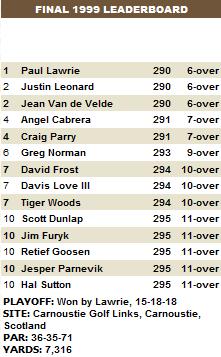
Note, as well…Tiger Woods, +10. When does Tiger ever shoot +10 for a tournament? That alone shows how unbelievably difficult Carnoustie was.
Next, the hole: 18 at TPC Southwind….

versus, 18th at Car-Nasty:

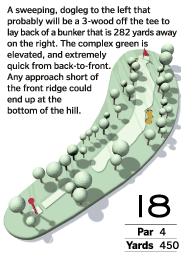
Look at that. Tell me where the “safe spot” is. Tell me where a 4-iron is supposed to land. Tell me how Van de Velde–who blocks 3 straight shots dead right so bad that he hits THE GRANDSTANDS–is supposed to get around that hole hitting a 4-iron off the tee. Tell me that it was not absolutely conceivable that Van de Velde could make a 6, standing on that tee.
Meanwhile, look at Garrigus at 18th of TPC Southwind. There is no way that a guy who hits the ball 350+ should ever have made a 7 on that hole. He could hit a driver into the trees, pitch out, hit up to the green, and 3-putt it without making a 7. There is no way that 18 at TPC Southwind compares to this…

Not to mention, 18 at TPC Southwind is a 450-yard dogleg, where Garrigus could easily have cut the corner. 18 at Carnoustie is 499 straight away; and you have to navigate the wind. There is no way to shorten it or make it easier.
Garrigus could easily dominate 18th at Southwind. No one can dominate 18 at Carnoustie.
But that brings me back to your other point: that Van de Velde had 3 bad decisions and Garrigus had only one; FALSE. Rather than smashing his driver to make sure he got his ball over the water, Garrigus decided to bring all the trouble into play by laying back with a hybrid. While Van de Velde brought the trouble into play, at least he was “going for it” by doing that. Had he nailed that driver, he would’ve walked it in for victory. Had Garrigus nailed his hybrid, he still would’ve had to get over the water to the green. But Garrigus made more bad decisions: he shouldn’t have dropped a ball in the rough; he shouldn’t have gone for the green on the next shot, but rather should’ve just laid up in the fairway with a wedge; and, once he hit the tree, he shouldn’t have hit the ball backwards to get it back into play. I mean, if you’re going to go for it, keep going for it. It’s bound to work out at least once.
But, perhaps most importantly, Van de Velde is French. I don’t know about you, but watching Van de Velde fall apart, I just knew it was going to happen. Somehow, you just knew he was going to throw it away. While it was unbelievable to be watching it, you knew it would happen.
Now, I get it–I’m not going to argue with you that throwing away the St. Jude Classic is like throwing away any major tournament. But, on the flip side: along with leading The Open Championship comes a whole deal of pressure that’s sure to lead to meltdowns. It happened to Tom Watson at Turnberry; a guy who had played beautifully all week suddenly takes 4 shots to get in from 170 yards. And don’t forget about Mickelson at the 2006 US Open; don’t forget how Mickelson double-bogeyed the last hole of that major championship to throw it away, just like Van de Velde. And, 18 at Winged Foot (see below) doesn’t even have water on it. What was Mickelson’s final score? +6, just like Van de Velde. So, why is Van de Velde’s collapse so special, when Mickelson did the same thing? Van de Velde was not the first time pressure played a part, and it won’t be the last. And, Turnberry and Winged Foot (even in US Open conditions) are way easier than Carnoustie in general, and the 18th holes are no comparison.
I know Garrigus didn’t throw away as much as Van de Velde or Mickelson did, but I’m not arguing that. I’m arguing that Garrigus’s collapse was far more painful to watch; it was far more unbelievable; it was far more gutwrenching. It has to be the biggest collapse in golf.
—————————————————————————————
LG’s Reply to JK’s response:
In order to resolve this conflict, we have to go back to the question originally posed: What has been the biggest collapse in professional golf history? . Our mutual disagreement seems to stem from our respective definitions of “epic collapse.” I think you believe that this term must mean which collapse is more unbelievable given the circumstance and the difficulty of the “collapsing” hole, while I take this term to mean the collapse that had the greatest impact on the history of the game. To this end, I don’t believe you’d (reasonably) argue with me that Van De Velde’s collapse had a greater impact on the history of game. (if you do, please let me know, i shall be happy to post all the reasons you’re wrong :P)
I also believe that my understanding of “epic collapse” is the one that most golfers would apply to this question as well. In the alternative, if we accept your definition, I still believe (though not as emphatically) that Van De Velde’s collapse could be greater. Here are the reasons why:
While I appreciate your analysis of the difficulty of the finishing holes, I think it more valuable to consider how difficult the hole was playing for the field. We can analyze the holes to death, but really the only thing that matters is how hard it is for the professionals playing it that day because you and I both know that this game depends heavily on the conditions on the day of play. Even the 106-yd par 3 seventh at Pebble can play anywhere from a lob wedge to a 4-iron for the pros. To this end, I think we should look at a better metric for determining difficulty of hole than our personal evaluations of the yardage book. *(quick aside – If I learned anything while researching this question JK, it’s that you and I have are NOT the first to argue this point.) A google search turned up the following table of final round scorecards for 1999 Open Championship top 10 finishers:
| HOLE YARDS PAR |
1 407 4 |
2 462 4 |
3 342 4 |
4 412 4 |
5 411 4 |
6 578 5 |
7 412 4 |
8 183 3 |
9 474 4 |
Out 3681 36 |
10 466 4 |
11 383 4 |
12 479 4 |
13 169 3 |
14 515 5 |
15 472 4 |
16 250 3 |
17 459 4 |
18 487 4 |
In 3680 35 |
Tot 7361 71 |
| Lawrie | 4 | 4 | 3 | 4 | 5 | 4 | 4 | 2 | 4 | 34 | 4 | 4 | 3 | 4 | 4 | 4 | 3 | 3 | 4 | 33 | 67 |
| Leonard | 4 | 4 | 4 | 4 | 4 | 4 | 4 | 3 | 4 | 35 | 5 | 4 | 4 | 3 | 4 | 5 | 3 | 4 | 5 | 37 | 72 |
| Van de Velde | 4 | 4 | 5 | 4 | 5 | 5 | 4 | 4 | 3 | 38 | 4 | 5 | 5 | 3 | 4 | 4 | 3 | 4 | 7 | 39 | 77 |
| Cabrera | 4 | 4 | 3 | 4 | 4 | 5 | 4 | 3 | 4 | 35 | 4 | 3 | 4 | 4 | 5 | 4 | 3 | 4 | 4 | 35 | 70 |
| Parry | 4 | 4 | 3 | 4 | 4 | 5 | 4 | 2 | 4 | 34 | 3 | 4 | 7 | 4 | 5 | 4 | 3 | 6 | 3 | 39 | 73 |
| Norman | 4 | 4 | 4 | 5 | 5 | 5 | 4 | 3 | 4 | 38 | 4 | 4 | 3 | 3 | 4 | 4 | 3 | 4 | 5 | 34 | 72 |
| Frost | 5 | 6 | 3 | 5 | 6 | 4 | 3 | 3 | 4 | 39 | 4 | 4 | 5 | 2 | 4 | 4 | 4 | 4 | 4 | 35 | 74 |
| Love | 4 | 3 | 4 | 3 | 4 | 5 | 3 | 4 | 5 | 35 | 5 | 3 | 5 | 2 | 4 | 4 | 4 | 4 | 3 | 34 | 69 |
| Woods | 4 | 4 | 4 | 4 | 4 | 5 | 4 | 3 | 4 | 36 | 4 | 4 | 6 | 3 | 4 | 5 | 3 | 4 | 5 | 38 | 74 |
As you can see, for a representative sampling of Van De Velde’s peers, the WORST score that he should have reasonably had on 18 was a 5. Instead, Van De Velde scored a gentleman’s 7; a full two shots worse than the WORST of his peers. Though no such table exists for the St. Jude (lending credence to the wide acceptance of my construction of “epic collapse”), my guess is that Garrigus’s performance was within two strokes of the worst of his peers on the final hole. Moreover, though you do make a fair point in arguing that the scores for the 1999 Open were some of the highest in history, a glance at the table shows that the scores on the final day are not reflective of the most difficult conditions experienced during that week, or even during the 10 most difficult rounds of the open championships. In the end, even if the difficulty of the hole is relevant to the determination of the most epic collapse, I think it’s questionable whether this factor falls in favor of Garrigus.
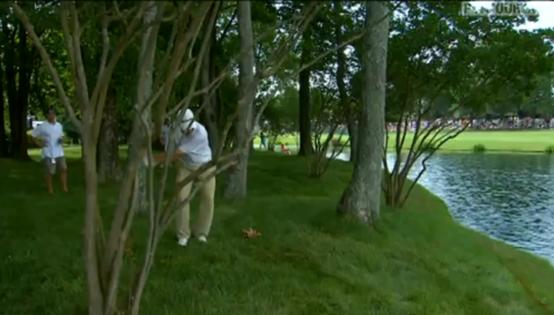
I also appreciate your attempts to muddy my “three mistakes to one” argument. This is not an argument related to general strategy as you frame it, but rather the mental mistakes that one must correct for once making the initial mistake off the tee. I agree with you 100% that had Van De Velde hit the driver well, he would have likely made 4 or 5. I also submit that had Garrigus hit the hybrid well, he would have likely made 4 or 5. The mistakes that I’m referring to come after the tee shot. Garrigus’s mistake here is not laying up. He first dropped it in a shaved area near the hazard mark (not in the rough) and then pulled his shot in the trees. His pitch out sideways is not a mistake. You tell me how he could have gone for the green from this position (note – green is behind Garrigus 1/2 way between him and his caddie in the picture below):
I kindly refer you back to the discussion of Van De Velde’s mistakes above. Garrigus really only made one mistake. His failure to lay up is the only thing that should be causing him nightmares. Van De Velde should (and has) taken long looks at three independent decisions he made en route to his 7 in 1999.
While I anticipate your worthy reply, I refer our readers to a similar discussion that was had by the writers at ESPN on whether Van De Velde’s gaff was the greatest blunder in major championship history. http://sports.espn.go.com/golf/britishopen07/news/story?id=2933998
Conversation: Zach Johnson
October 30, 2010
LG and I have talked about this on several occasions, and we’d like the PF community to weigh in on the subject (comment below).

2010-10-25 at 12:01 AM:
In my opinion, Zach Johnson is one of the absolute best players on the PGA Tour. He makes more with what he has than anyone else. He doesn’t have a long game, ranking 155th on Tour in driving distances. He makes his way around the course differently from everyone else. But he still manages to pace the field on so many occasions. When he donned the Green Jacket at the Masters several years ago, some people thought it was a fluke. But ZJ (my new nickname) has managed to finish in the top 10 of major tournaments 3 times and win on Tour 6 times in the last 4 years. He’s just an Iowa kid with a SeeMore putter, and he’s made over $3 million just this year (2010). In my opinion, ZJ is one of the best.
————————————————————————————–
2010-10-28:
JK has thrown down the public gauntlet on an argument that he and I have had for some time now. A little context is helpful (or in this case, funny enough to write about). I had driven to Atlanta as part of a “tour of the south” golf trip that we decided to take after our time working together in Palo Alto. We had taken one other trip to the Monterey Peninsula to play Spyglass Hill and Spanish Bay (don’t worry, we’ll be posting about this too), and found that we enjoyed each other’s company on golfing adventures. This trip included a stop at one of the famed Robert Trent Jones trail courses (Silver Lakes just outside of Anniston, AL) as well as JK’s home course in ATL.
During our non-golf time, we took a trip to the PGA Tour Superstore located in Duluth, GA. If you are unfamiliar with this facility, think of the hacker’s mecca. This place has EVERYTHING. Not only do they sell every freaking club imaginable, but they have every single item of clothing any tour player has ever worn, a full-service repair shop, driving range simulators, short game area, and a putting green that’s the size of most school playgrounds. Needless to say, JK and I headed straight to the putting green and engaged in a contest of wits (or contest lacking wits, I’ll let you decide). We setup obstacles and gave each other the crappiest ball and putter that we could find and challenged the other to make the putt for the win. While browsing for the worst flatstick possible, JK passed by those that were long, short, oblong, mis-shapen, ugly, or otherwise unsavory and landed upon the SeeMore. This useless implement should only be used for prying open the trunk of a car when you’ve locked the keys inside. As JK stated above, this is the putter that ZJ putts with, so our argument ensued in due course.
JK sets the stage for me to completely disagree with him and argue that ZJ is a terrible golfer and a fluke. Nothing could be further from the truth. Were I to attempt to argue otherwise, I would certainly lose all credibility that I may have on this blog. Any person that can drop a ball into a trashcan from 200+ yards out consistently is clearly a fantastic golfer. ZJ has proven this not only by winning the Masters (laying up on every par 5, i might add), but also 6 other times on the PGA Tour and twice on the Nationwide Tour.
That being said, there is a difference of opinion that must be expressed. I am not a fan of ZJ’s putting stroke. I have to admit that it works for him. He is a great putter. I don’t understand how it works for him though. Having a straight right hand and adding loft to the putter face is a recipe for disaster for the average player. I remember reading an article ZJ wrote in Golf Digest that discussed his technique as particularly good on the lightning quick greens at Augusta. I couldn’t imagine anything being further from the truth. While it is true that you can strike a downhill putt slightly harder if you add more loft to a putter face, doing so (for the average player) will only increase inconsistency because this creates a tendency not to finish the stroke. Without the proper release of the putter face, the ball will never start on the intended line. It has been my experience that most amateurs, even highly skilled amateurs, do not hit putts flush unless they focus on keeping the left wrist straight and leading the clubface with the back of their left hand. This action encourages the proper release of the putter and creates the end-over-end roll that is the hallmark of a great putter.
Also, I dislike ZJ’s Oakleys. dude, pick one. the hat or the shades. you don’t need both.
————————————————————————————–
2010-10-30 at 9:22 AM:
LG, very nice description. But I’ll have to disagree with you–that “useless implement” has many possible applications besides prying open a locked car trunk. You could use it as a blunt object for mugging people, hit nails, or even “rescue” your passed-out, cheating husband from his black Escalade at 2:00 in the morning after he ran into a fire hydrant by smashing out the back window….or whatever else really happened.
However, you’ve conveniently left out the rest of the story. PGA Tour Superstore happened to have a “putting competition” that day. Store patrons who happened to be in the store at 12:00 were invited to participate in a putting competition. The winner got a store gift card–$20 or so. LG and I, being the fun-loving guys that we are, decided to bet between us. Using the aforementioned “ugly” putter that we had each picked out for the other, if either won the entire putting competition (including about 20 other store patrons who had participated), the winner would get $10 from the other. As I recall, LG finished second out of all the participants while using the “useless implement.”
The SeeMore putter actually is an interesting concept. Its goal is to get its user to properly line up putts. Rather than giving an aiming line, it has a “red dot” that the user must “hide” by putting the shaft over it. In this way, the user knows the face will be lined up. Of course, this process makes a lot of assumptions–for example, that the user’s eyes are properly located above the ball, that the user does not forward press the shaft, etc.
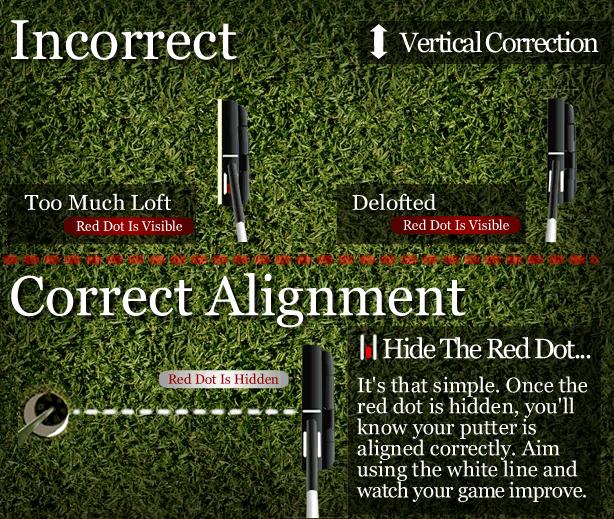
The particular putter used by LG in this competition, however, was quite useless because it had a double-bend shaft. What that meant was, there was really no way to “hide” the red dot. That’s why I chose it. It was pretty frustrating.

While you may not like ZJ’s flat right hand, there’s no reason why it’s a bad stroke. I’ll admit it looks different than the rest of the PGA Tour (which of itself usually indicates that something is wrong), but everything about ZJ’s game is “different” from the rest of the PGA Tour. The flat right hand, however, is not the only important thing in the stroke–in fact, it’s not even one of the important things in the stroke. (see http://www.golfdigest.com/golf-instruction/2009-02/obrienputting) ZJ’s arms and shoulders are aligned to the target. He has his eyes inside the line of the ball. He makes a good rotational stroke. What else is needed to sink putts? Apparently, not a straight left hand–ZJ was 6th on Tour this year in putting.
So, really, your gripe is that he looks funny. Your problem is that his hand isn’t the same as yours. well, LG, I refuse to be a hand-ist; I judge a golfer by the score on his player sheet, not by the look of his hands.
But the sunglasses are kind of bad.


 The Power Fade Golf Blog