Repainting a Club
November 30, 2010
First, I’d like to give credit where due. I followed the instructions on the following thread at the golfWRX forums, modifying (of course) for my own paint.
http://www.golfwrx.com/forums/topic/215937-titleist-905r-black/
Also, I used Duplicolor Mirage paint, which has a tutorial at the following YouTube address.
http://www.youtube.com/watch?v=FHZoCEzAgmc
A look at the paint itself is below:
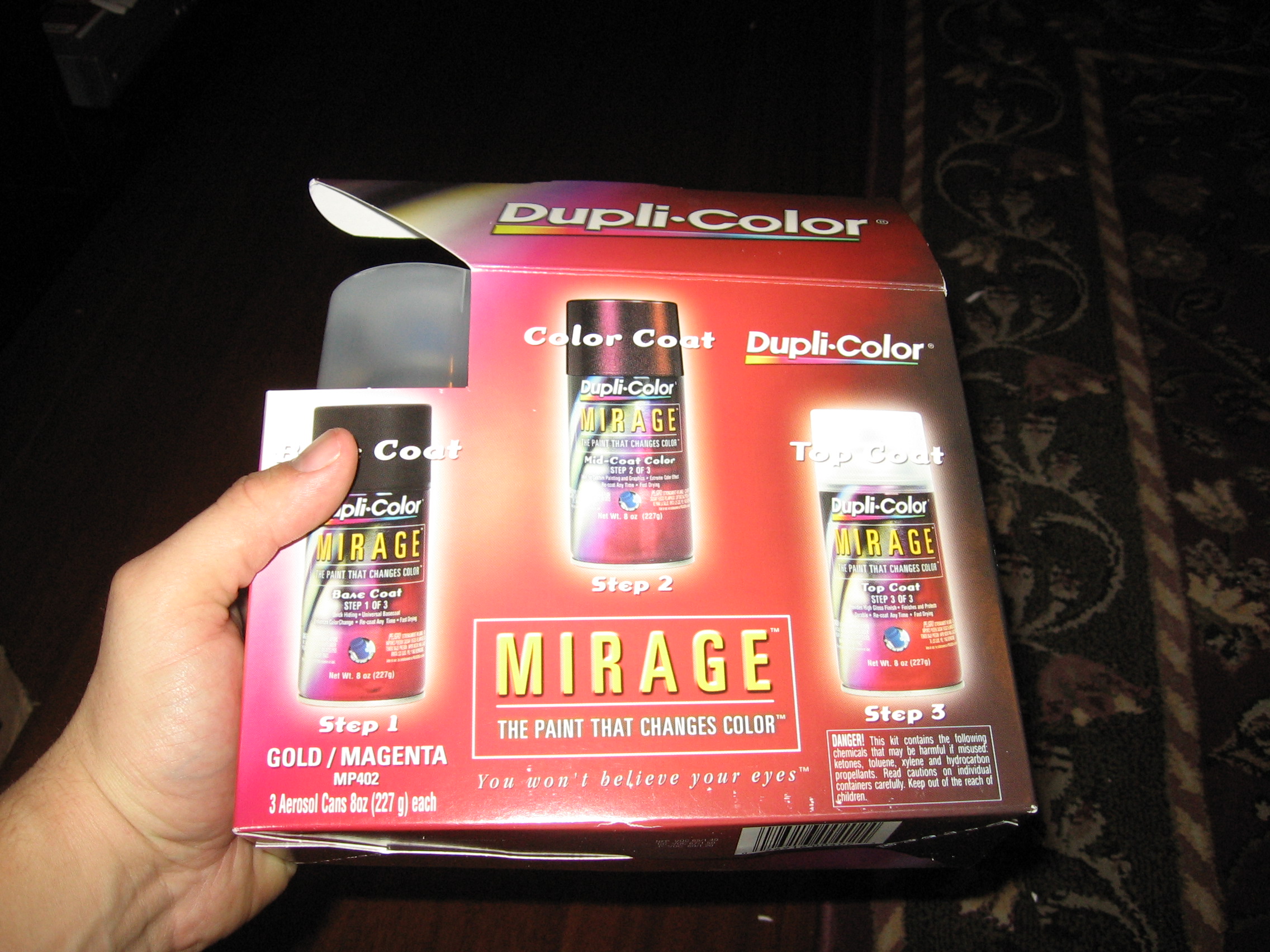
Alright, so, now for the gory details. I decided I was sick of seeing scratches on the top of my Titleist 904f, so I starting trying to find who would repaint it for me. As I looked around, the light bulb went off, as if to say “hey, why don’t you do it yourself? It would be cheaper, and you could customize it!” So, I tried to found the information online, and the GolfWRX forum listed above is what I came across.
However, I wasn’t confident enough to try it off the bat on my precious 904f. Instead, I decided Read the rest of this entry »
JK’s Swing
November 27, 2010
Take a look. There are 3 shots in the swing–straight, draw, and fade. When LG was trying to learn the difference in shots, I sent this video to him to help him understand the difference in setup, swing path, and plane for the 3 different shots.
As you can see, there are subtle differences in the setup and actual swings between the three different shots.
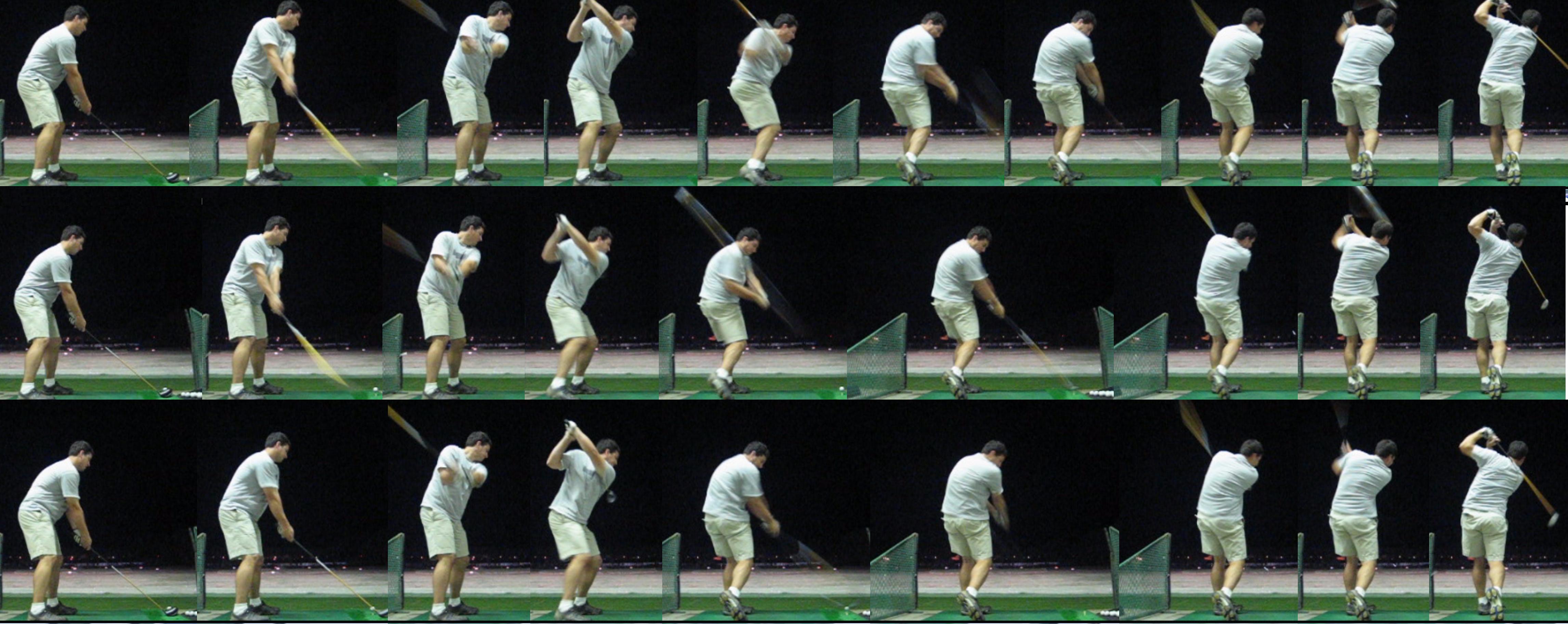
And, the image below shows how the swing looks on path/plane, and how the hands get through the swing.

Please comment if you have any questions or would like any specifics. We’re happy to help.
Golf Fitness: Power
November 24, 2010
Much has been written about golf fitness in terms of how to generate power. My goal is not to advocate a particular swing theory or exercise program, but rather to provide general fitness advice that should be helpful to any swing. While the average golfer generally wants to get more power in his or her full swing, rarely is that energy properly focused at the gym to develop the right muscles. Here are some fundamentals to focus on:
1) Mix in both Unilateral and Bilateral exercises – Bilateral exercises use both limbs in unison to move a load, such as barbell squats, barbell bench press, and chinups. If one limb pushes or pulls harder than the other, the load will not move evenly. Unilateral exercises focus on each limb working independently of each other. This can be accomplished by either isolating one limb at a time or by using dumbbells or independent stack cables to push or pull with both limbs at the same time. Examples of these movements include exercises such as dumbbell shoulder presses, dumbbell bent-over rows, and lunges. Read more here on these terms.
2) Start with your lower body – the only way to swing faster (not harder) is to have a stable foundation. Since good footwork is critical to nearly every swing, making sure your legs are strong is a good start to getting more power. I personally try to work my legs every single time I go to the gym. For me, mixing squats, splits squats, step ups, and a number of explosive leg exercises has helped improve my stability. In particular, curtsy squats help replicate the hip rotation that occurs in the golf swing. For those of you who are uncomfortable with weighted exercises, using an aerobics step for a number of ploy-metric exercises maybe the correct option. For others, squats and lunges will provide more than enough resistance.
3) Don’t forget your lower back – This area of the body is often forgotten but critical to maintaining spine angle throughout the swing – another fundamental of nearly every golf swing. To effectively work your lower back, you could start with an exercise ball and roll slowly backward while lying with your back on the ball to stretch it out. Most gyms are equipped with some variation of a back extension machine. Start with the one at a 45 degree angle and work your way up to the horizontal back extension. This exercise can be intimidating the first time you do it because you may feel as though you can’t support your body weight. Ease into it. Soon enough, you’ll be doing this exercise with only one leg supporting your weight.
4) Core strength – instead of just doing crunches, mix this up and use the cable machines to work your full range of motion. Woodchoppers and bar bell torques are the best for really feeling the burn and can be done with low weight. Also, don’t forget to work your lower abs. This will not only supplement the work you are doing on your lower back, but it will prevent lower back pain from carrying your bag around the course (another great fitness benefit!). One of my favorites is having a partner stand by your head while you are lying with your back on the ground. Kick your feet up towards your partner while keeping your legs straight and back on the ground. Have your partner throw your feet back toward the ground, but don’t them hit the floor. bring your feet back up to your partner and repeat. Once this becomes to easy, have your partner mix it up by throwing your feet down at an angle. This really burns.
5) Work your back, chest, and shoulders evenly! – don’t over-exercise on any one area in an attempt to “bulk up” because you’ll throw off your natural rhythm. Also, be sure to mix it up with bilateral and unilateral exercises here. Doing too many unilateral exercises will definitely throw off your body’s ability to coordinate muscles for a powerful, smooth swing.
6) Work your wrists – an often overlooked area for generating power in the golf swing is wrist strength. Rock climbers roll a weight that is hung from a dowel up and down while holding at arm’s length. I also recommend holding a light dumbbell and simply rotating your wrists as long as you can. These exercises will also help you generate clubhead speed because your wrists will be more supple during impact.
7) Don’t be discouraged, Keep at it! – soreness from working out and the uneven strength gains you make will likely translate into some initial backward movement in your ability. You may hit the ball shorter or make less flush contact initially, but give it time. Exercising will only improve your ability in the long run. Jokes aside, a good golf swing is an athletic motion that requires precision and balance. Developing leg and core strength will only improve your ability to swing faster.
When I first started working out, I started with a friend using a program endorsed by Men’s Health Magazine. You can find that program here.
More to come! If you’re currently working on your own program, please feel free to post about it!
Conversation: Kuchar and The FedEx Cup
November 24, 2010
Sent at 2:10 PM on Tuesday
JK: Did you see my Kuchar post on the PF?
–
LG: I did. Well done. Not sure I agree 100%, but you make a compelling argument
–
JK: I am a little biased =)
–
LG: I’m not sure he’s “easily” player of the year. I think Jim Furyk won that particular award. 3 wins is a big deal
–
JK: So is 11 top ten finishes
–
LG: agreed. I think there’s something to be said for just the 72nd hole at the Tour Championship. $10 Million par.
–
JK: I know. But the 70th and 71st, Furyk tried to choke it away
–
LG: There are no pictures on a score card. The number is all that matters—and that number is 10 million.
–
JK: I’ll give it to ya. Kuchar’s on the top of the money list; above Furyk, Els, Stricker, DJ, and Phil. That’s pretty amazing company
–
LG: Defintiely man
–
JK: And the casual golf fan will not think of him in that company
–
LG: He’s easily the “where the heck did he come from” player of the year
–
JK: He definitely played above his level
–
LG: The Rocco mediate award
–
JK: And, he would’ve won the FedEx Cup if it had been played the same way as last year
–
LG: Yeah, definitely
–
JK: But they reset the points, so we wouldn’t even be talking about Furyk if Kuchar hadn’t gotten screwed
–
LG: It wouldn’t be very exciting if they didn’t, to be honest. Playoffs always work that way
–
JK: Then they need to find a better way to do it. But don’t penalize the guy for being great in the first 9 events and sucking the last one
–
LG: That’s how playoffs always work!
–
JK: No it’s not. The sprint cup isn’t Read the rest of this entry »
Play of the Week 5
November 23, 2010
This week’s play of the week has to go to Matt Kuchar. I’ll always give a shout-out to a Yellow-Jacket, but this week, Kuchar has certainly earned it.
The Top 10 on the final money list:
1. Matt Kuchar, $4,910,477
2. Jim Furyk, $4,809,622
3. Ernie Els, $4,558,861
4. Dustin Johnson, $4,473,122
5. Steve Stricker, $4,190,235
6. Phil Mickelson, $3,821,733
Kuchar was easily the top player of the 2010 season. He finished at the top of the money list for 2010. He racked up 23 cuts, 11 top 10 finishes, and 20 top 25s. Without the crazy resetting of the points before the Tour Championship, Kuchar would’ve cruised to the FedEx Cup championship, as long as he simply finished the Tour Championship (which he did).
2010 will easily be remembered for a lot of failures: Bubba Watson, Dustin Johnson (twice), the US Ryder Cup Team, Tiger’s Marriage…. But, in a year of failures, Kuchar was a shining star among the masses, playing solid golf every week.
Here’s to you, Kuch! And along with Stu (Cink) and Double-D (Duval), we’re looking for a great showing of Yellow Jackets in 2011.
Sting ‘Em!

Quote of the Day
November 11, 2010
Tiger Woods played 14 holes before finally missing a green in the opening round of the Australian Masters, which would seem like the ideal start to defending a title for the last time this year.
Woods had to settle for a 2-under 69 on Thursday, leaving him four shots behind a trio of players who competed before far fewer fans and had far less trouble on the greens at Victoria Golf Club.
“That was probably the highest score I could have shot,” Woods said.
Me thinks he’s back. What say you, Papa JK?
http://sports.espn.go.com/golf/news/story?id=5781850
———————————————————————————–
Response from JK:
Well said, sir. Ever since Tiger dumped Haney, his swing has looked 1000 times better. I can’t wait to see what he does next year. I’m going on a limb here, but I think 2011 will hold some of the best we’ve seen of Tiger.
Play of the Week 4
November 9, 2010
Alright boys and girls, gather ’round. This week’s play of the week goes to Byron Morgan Putters. No more words needed. Look at this beauty:
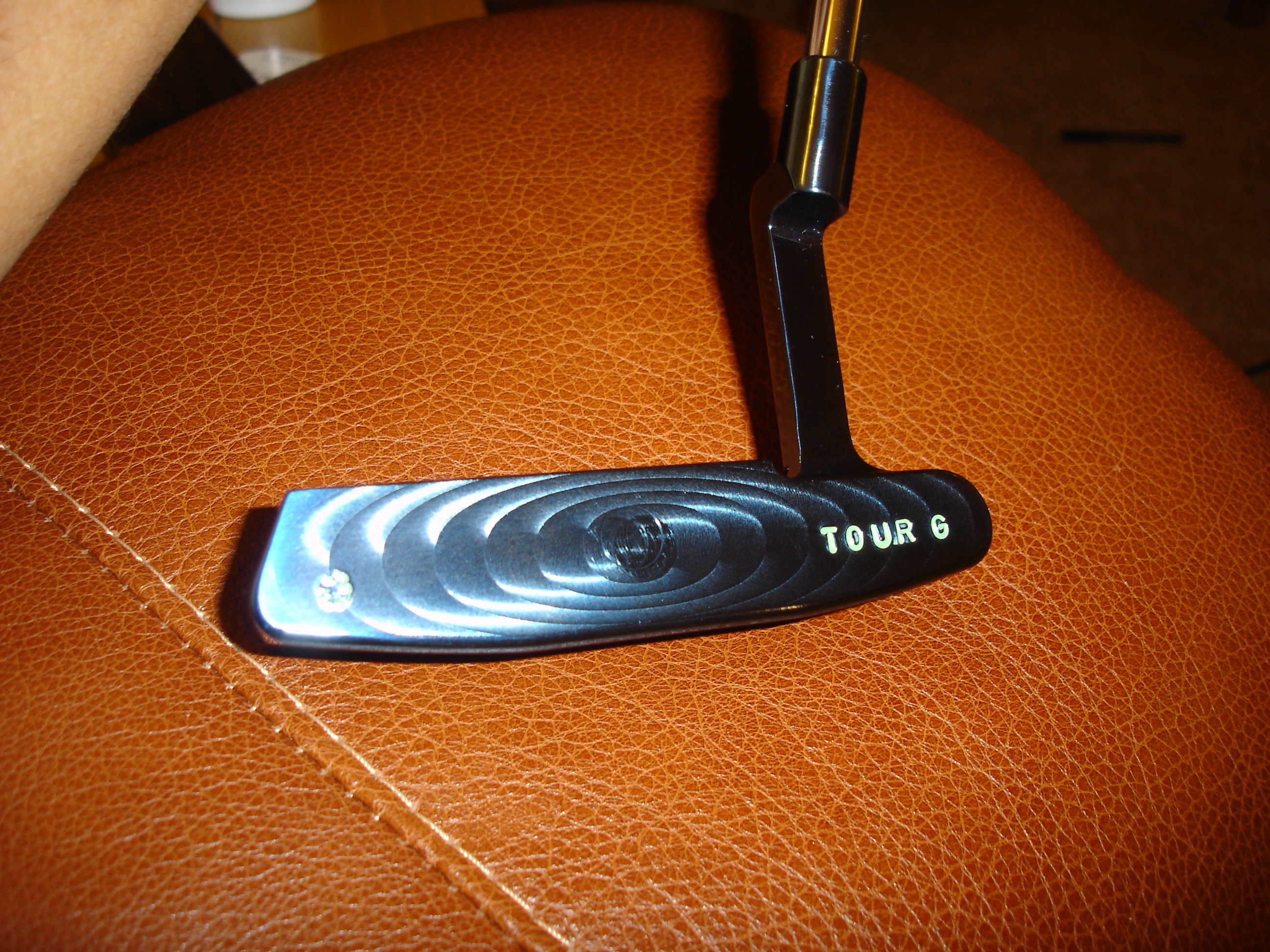
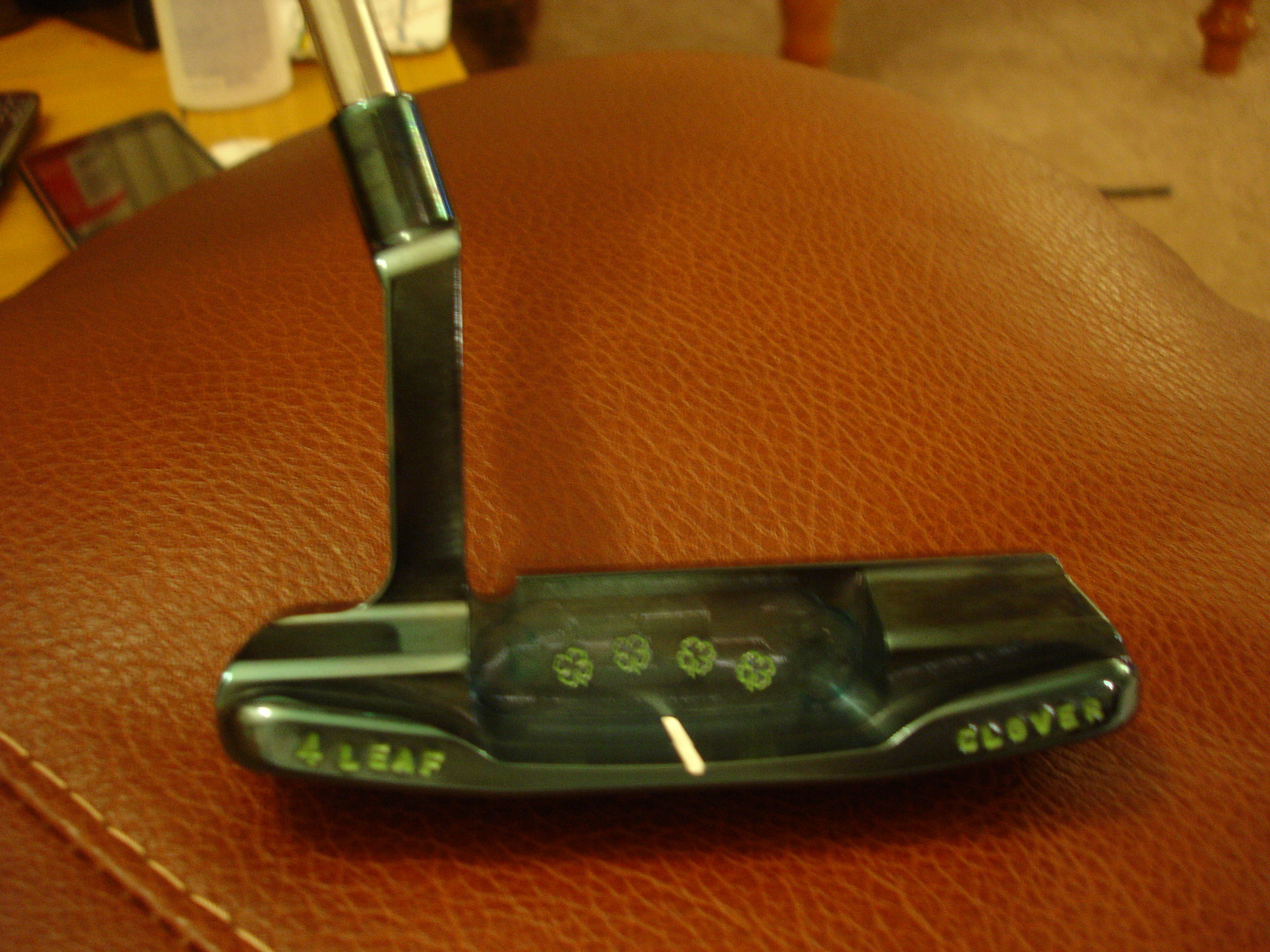
Go ahead. Click on the image to get the full effect.
New Page: Equipment Links
November 8, 2010
We have just posted a page that includes links to some obscure equipment manufacturers. Check it out–you might find something you like.
Conversation: POTW 3 – Garrigus vs. Van de Velde
October 31, 2010
LG had some problems with my presentation in POTW 3. His remarks are reproduced below.
——————————————————————————————–
Comments from LG:
Hold up. You SERIOUSLY think that blowing a three-shot lead on the final hole is worse than VAN DE VELDE?!? *blink* *blink* How is this even a real comparison? Sure, three is more than two, especially in golf, but, respectfully sir, that is the only factor that falls in your favor. Admittedly, a two-shot lead going into what is probably the most difficult closing hole in the Open rota is far less safe than a three shot lead at the St. Jude, but as far as the biggest choke? No Contest.
I fail to see how you can even compare losing the St. Jude Classic to losing the Open Championship. Venue has to play a role. Carnoustie versus … wait, where’s the St. Jude played again? Let’s not forget, also, that this would be the first time in God know’s how long that a Frenchmen would have won a major championship. While this may not seem like a big deal, Van De Velde had the opportunity to bring golf to the forefront in his home country. Consider the impact that Arjun Atwal’s win at the Wyndham Championship has had on golf in India. The impact of a win at golf’s oldest contest would have sent shock waves throughout the country. I don’t recall this even being mentioned in the highlights in SportsCenter.
Moreover, as you describe it, Garrigus had one opportunity to play the right shot (the shot after his drop). Van De Velde had no fewer than THREE. First, he should NOT have played a driver on the final hole. 4 iron was always the play. Second, after getting lucky to not go OB, he should have hit the wedge to lay up. Instead, he takes 4 iron and goes for the hero shot. AGAIN he gets the biggest break of his life and hits the grandstands. Rather than bounce into Barry Burn, he lands in the weeds behind it. AGAIN he should have pitched out, but again, he goes for the green and this time lands in the burn. Another reason why Van De Velde is easily the biggest choke of all time: I didn’t need a video to write that description. It’s burned into my memory in the same way as Norman’s epic collapse in 1996. Majors will always matter more than any other tournament. Especially the epic collapses.
JK, you know who Van De Velde lost to in the resulting playoff. You know the only person to ever beat Tiger when he held a 54 hole lead going into the final round of a major. You know who shot 67 to beat Norman in 1996. Without looking, who did Garrigus lose to? yeah.
——————————————————————————————–
Response from JK
Without looking, Westwood ended up beating Garrigus in the first hole of the playoff. I think Westwood beat Stenson in the second hole of the playoff, but I’m not sure–I know it was a Sweed.
Anyways, that’s incidental. Basically, what you’re saying is that venue matters more than the degree of difficulty of the course, the degree of difficulty of the hole, the cushion of the lead, the way that player had played earlier in the week and earlier in the day, and how that player’s game fits the hole? Nevermind the amount of pressure on the player because of the size of the win. The whole “3 shots vs. 2 shots” is not “the only thing that goes in [my] favor.”
So, let me start at the top: The course. Carnoustie. One of the nastiest, craziest, unbelievable courses in the whole world. There are burns, blinds, crazy winds, small targets, pot bunkers, tight fairways, and hazards everywhere. People forget how bad it was: in a major championship, with the best golfers in the world playing, Van de Velde’s gaffe put him from +4 to +6. That’s right: a 3-way playoff at 6-over-par!! Tell me that course wasn’t hard. Garrigus finished at -10. Tell me that TPC Southwind is more difficult.
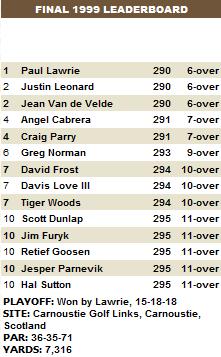
Note, as well…Tiger Woods, +10. When does Tiger ever shoot +10 for a tournament? That alone shows how unbelievably difficult Carnoustie was.
Next, the hole: 18 at TPC Southwind….

versus, 18th at Car-Nasty:

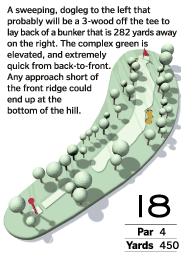
Look at that. Tell me where the “safe spot” is. Tell me where a 4-iron is supposed to land. Tell me how Van de Velde–who blocks 3 straight shots dead right so bad that he hits THE GRANDSTANDS–is supposed to get around that hole hitting a 4-iron off the tee. Tell me that it was not absolutely conceivable that Van de Velde could make a 6, standing on that tee.
Meanwhile, look at Garrigus at 18th of TPC Southwind. There is no way that a guy who hits the ball 350+ should ever have made a 7 on that hole. He could hit a driver into the trees, pitch out, hit up to the green, and 3-putt it without making a 7. There is no way that 18 at TPC Southwind compares to this…

Not to mention, 18 at TPC Southwind is a 450-yard dogleg, where Garrigus could easily have cut the corner. 18 at Carnoustie is 499 straight away; and you have to navigate the wind. There is no way to shorten it or make it easier.
Garrigus could easily dominate 18th at Southwind. No one can dominate 18 at Carnoustie.
But that brings me back to your other point: that Van de Velde had 3 bad decisions and Garrigus had only one; FALSE. Rather than smashing his driver to make sure he got his ball over the water, Garrigus decided to bring all the trouble into play by laying back with a hybrid. While Van de Velde brought the trouble into play, at least he was “going for it” by doing that. Had he nailed that driver, he would’ve walked it in for victory. Had Garrigus nailed his hybrid, he still would’ve had to get over the water to the green. But Garrigus made more bad decisions: he shouldn’t have dropped a ball in the rough; he shouldn’t have gone for the green on the next shot, but rather should’ve just laid up in the fairway with a wedge; and, once he hit the tree, he shouldn’t have hit the ball backwards to get it back into play. I mean, if you’re going to go for it, keep going for it. It’s bound to work out at least once.
But, perhaps most importantly, Van de Velde is French. I don’t know about you, but watching Van de Velde fall apart, I just knew it was going to happen. Somehow, you just knew he was going to throw it away. While it was unbelievable to be watching it, you knew it would happen.
Now, I get it–I’m not going to argue with you that throwing away the St. Jude Classic is like throwing away any major tournament. But, on the flip side: along with leading The Open Championship comes a whole deal of pressure that’s sure to lead to meltdowns. It happened to Tom Watson at Turnberry; a guy who had played beautifully all week suddenly takes 4 shots to get in from 170 yards. And don’t forget about Mickelson at the 2006 US Open; don’t forget how Mickelson double-bogeyed the last hole of that major championship to throw it away, just like Van de Velde. And, 18 at Winged Foot (see below) doesn’t even have water on it. What was Mickelson’s final score? +6, just like Van de Velde. So, why is Van de Velde’s collapse so special, when Mickelson did the same thing? Van de Velde was not the first time pressure played a part, and it won’t be the last. And, Turnberry and Winged Foot (even in US Open conditions) are way easier than Carnoustie in general, and the 18th holes are no comparison.
I know Garrigus didn’t throw away as much as Van de Velde or Mickelson did, but I’m not arguing that. I’m arguing that Garrigus’s collapse was far more painful to watch; it was far more unbelievable; it was far more gutwrenching. It has to be the biggest collapse in golf.
—————————————————————————————
LG’s Reply to JK’s response:
In order to resolve this conflict, we have to go back to the question originally posed: What has been the biggest collapse in professional golf history? . Our mutual disagreement seems to stem from our respective definitions of “epic collapse.” I think you believe that this term must mean which collapse is more unbelievable given the circumstance and the difficulty of the “collapsing” hole, while I take this term to mean the collapse that had the greatest impact on the history of the game. To this end, I don’t believe you’d (reasonably) argue with me that Van De Velde’s collapse had a greater impact on the history of game. (if you do, please let me know, i shall be happy to post all the reasons you’re wrong :P)
I also believe that my understanding of “epic collapse” is the one that most golfers would apply to this question as well. In the alternative, if we accept your definition, I still believe (though not as emphatically) that Van De Velde’s collapse could be greater. Here are the reasons why:
While I appreciate your analysis of the difficulty of the finishing holes, I think it more valuable to consider how difficult the hole was playing for the field. We can analyze the holes to death, but really the only thing that matters is how hard it is for the professionals playing it that day because you and I both know that this game depends heavily on the conditions on the day of play. Even the 106-yd par 3 seventh at Pebble can play anywhere from a lob wedge to a 4-iron for the pros. To this end, I think we should look at a better metric for determining difficulty of hole than our personal evaluations of the yardage book. *(quick aside – If I learned anything while researching this question JK, it’s that you and I have are NOT the first to argue this point.) A google search turned up the following table of final round scorecards for 1999 Open Championship top 10 finishers:
| HOLE YARDS PAR |
1 407 4 |
2 462 4 |
3 342 4 |
4 412 4 |
5 411 4 |
6 578 5 |
7 412 4 |
8 183 3 |
9 474 4 |
Out 3681 36 |
10 466 4 |
11 383 4 |
12 479 4 |
13 169 3 |
14 515 5 |
15 472 4 |
16 250 3 |
17 459 4 |
18 487 4 |
In 3680 35 |
Tot 7361 71 |
| Lawrie | 4 | 4 | 3 | 4 | 5 | 4 | 4 | 2 | 4 | 34 | 4 | 4 | 3 | 4 | 4 | 4 | 3 | 3 | 4 | 33 | 67 |
| Leonard | 4 | 4 | 4 | 4 | 4 | 4 | 4 | 3 | 4 | 35 | 5 | 4 | 4 | 3 | 4 | 5 | 3 | 4 | 5 | 37 | 72 |
| Van de Velde | 4 | 4 | 5 | 4 | 5 | 5 | 4 | 4 | 3 | 38 | 4 | 5 | 5 | 3 | 4 | 4 | 3 | 4 | 7 | 39 | 77 |
| Cabrera | 4 | 4 | 3 | 4 | 4 | 5 | 4 | 3 | 4 | 35 | 4 | 3 | 4 | 4 | 5 | 4 | 3 | 4 | 4 | 35 | 70 |
| Parry | 4 | 4 | 3 | 4 | 4 | 5 | 4 | 2 | 4 | 34 | 3 | 4 | 7 | 4 | 5 | 4 | 3 | 6 | 3 | 39 | 73 |
| Norman | 4 | 4 | 4 | 5 | 5 | 5 | 4 | 3 | 4 | 38 | 4 | 4 | 3 | 3 | 4 | 4 | 3 | 4 | 5 | 34 | 72 |
| Frost | 5 | 6 | 3 | 5 | 6 | 4 | 3 | 3 | 4 | 39 | 4 | 4 | 5 | 2 | 4 | 4 | 4 | 4 | 4 | 35 | 74 |
| Love | 4 | 3 | 4 | 3 | 4 | 5 | 3 | 4 | 5 | 35 | 5 | 3 | 5 | 2 | 4 | 4 | 4 | 4 | 3 | 34 | 69 |
| Woods | 4 | 4 | 4 | 4 | 4 | 5 | 4 | 3 | 4 | 36 | 4 | 4 | 6 | 3 | 4 | 5 | 3 | 4 | 5 | 38 | 74 |
As you can see, for a representative sampling of Van De Velde’s peers, the WORST score that he should have reasonably had on 18 was a 5. Instead, Van De Velde scored a gentleman’s 7; a full two shots worse than the WORST of his peers. Though no such table exists for the St. Jude (lending credence to the wide acceptance of my construction of “epic collapse”), my guess is that Garrigus’s performance was within two strokes of the worst of his peers on the final hole. Moreover, though you do make a fair point in arguing that the scores for the 1999 Open were some of the highest in history, a glance at the table shows that the scores on the final day are not reflective of the most difficult conditions experienced during that week, or even during the 10 most difficult rounds of the open championships. In the end, even if the difficulty of the hole is relevant to the determination of the most epic collapse, I think it’s questionable whether this factor falls in favor of Garrigus.
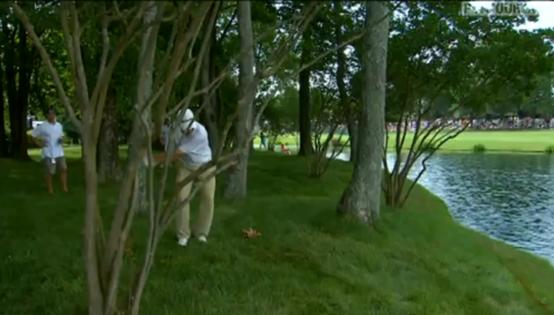
I also appreciate your attempts to muddy my “three mistakes to one” argument. This is not an argument related to general strategy as you frame it, but rather the mental mistakes that one must correct for once making the initial mistake off the tee. I agree with you 100% that had Van De Velde hit the driver well, he would have likely made 4 or 5. I also submit that had Garrigus hit the hybrid well, he would have likely made 4 or 5. The mistakes that I’m referring to come after the tee shot. Garrigus’s mistake here is not laying up. He first dropped it in a shaved area near the hazard mark (not in the rough) and then pulled his shot in the trees. His pitch out sideways is not a mistake. You tell me how he could have gone for the green from this position (note – green is behind Garrigus 1/2 way between him and his caddie in the picture below):
I kindly refer you back to the discussion of Van De Velde’s mistakes above. Garrigus really only made one mistake. His failure to lay up is the only thing that should be causing him nightmares. Van De Velde should (and has) taken long looks at three independent decisions he made en route to his 7 in 1999.
While I anticipate your worthy reply, I refer our readers to a similar discussion that was had by the writers at ESPN on whether Van De Velde’s gaff was the greatest blunder in major championship history. http://sports.espn.go.com/golf/britishopen07/news/story?id=2933998
Conversation: Zach Johnson
October 30, 2010
LG and I have talked about this on several occasions, and we’d like the PF community to weigh in on the subject (comment below).

2010-10-25 at 12:01 AM:
In my opinion, Zach Johnson is one of the absolute best players on the PGA Tour. He makes more with what he has than anyone else. He doesn’t have a long game, ranking 155th on Tour in driving distances. He makes his way around the course differently from everyone else. But he still manages to pace the field on so many occasions. When he donned the Green Jacket at the Masters several years ago, some people thought it was a fluke. But ZJ (my new nickname) has managed to finish in the top 10 of major tournaments 3 times and win on Tour 6 times in the last 4 years. He’s just an Iowa kid with a SeeMore putter, and he’s made over $3 million just this year (2010). In my opinion, ZJ is one of the best.
————————————————————————————–
2010-10-28:
JK has thrown down the public gauntlet on an argument that he and I have had for some time now. A little context is helpful (or in this case, funny enough to write about). I had driven to Atlanta as part of a “tour of the south” golf trip that we decided to take after our time working together in Palo Alto. We had taken one other trip to the Monterey Peninsula to play Spyglass Hill and Spanish Bay (don’t worry, we’ll be posting about this too), and found that we enjoyed each other’s company on golfing adventures. This trip included a stop at one of the famed Robert Trent Jones trail courses (Silver Lakes just outside of Anniston, AL) as well as JK’s home course in ATL.
During our non-golf time, we took a trip to the PGA Tour Superstore located in Duluth, GA. If you are unfamiliar with this facility, think of the hacker’s mecca. This place has EVERYTHING. Not only do they sell every freaking club imaginable, but they have every single item of clothing any tour player has ever worn, a full-service repair shop, driving range simulators, short game area, and a putting green that’s the size of most school playgrounds. Needless to say, JK and I headed straight to the putting green and engaged in a contest of wits (or contest lacking wits, I’ll let you decide). We setup obstacles and gave each other the crappiest ball and putter that we could find and challenged the other to make the putt for the win. While browsing for the worst flatstick possible, JK passed by those that were long, short, oblong, mis-shapen, ugly, or otherwise unsavory and landed upon the SeeMore. This useless implement should only be used for prying open the trunk of a car when you’ve locked the keys inside. As JK stated above, this is the putter that ZJ putts with, so our argument ensued in due course.
JK sets the stage for me to completely disagree with him and argue that ZJ is a terrible golfer and a fluke. Nothing could be further from the truth. Were I to attempt to argue otherwise, I would certainly lose all credibility that I may have on this blog. Any person that can drop a ball into a trashcan from 200+ yards out consistently is clearly a fantastic golfer. ZJ has proven this not only by winning the Masters (laying up on every par 5, i might add), but also 6 other times on the PGA Tour and twice on the Nationwide Tour.
That being said, there is a difference of opinion that must be expressed. I am not a fan of ZJ’s putting stroke. I have to admit that it works for him. He is a great putter. I don’t understand how it works for him though. Having a straight right hand and adding loft to the putter face is a recipe for disaster for the average player. I remember reading an article ZJ wrote in Golf Digest that discussed his technique as particularly good on the lightning quick greens at Augusta. I couldn’t imagine anything being further from the truth. While it is true that you can strike a downhill putt slightly harder if you add more loft to a putter face, doing so (for the average player) will only increase inconsistency because this creates a tendency not to finish the stroke. Without the proper release of the putter face, the ball will never start on the intended line. It has been my experience that most amateurs, even highly skilled amateurs, do not hit putts flush unless they focus on keeping the left wrist straight and leading the clubface with the back of their left hand. This action encourages the proper release of the putter and creates the end-over-end roll that is the hallmark of a great putter.
Also, I dislike ZJ’s Oakleys. dude, pick one. the hat or the shades. you don’t need both.
————————————————————————————–
2010-10-30 at 9:22 AM:
LG, very nice description. But I’ll have to disagree with you–that “useless implement” has many possible applications besides prying open a locked car trunk. You could use it as a blunt object for mugging people, hit nails, or even “rescue” your passed-out, cheating husband from his black Escalade at 2:00 in the morning after he ran into a fire hydrant by smashing out the back window….or whatever else really happened.
However, you’ve conveniently left out the rest of the story. PGA Tour Superstore happened to have a “putting competition” that day. Store patrons who happened to be in the store at 12:00 were invited to participate in a putting competition. The winner got a store gift card–$20 or so. LG and I, being the fun-loving guys that we are, decided to bet between us. Using the aforementioned “ugly” putter that we had each picked out for the other, if either won the entire putting competition (including about 20 other store patrons who had participated), the winner would get $10 from the other. As I recall, LG finished second out of all the participants while using the “useless implement.”
The SeeMore putter actually is an interesting concept. Its goal is to get its user to properly line up putts. Rather than giving an aiming line, it has a “red dot” that the user must “hide” by putting the shaft over it. In this way, the user knows the face will be lined up. Of course, this process makes a lot of assumptions–for example, that the user’s eyes are properly located above the ball, that the user does not forward press the shaft, etc.
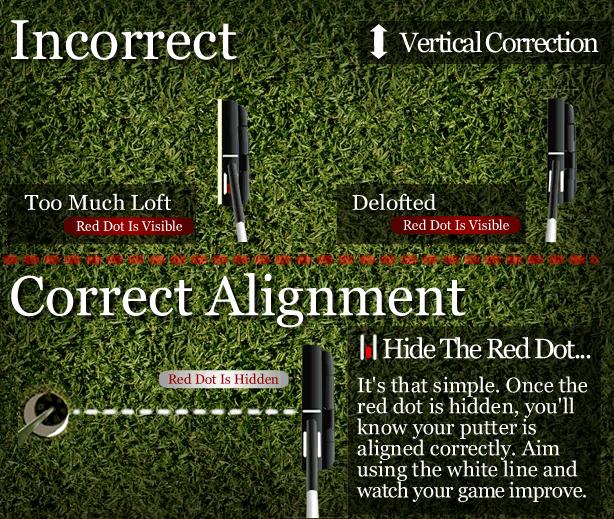
The particular putter used by LG in this competition, however, was quite useless because it had a double-bend shaft. What that meant was, there was really no way to “hide” the red dot. That’s why I chose it. It was pretty frustrating.

While you may not like ZJ’s flat right hand, there’s no reason why it’s a bad stroke. I’ll admit it looks different than the rest of the PGA Tour (which of itself usually indicates that something is wrong), but everything about ZJ’s game is “different” from the rest of the PGA Tour. The flat right hand, however, is not the only important thing in the stroke–in fact, it’s not even one of the important things in the stroke. (see http://www.golfdigest.com/golf-instruction/2009-02/obrienputting) ZJ’s arms and shoulders are aligned to the target. He has his eyes inside the line of the ball. He makes a good rotational stroke. What else is needed to sink putts? Apparently, not a straight left hand–ZJ was 6th on Tour this year in putting.
So, really, your gripe is that he looks funny. Your problem is that his hand isn’t the same as yours. well, LG, I refuse to be a hand-ist; I judge a golfer by the score on his player sheet, not by the look of his hands.
But the sunglasses are kind of bad.


 The Power Fade Golf Blog