Review: Stone Mountain Golf Course (Lakemont Course)
June 30, 2011
Today, I review the golf course at Stone Mountain Park. Specifically, I review the Lakemont Course.
Stone Mountain Park is close to where I grew up. As such, I am pretty familiar with the park and its attractions. When my friend recently suggested we visit the golf course, I thought it would be a good subject for review here on the PF.
Stone Mountain Park (http://www.stonemountainpark.com/) is a park built around a natural monument east of Atlanta, GA. “Stone Mountain” is a monolith–essentially, it’s a large outcropping of granite. Although it is technically not a “mountain,” it is definitely a large rock. Many years ago, crews carved a picture of Civil War heros into the side of the mountain–similar to Mount Rushmore, but not quite as grandiose. The park has many attractions–including the laser show, a walking track around the mountain (about 5 miles) that joggers and cyclists use for exercise, a trail to walk up the mountain, and a ski lift for those who don’t want to walk. From the top of the mountain, you can see 7 states (or so I’m told).
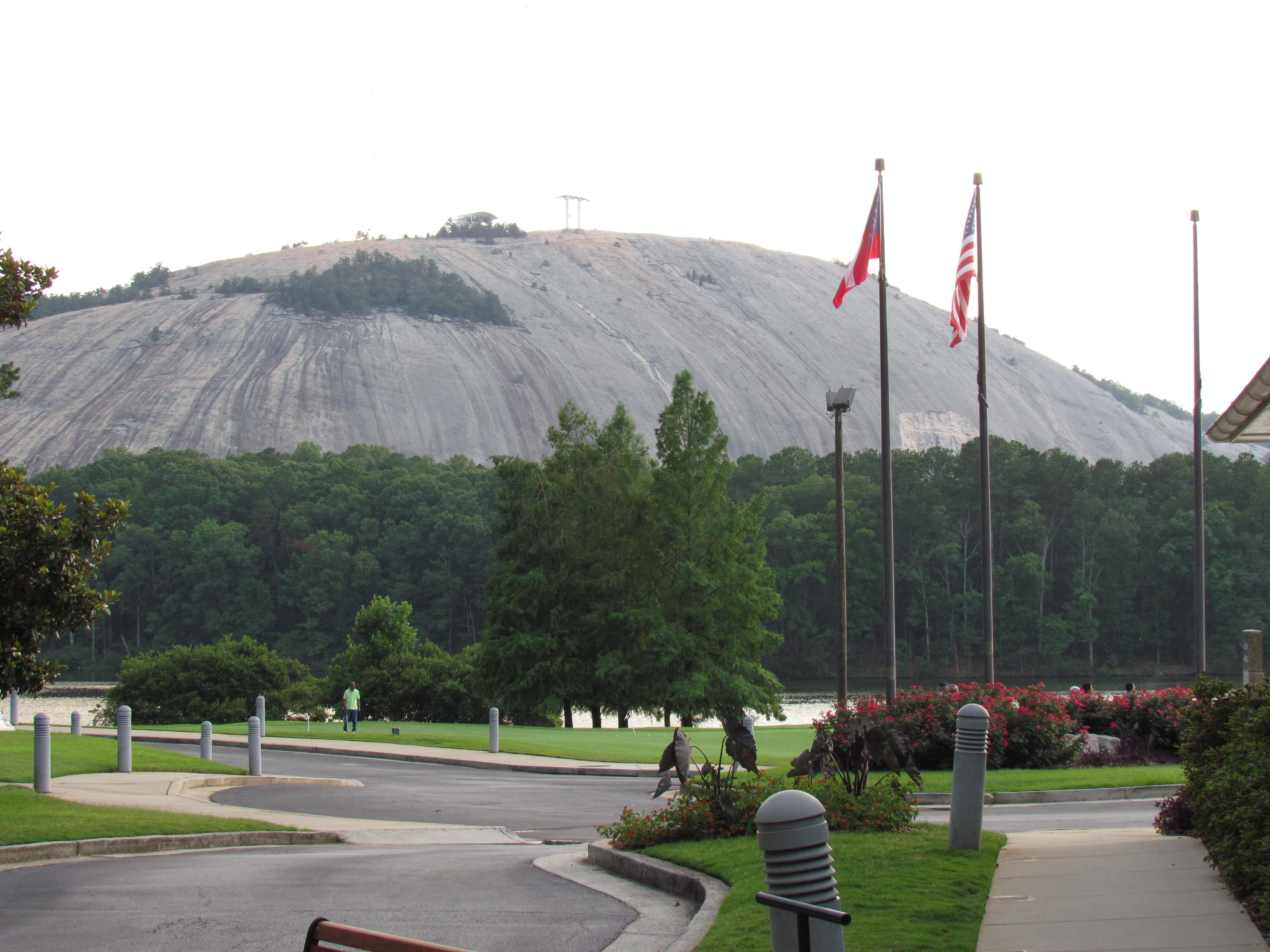
Stone Mountain Park also includes two golf courses–and, to understand some of the nuances, you must understand the history. The first, Stonemont, was designed and built by Robert Trent Jones, Sr. in 1969. The Stonemont course lay by itself for almost 30 years, until, in 1988, Stone Mountain Park built the Lakemont course. The Lakemont course encompasses much more of a resort feel to it and was intended to focus at least some holes around Stone Mountain’s new man-made lake. In order to do this and to maintain two full 18s of play, Read the rest of this entry »
This year’s US Open was played at Congressional country club. While more of the pre-tournament coverage was focused on the lack of a clear front runner than any other single story, one of the more interesting stories, for me, came from the course itself: the controversy over the par rating of the course. For the members, Congressional plays as a par 72. For Tiger’s AT&T National championship, the course plays as a par 70. For the US Open this year, it played as a par 71. This metamorphosis got me thinking about the value that golfers place on the concept of par.
Par derives its name from Latin, in which “par” means equal. To me, par means the number of strokes that an accomplished golfer should take to complete a given golf hole. This number is usually based on the length of the hole from tee to green. With that basic definition, the concept ends, and of you want to see the variety of interpretations of “accomplished” that this phrase has generated, you need look no further than any two courses designed by different architects. By way of example, the 9th hole at the Davis municipal course that I learned to play this game on is a narrow hole that measures 237 yards from the back tees. That hole plays relatively flat and the prevailing wind is a left to right cross wind. The hole has a relatively small green that is protected by a bunker in front and on on both sides. There is a small run up between the bunkers in the front and on the right. On the other hand, 12th hole at Las Campanas is 247 yards that has a large green that is protected by a lake on the left that runs from the tee to the green and a bunker on the right. There is also a small run up, but the elevated tee prevents lower trajectory shots from being as effective as they may be on other topologies.
Despite these similarities, The 9th at the muni is a par 4, while the 12th at Las Campanas is a par 3.
Now, realistically, there is very little difference in how a given golfer should approach these holes. If he or she is capable of carrying the ball 230 yards off the tee and hitting it reasonably straight, the hole should be played as a par 3. For the rest of us, the hole is more likely a short par 4 that should be played with a layup short and right of the trouble surrounding the green with a short pitch remaining to the flag.
So what gives? How do these course designers or raters come up with these seemingly arbitrary par values for holes? What difference does it make? And for me, why isn’t par different for different players?
I heard recently about a new movement to help golf draw new players called “tee it forward” which encourages golfers to play one or two sets of tees forward of tees they are playing now to help bring some of the fun back to golf. While the theory is sound in principle, to me, it makes little sense to ask a weekend player to move forward because of the simple fact that his or her short game is the real reason why they are shooting high numbers. It doesn’t really matter if I hit driver-hybrid short of the green or driver-7 iron short of the green, it is my short game and putting that will determine the number that I write down on the scorecard. Also, for the average hacker, hitting driver into the woods from tees that are 25 yards forward of his usual tees does not make searching in the woods any more fun or less irritating. Finally, for the male ego, shooting 96 from the white tees is infinitely more humiliating than shooting 101 from the tips. (what happened out there today, Sally?) At best, rounds may take slightly less time, but are not likely to produce lower scores that will ultimately lead to more “fun.”
Since scores are what ultimately drive entertainment for most players, why not change par to reflect what the “average” golfer should shoot rather than what the accomplished golfer would shoot? I can’t imagine a more fun round for the average hacker than shooting -2 (even if par is 90). Short games may not improve, driving will not improve, and technique will not improve. Indeed, none of these will improve from a national “movement.” Instead, entertainment value for a round will go up, and hopefully course management skills will improve. I am not naive enough to think that people will not try to make eagles on every hole instead of birdies, but the resulting pars will take the sting out of the poorly hit second shot, and possibly encourage some players to play safer routes to the hole to make birdie. Indeed, for players striving to break 100 or even 90, why not think of every hole’s par value as one more than the value listed on the scorecard? This strategy is exactly how I broke 90 for the first time with an 87.
JK, if we assume that something has to be done to make golf more appealing to new players, and massive overhauls to courses are not practical, what do you think courses can do to to draw new players?
—————————————————————–
Response from JK:
To me, there are 2 reasons that interest in playing golf is waning (playing, not watching; we all know TW is the reason that interest in following golf is waning): (1) it takes forever, and (2) it costs a lot of money. I justify #2 by looking at my current golf bag, for which I got bargain basement deals on most of the equipment and still have spent over $700. The balls I play are $4 each, and they are the most commonly played balls in the game. In most areas, $90/round is not an uncommon price. Even in Atlanta, where golf is “cheap,” a typical course charges $55 on a weekday morning and $75 on a weekend. Although it is 4+ hours of entertainment, it’s easy to see why the average joe isn’t going to break into this sport.
So, for those who can swallow the cost, they have consigned themselves to the fact that the game is addictive, interesting, and fun. The thrill of achieving a new level is what brings us all back.
However, you know just as well as I do that there’s nothing worse than spending 5 hours on a golf course on a Sunday. Picture the scene: a beautiful spring day; it’s 80 degrees and a little breezy; you can smell the grass clippings from the early morning crew. You’re standing on the first tee, ready to tee off, looking at a wide, green fairway. Nothing but open possibility in front of you. You start to approach the ball to go into your pre-shot routine. All of a sudden, you hear the crack of a golf ball squarely contacting a pine tree. 2 golf carts come flying out of the woods into your fairway. 4 golfers get out of their carts, crack a beer each, grab a 3-wood, and proceed to take 9 practice swings each before topping the ball 40 yards ahead of themselves, into a bunker. You watch painfully as they struggle just to make contact. One slices into the woods right of the green. One puts his in the left front bunker (with a back right pin placement). One thuds 3 shots out of the fairway bunker trying to get it out, then just gives up, picks up the ball, and throws it back in the fairway, then spends 8 minutes raking the bunker he just obliterated, only to take 9 more practice swings from the fairway and top his ball, hitting the worm-burner onto the green. His friends tell him he’s hit a “nice shot,” which you can hear because they’re speaking at a volume normally reserved for movie theater sound commercials. Finally, after this ordeal, the fairway is clear. You stripe your tee shot down the right side of the fairway. But you know that, as soon as you get to your perfectly hit ball, you’re going to be paying for their mistakes again, waiting for the group in front of you to putt out on the green.
This is the main reason why I don’t want to play weekend golf. While I like the idea that the game is available to everyone, I don’t like that everyone cannot manage themselves and their games in a courteous manner for the betterment of all of the golfers behind them. This fact alone makes the game less enjoyable for the new golfer starting out. It’s impossible to enjoy the game with either (a) people holding you up in the fairway, or (b) people behind you pushing you to play faster. One or the other is not going to be happy.
This is why I don’t have as big of a problem with Tee It Forward as you. I think you’re spot-on that ego is the biggest reason that golfers won’t play the forward tees, but how often is that a reasonable justification for anything? The game is about putting the ball into the hole, not about how far you hit it, how good you play from the trees, how well you can drive a golf cart…nothing; all that matters is that the ball goes in the hole. The problem with playing the back tees is apparent for the weekend golfer. Most of them don’t hit the ball over 240 with a driver. They slice it more often then not, but never play for the slice. If you’re playing the tips, that combination of shortness and inaccuracy is deadly, not only for score, but also for round length. If there’s a 230-yard forced carry over water, my 275-carrying driver doesn’t even come close. But the weekend golfer is knocking knees trying to make it. And, if he doesn’t, he has to re-tee his ball and try again. Not exactly the best way to ensure that the game is enjoyable.
Your example re Davis Muni and Las Campanas is a little skewed. 247 yards is not a reasonable length to call anything a “par 4,” unless it’s playing straight uphill. Oakmont has a 290-yard “par 3.” Plus, you misrepresent Las Campanas a little, as 237 yards downhill in the desert plays closer to 210. Your point is well-taken: just because you call it a par 4 or par 3 doesn’t make it so. However, I don’t think it’s a realistic strategy for making the game more enjoyable. Telling someone that par is 90 only exemplifies the “everyone gets a trophy” idea. While golf is about you and you alone, the achievements made are universal. “Birdieing” a difficult hole only matters when it’s against an objective standard. For some people, birdie is an incredible score; for others, it should be expected one of four times playing the hole. But you can’t cheapen the value of that by saying my 3 is a birdie when your 5 is a birdie.
Moreover, what you’ve suggested is already accounted for by the USGA handicap system. A player of a 15 handicap “gets a stroke” on each of the 15 most difficult holes, giving him or her a relative value to par. When was the last time you actually saw someone use this system?
I agree with your advice that par is only a suggested number. For example, I played a 502 yard par 5 this weekend. After a good drive, I played it like a par 4, as I had only about 200 yards into the green. 500 is a reasonable length par 4 on the PGA Tour. However, most golfers can’t do that. If they play a 450-yard par 4, they should realistically think of it as a par 4.6 or 4.7, wherein they will par it only 1/3 or 1/4 of the time. But that determination is based on the player’s length, not their playing ability. Certainly, that player should not be upset with a 5, unless the hole is 80 feet downhill. However, teeing it forward alleviates this problem altogether, in that no forward tees will force a 450-yard par 4 on a player that can’t drive the ball over 240. Your strategy–thinking of each hole as a par of one greater than it actually is–is a good suggestion for course management. But that’s all it is. Few players will actually be encouraged by using that strategy to make the game more fun or enjoyable.
At the end of the day, the average golfer needs to accept that the tees you play are only a determination of the total length of the golf course. They are not an indication of how good you are. Some golf courses (i.e., the Judge) are insanely long, even from the forward tees. Others are short (i.e., Harbour Town), even from the back tees on a professional course. Shooting 96 from the forward tees may be the same in your mind as shooting 105 from the tips, but at least you broke 100. And if you shoot 72 from the forward tees, is anyone going to say “oh, well, you were playing the forward tees; it doesn’t count unless you’re on the tips”? Once people get over their own egos, the game naturally becomes more enjoyable. You stop worrying about your results, and you start worrying about enjoying the process of improvement.
Play of the Week 17
June 21, 2011
This week’s play of the week is obvious to anyone who would read this blog. Rory, you were superb. Four rounds in the 60s, a -16 finish to the US Open, breaking or tying a dozen records–it was truly amazing. From his scores in last year’s British (I believe he shot 62? LG, correct me if I’m wrong) and this year’s Masters (4-shot lead heading into the final day), we knew Rory had game. But the Norman-like collapses left us doubting. This was no doubt. You performed like Tiger, Jack, or Arnold. And, better yet, you were humble and personable afterwards, which this game needs. I’m looking forward to seeing more.

So here’s to you Rory. Let’s hope you can save golf.
A PS for the PF here, I also want to honorable mention YE Yang and Robert Garrigus. Both Garrigus and Yang tied for third behind McIlroy and Jason Day. Anyone who reads this blog knows that Garrigus appears on it regularly–I think maybe his game gives me hope that one day I can be on the Tour too, because we have similar swings and many of the same faults. Yang showed that he’s not just a one-hit wonder (winning the PGA over Tiger two years ago). Garrigus, playing in just his 3rd major ever, showed he has the skill to compete. We at the PF salute you both too for sticking around. We’re looking forward to following you as well.
Conversation: U.S. Open Predictions
June 20, 2011
Wow…were we wrong. Actual answers in bold.
(originally published Jun 16, 2011)
It’s that time of the year again! Our National Open is being played in our nation’s capital at Congressional near Bethesda, MD.
Here’s how we think things will shake out:
LG:
Winner: Dustin Johnson Rory McIlroy
Winning Score: -2 -16
Runner Up: Phil Mickelson Way wrong. +7, T-54
Low Amateur: Peter Uihlein wrong, Patrick Cantlay
“Unknown” in the Top 10: Jason Day correct (T-2), although I question if Day is really an “unknown.” The real answer is Kevin Chappell
Most difficult hole vs. par: 18
Easiest hole vs. par: 16
Last Year’s Winner (GMac) Will … (Win, Top10, Make the Cut, or Miss the Cut): make the cut, but be outside of the Top 10. Correct, T-14
Fred Funk will: MC Correct
How many prior winners will be in the Top 10: 0 Correct
Will there be a hole in one: No
…Which hole: n/a
Will Rory blow the 54 hole lead? Probably. Hell No
Will Obama present the trophy?: He should! but no. Correct
Who will be more embarrassed at the end of the tournament? Mickelson or McIlroy? If Mickelson doesn’t win, he should be more embarrassed. I expect Rory will just be forlorn. half correct…Mickelson definitely should be embarrassed with +7. Rory was definitely not forlorn
Will someone win it, or will everyone else lose it? Everyone else will definitely lose. Wrong. 4 rounds in the 60s, Rory won it
Who is most likely to “Dustin Johnson” it? I’m going to go with Phil on this one. I’d prefer to call it “Phil at Winged foot-ing it” yea, no one really did this, so, Phil’s +7 is about the closest thing to it
JK:
Winner: Stewart Cink Wrong. Cut
Winning Score: +1 WRONG -16
Runner Up: Matt Kuchar and Jason Day Day T-2, Kuchar T-14
Low Amateur: Peter Uihlein wrong, Patrick Cantlay
“Unknown” in the Top 10: Andres Gonzales wrong, MC. Correct answer was Kevin Chappell
Most difficult hole vs. par: 18
Easiest hole vs. par: 16
Last Year’s Winner (GMac) Will … (Win, Top10, Make the Cut, or Miss the Cut): Miss the cut. Too much going on in that dome. wrong. T-14
Fred Funk will: Seriously? Is he even in the field? MC correct
How many prior winners will be in the Top 10: 4 When I read this question, for some reason I thought this said “how many prior major winners in the top 10.” There were 3, Schawrtzel, Oosthuizen, and YE Yang. DLIII was T-11, so I almost got it.
Will there be a hole in one: No
…Which hole: n/a
Will Obama present the trophy?: If he reads the PF, I’m sure there’ll be a presidential veto of the authority to award the trophy. conclusion: obama does not read the PF
Who will be more embarrassed at the end of the tournament? Mickelson or McIlroy? Mickelson. Just seems to do dumb stuff in majors. correct.
Will someone win it, or will everyone else lose it? It’s the Open. Regardless of McDowell winning it last year, the bigger story will be everyone else losing it. jees was i wrong here
Who is most likely to “Dustin Johnson” it? Dustin Johnson. Again. T-23…I’d say I was wrong
The Woes of Golf and a Letter to Tiger
June 17, 2011
The Grantland, a compendium of sports knowledge and humor started by the Sports Guy, Bill Simmons, recently ran an article that got me thinking about the sad state of golf today:
“3. The U.S. Open, Congressional Country Club, Bethesda, Md.
You know what’s fascinating about Lee Westwood? Nothing is fascinating about Lee Westwood. According to this profile, Lee Westwood is proud to declare that he has never read a book in his entire life. He may be the most boring man alive, and he is the no. 2 golfer in the world. Good luck in your new Tiger-less paradigm, golf.”
Really, Lee? You’ve never read a book? Come on, guy. No wonder people hate golf and think of it as an elitist, bland, mayonnaise flavored “game.”
I was recently visiting one of my favorite watering holes in Palo Alto with a golfer and two non-golfers. After having a few adult beverages, we got into a discussion about who was the most famous athlete to attend Stanford. The two non-golfers were adamant that it was John Elway while the golfer and I were equally adamant that it was Tiger Woods. The two non-golfers did not dispute that Tiger made more money, is/was more dominant, or is more decorated in his game. Their dispute was that golf is not a sport. Now, my guess is that neither of these clowns had ever tried to hit a golf ball, but their argument becomes more tenable when players like Tiger are laid up with injuries and we are left with Phil’s “golf” handles to fill up the 55″ widescreen.
I guess my point is, Tiger, the game needs you back. Rory’s looking good this week, but its still not that compelling. He (literally) just tied your record for most strokes under par at the U.S. Open, but I’m still not riveted. From us at the PF, we wish you a speedy recovery, Tiger. Make golf interesting again.

Aside: I don’t mean to diminish Rory’s achievement. Tying any one of Tiger’s records is a feat that any golfer should be so lucky to achieve. -12 in a U.S. Open is phenomenal. Rory has played beautiful (and as of this writing) bogey free golf. I hope you keep it up, sir. Tiger shot -12 at Pebble, with second place at +3. Your work is cut out for you, sir. I take my hat off to you.

(Click here for the full article from Grantland)
Review: Cobblestone Golf Course (Acworth GA)
June 13, 2011
One of the best things about having a golf blog is having the opportunity to do a write-up of great golf courses. In line with others, this week I review Cobblestone Golf Course in Acworth, GA.
I have been playing Cobblestone off and on for the last 15 or so years. Every time I go back, I am reminded that it is one of the more fun layouts near the city of Atlanta.
Cobblestone is, oddly, a municipal golf course maintained by Cobb county. Unlike many munis, however, it’s not a golf course that was just clear cut out of some trees and plopped in place. Serious earth was moved to put this course in place. The result is a layout that intrigues.
Cobblestone is placed at the very southern tip of Lake Acworth. 8 of the 18 holes play on, over, or around the lake, giving many picturesque vistas. The 11th hole (shown below–that tree is actually growing out of the marsh at the southern tip of the lake), a 436-yard par 4, plays to a wide fairway some 250-yards out, but necks down after that to only about 20 yards across. The green on the 11th sits less than 2 paces from an embankment to the lake, making for a very tough approach shot with a long iron.

At 6700 yards from the back tees, it’s not terribly long. However, the 73.5 rating (on a par-71 course) shows that it has some bite. 12 of 18 holes include hazards noted on the scorecard, and several others include treacherous shots.
The appeal of Cobblestone is not only that it is challenging, but also that it includes a good mix of golf holes. At par 71, the course includes four par 5’s that are all reachable–two that are flat that play under 530 from the back tees, and two that are well-downhill at 542 and 570. I had a 3-iron into the 570-yard par 5 9th when I played it recently. Although I’m a “big hitter,” we are talking about reaching par 5s, which short hitters would not consider. The course has a good amount of elevation change as well, which is rare for courses this close to water. Part of this can be seen from the views of the par 3 16th below.


Moreover, Cobblestone includes a good mix of holes. There are doglegs in both directions. There are holes that play over water and holes that play through the trees. There are some wide fairways and some narrow fairways. Some long par 4s (the 2nd, for example, at 472 yards, and the 14th at 461) and some driveable par 4s (the 17th, at 316 and about 60 feet downhill, and 4th at 313, shown below). Some long par 3s (the 8th at 240), and some short ones (the 16th at 133 over water). Cobblestone tests all parts of your game and gives a great opportunity to see how you play all your shots.
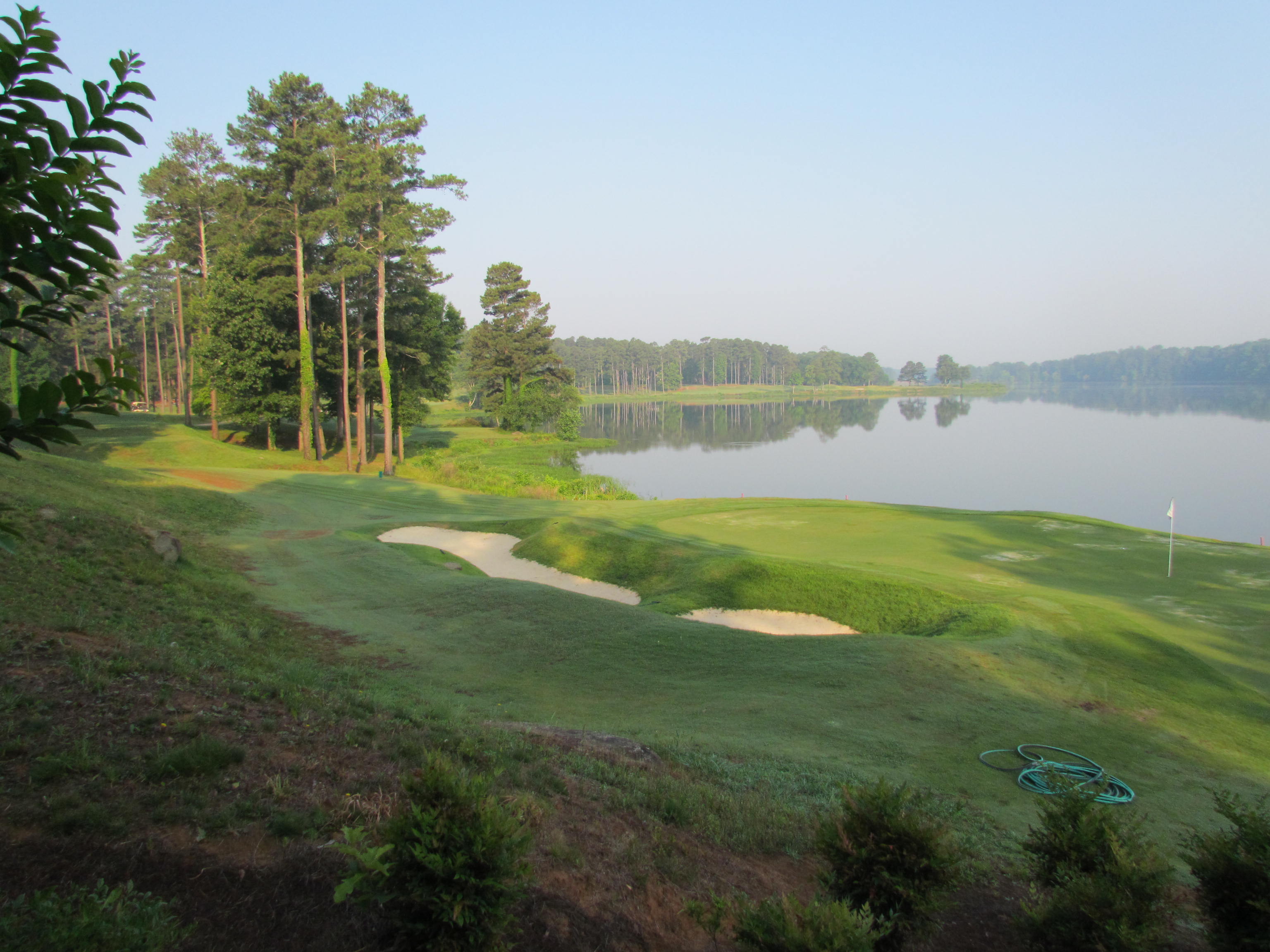

Cobblestone is a surprising muni, both for its quality and its beauty. The course is truly a gem of a layout.

There are always drawbacks, however. The condition of the course the last few times I’ve been out has been less than ideal. Far less. There was a temporary green on the 1st hole (which the staff did not warn us about). This comes less than 10 months after a full renovation where the course was converted from bent greens to bermuda (which I dislike anyway), leading me to wonder if they are capable of maintaining the course. The fairways were in good shape in many places but also had a good amount baked and dry spots as well as muddy puddles–in other words, it was very inconsistent, even when in the fairway. I guess the staff have never heard of bagging mowers, because they were still dragging the fairways to pick up the grass clippings when we teed off–not something you want to see (see the picture of the fairway at the 11th, above). Bermuda greens–I guess that’s all I have to say about that. At $56/round, I would have expected more. And it’s not exactly close to Atlanta. I guess there’s a reason why all the courses worth playing aren’t built anywhere near the city of Atlanta, but I’m starting to get sick of driving 45-minutes outside of the perimeter just to play a course worth playing. While the course is fun to play, there’s a reason why I don’t get out there but once every other golf season or so. Still, it’s always enjoyable, and I love a good layout.
Layout: 10/10
Greens: 7/10
Fairways: 7/10
Other Maintenance/Upkeep: 6/10
Cost: 5/10
Value: 6/10
Location: 7/10
Staff: 8/10
Overall: 7/10
Fail of the Week 4
June 8, 2011
This week’s FAIL is the state of golf. Currently, the game has never been less intriguing, and the reason is that we haven’t seen the dominance of the players we like and root for. Tiger has been out of contention in most tournaments (or just out of them), Phil hasn’t played well, and the big boys who made so much noise last year (DJ, Bubba) have been very quiet this year.
Don’t get me wrong, Luke Donald is a fine player. He’s currently #1 in the world rankings (which makes no sense because he hasn’t won a major, but, whatever, that’s the case). He plays measured, consistent golf and deserves the money and publicity he gets. But it really speaks to the current state of the game when THIS is what the #1 player in the world looks like:

The #1 player in the world should look like a champion. This guy looks like a pack of watermelon gum. It would be one thing if this were a rare moment, but, unfortunately, I think he might’ve borrowed his wardrobe from Ian Poulter.

My grandmother wouldn’t wear that shade of pink, much less in pants. And to pair it with a black shirt–at Harbour Towne, no less–you’re asking for trouble.
Don’t get me wrong; I like pink, when used appropriately. But, this is not appropriate. This just speaks to the state of golf. If you asked 100 people on the street who the top 3 golfers in the world were, none of them could tell you Donald, Westwood, and Kaymer in that order. Yet that’s what we have.
It’s sad, but the most in-your-face and recognizable American golfer we have is Rickie Fowler. Can anyone explain this? I mean, seriously? This is what people want to see?
Here’s Rickie Fowler looking like a prison inmate:

Here’s Rickie Fowler dressed like a grape popsickle:

Here’s Rickie Fowler’s award wardrobe for selling the most Mary Kay:

Moreover, news came out yesterday that Tiger will not be playing in the US Open, and his absence from golf is putting a further decline on the popularity of the game.
Tim Finchem, please, do something. Fast. Otherwise, you’ll be losing more than just the casual fan.
For a photo of Ian Poulter’s ungodly obsession with the color pink, see http://i.telegraph.co.uk/multimedia/archive/01583/ian-poulter_1583748c.jpg. Warning, too shockingly pink for the PF. Proceed at your own risk
Play of the Week 16
June 8, 2011
This weeks POTW goes to Steve Stricker, champion of the Memorial Tournament.
Although a little belated, Stricker’s play this weekend needs to be commended. Stricker played incredibly, including two hole-outs in a four-hole span from Friday to Saturday. Although it’s not quite as impressive as Rocco Mediate’s 4-hole-out performance at CordeValle (the subject of POTW 2 and POTW 2.5), in four holes, Stricker hit an ace and holed out from the fairway on a par 4. He is now ranked 4th in the world, and he stands as the US’s best chance to overtake one of the pesky Euros (Westwood, Donald, and Kaymer) for the #1 ranking.
Although Stricker only managed a one-shot victory, a win is a win, and we’re proud of it.

So here’s to you, Steve. We hope to see you represent us (or, US) well at Congressional.
Previously, I had reviewed Twin Warriors in New Mexico. I now review the Club at Las Campanas – The Sunrise Course.
This was the second course that I had an opportunity to play (in as many days) during my stay in New Mexico. After subjecting myself to the 7800 yard behemoth that was Twin Warriors, a brisk 7626 yards of Nicklaus’ best work should be no problem, right? Away we go!
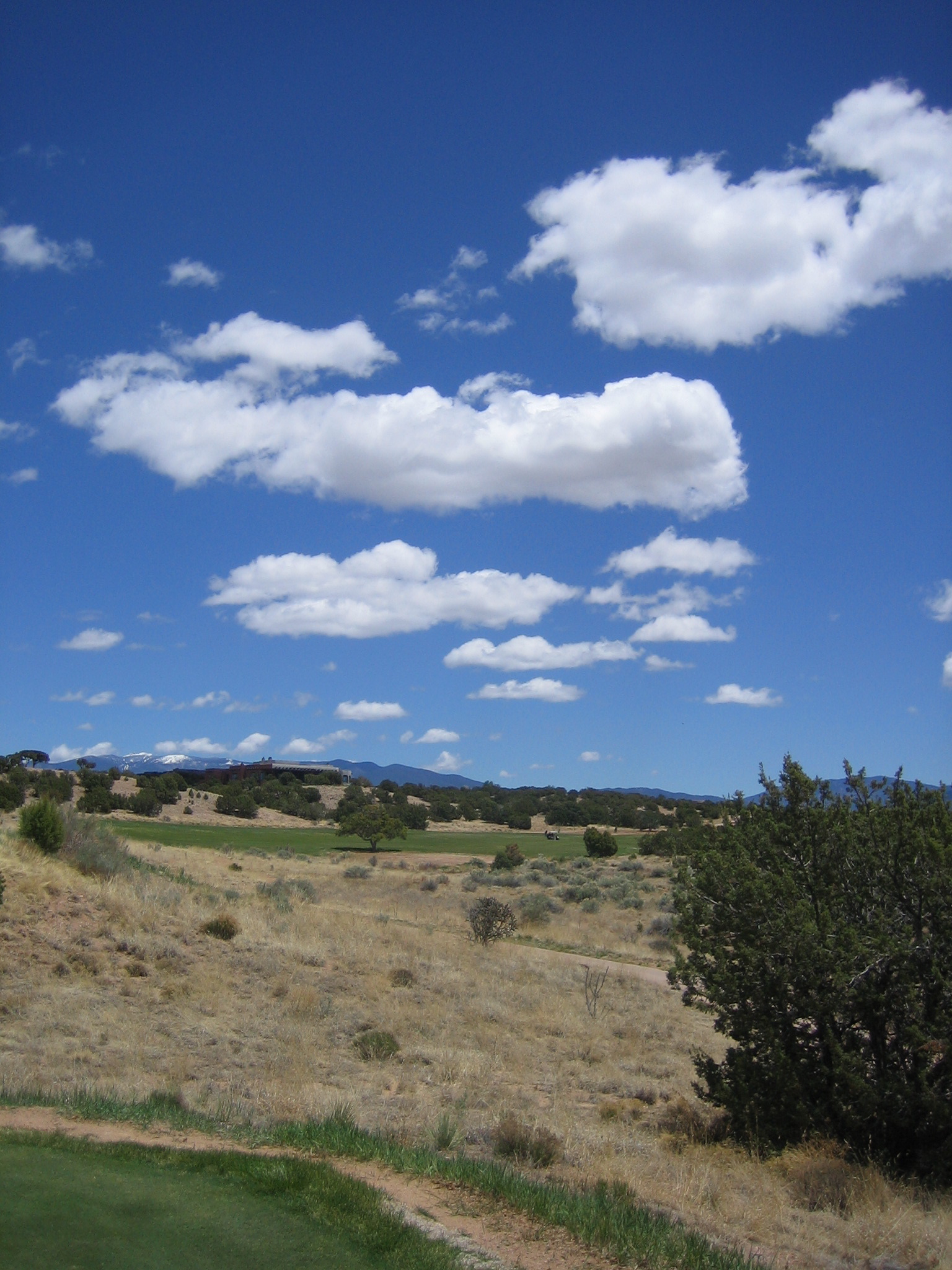
Again, we break with our stated goal of reviewing courses that the average joe can play without paying an arm and a leg by visiting one of the more exclusive clubs in New Mexico (hey, what can I say, if you can get on you’re going to play). While these courses are private, they have a distinctly resort feel to them. The drive up to the club house wanders through the prairie and has me wondering why I don’t live out in the desert. We pass tennis courts, adobe houses, and some of the back nine on two beautiful Jack Nicklaus designs. The pro shop is WELL apportioned and has a full array of titleist equipment (complete with fitting guy!). There are at least 10 different brands of clothing, any of which might be at home on the set of caddyshack. The practice facility was equally well apportioned. Grass driving range complete with pyramids of Nike practice balls and a LARGE putting green/chipping area with every contour imaginable. As for the facility:
The facility has two championship layouts. They were apparently Jack’s 99th and 100th courses respectively. Each one has a distinct character (the Sunset, I am told is slightly more of a shot makers course, while the Sunrise is the bombers course). On advice of the member who some how finagled me into the line-up, I played the Sunrise Course. Here are the stats:

The Club at Las Campanas – The Sunrise Course:
Green Tees (Tips) 7626, 73.9/132
Gold Tees 7033, 71.0/130
Blue Tees 6462, 69.3/124
White Tees 5928, 66.4/114 (M); 71.9/132 
Red Tees 5029, 66.6/120
Because we so rarely have the time to write reviews these days here at the PF, we choose to write about winners. The Sunrise Course was precisely that. Though it listed shorter than Twin Warriors, it was certainly the more interesting of the two courses. Jack has made use of elevation change in the middle of the prairie in ways that I thought unimaginable. There were also blind drives that were rewarded by big drives and aggressive lines. See for example, the split fairway on the 9th hole.
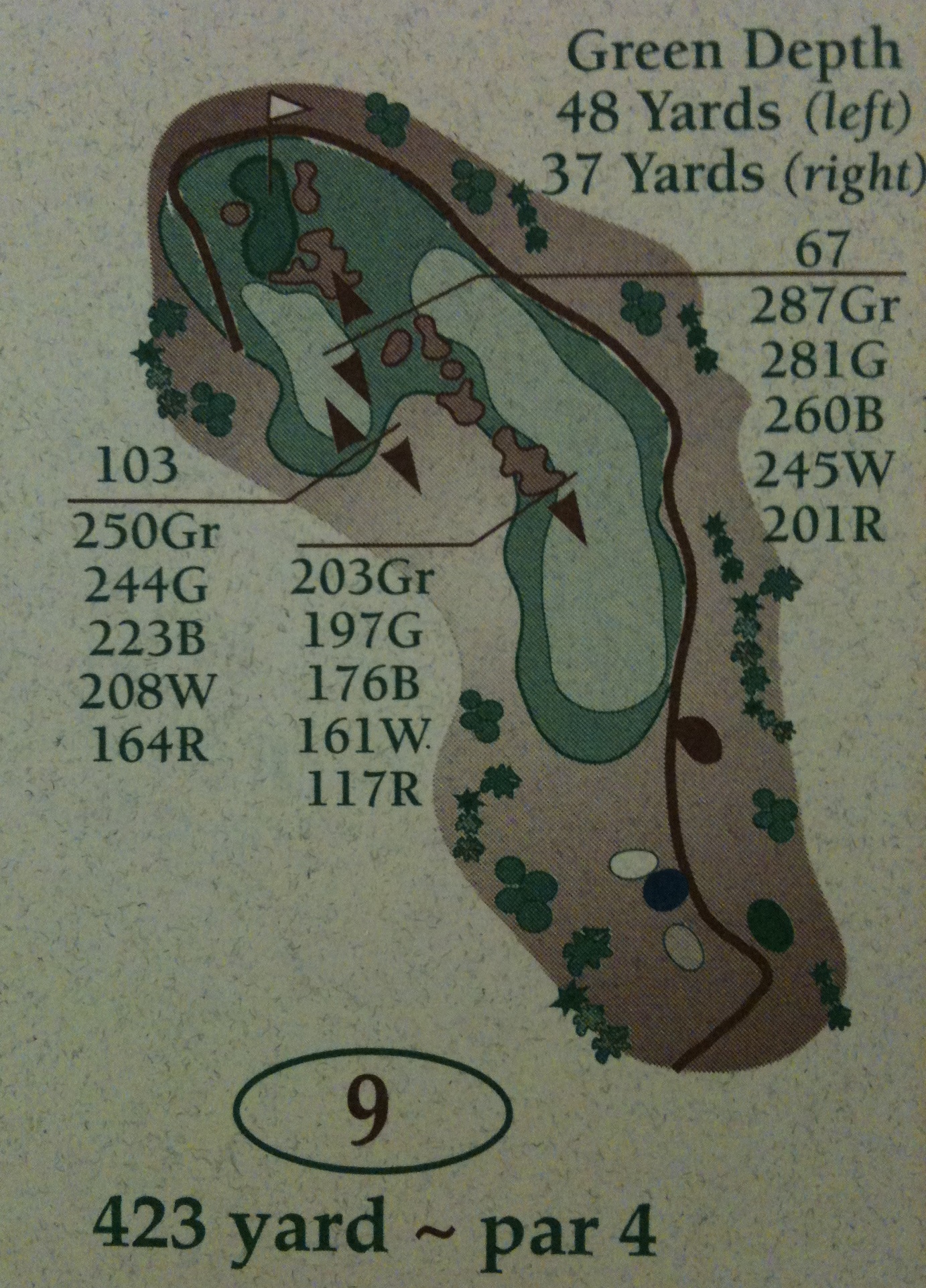
One thing about Jack’s designs that I found to be particularly true here though was that if you miss left, you were generally able to recover. Another truism of Jack’s designs is that if you are having a “loose” iron play day, you will feel the burn of the course. Thankfully, however, I was fortunate to be having a nice ball striking day. with a 42-44 = 86, I was more than pleased with my play from the Green Tees. Though my lone birdie of the day came on the 10th hole after a long drive, long three wood and chip sideways onto the tiny, well bunkered green; my favorite hole of the course was the par 3 twelfth.
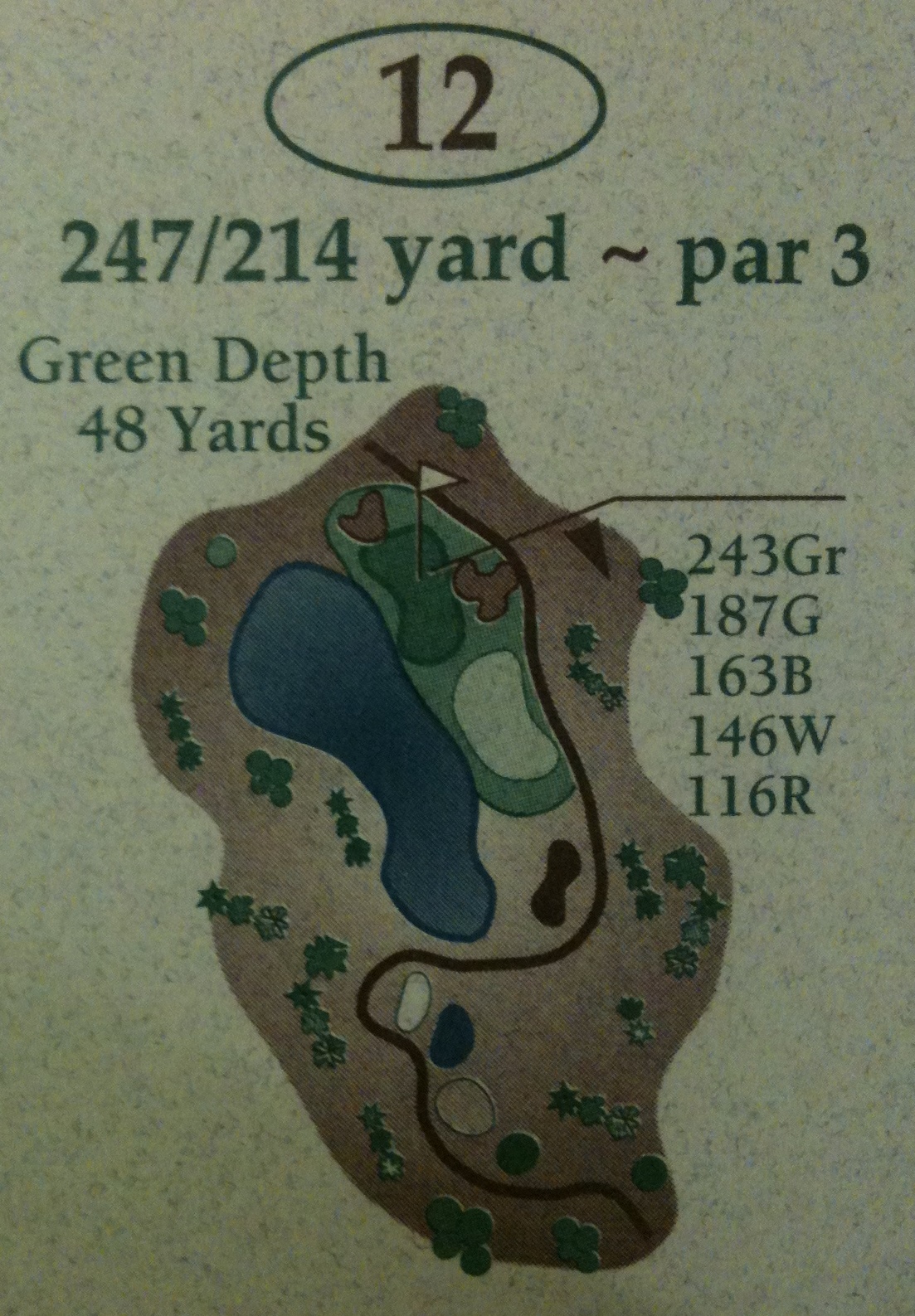
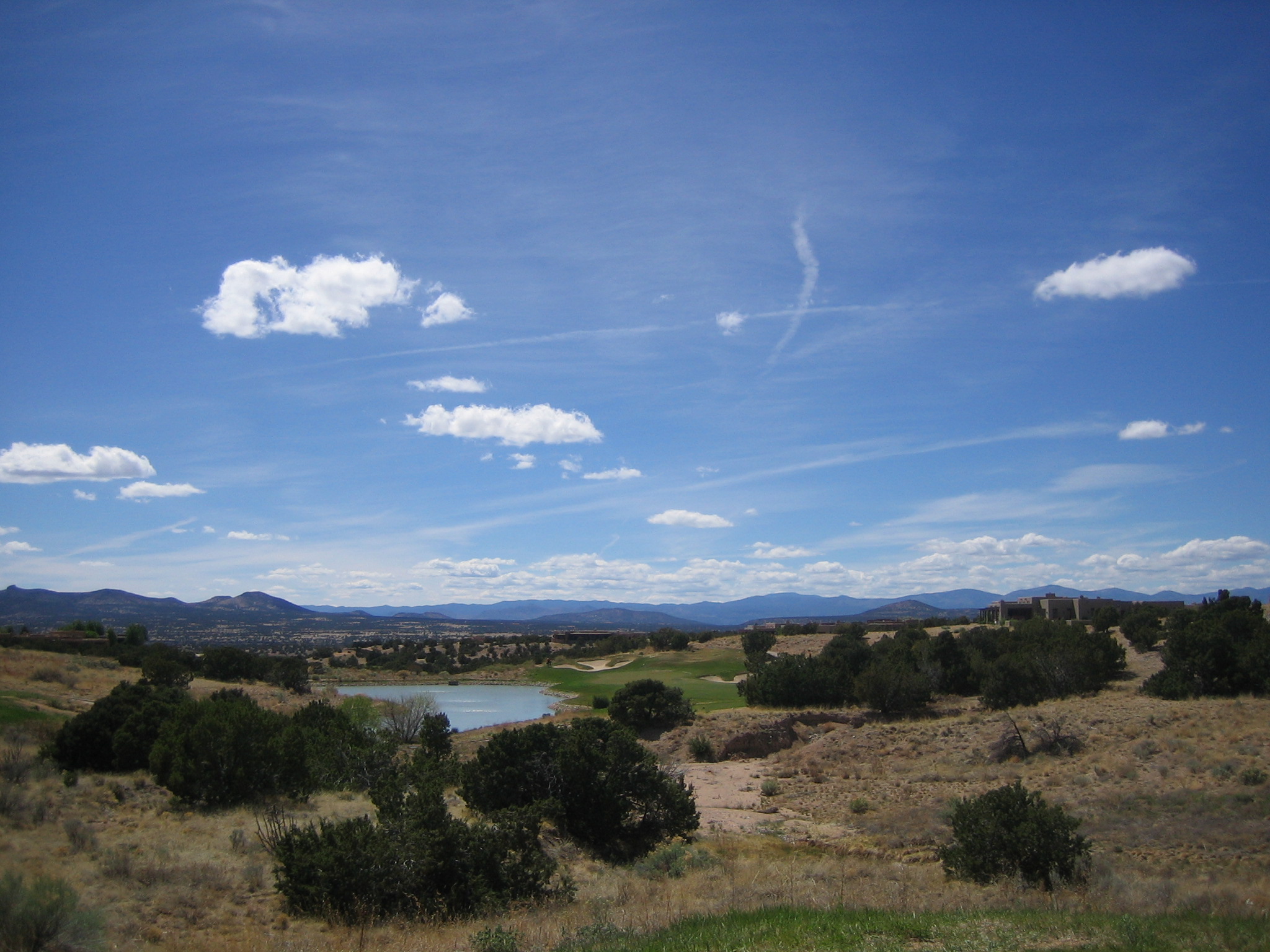
The twelfth (yardage guide and picture above from the tee) measures a stout 247 yards from the Green Tee. This monster of a par 3 affords very little in the way of forgiveness. Water left, bunkering right, and the only real bailout short into a collection area make this truly a “heroic” school of design hole. Oh, lets not forget the head wind. As if this beast was not enough pressure on its own, two of the cart boys had made their way down to watch me tee off. I guess it is rare for them to see new blood around this course (much less anyone that could reasonably be called “new”). I carefully teed up my TaylorMade Penta and gave it as smooth a ride as I could manage with my 3-wood. The instant it left the club face, I knew it was going to be pretty damn good. Below is the result that I drove up to after the long, 247 yard tee shot.
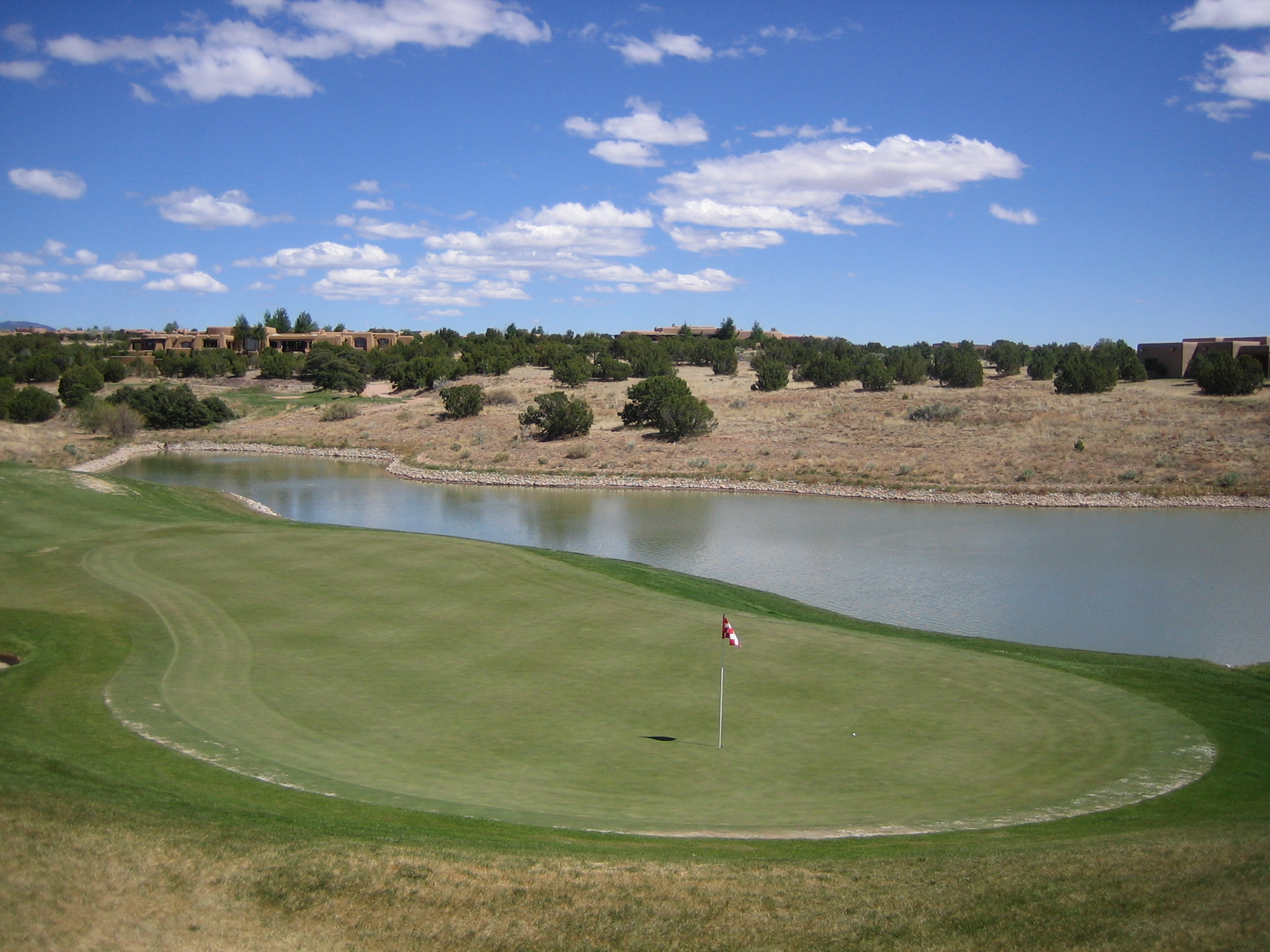
Needless to say, my round was made (unlike the putt).
The course was in impeccable condition. Parts were dry, as they should be in the desert, but for the most part, it was quite lush. The bunkering was superb and set up some fantastic aiming lines for the first time player. Though there were blind shots, I always felt as though I had a sense for where Jack wanted me to go.

Overall, I’d have to say the Golden Bear’s 100th was clearly a monument to the prowess he has developed over years of designing courses. I truly think that this course is one that I could continue to play every day and it would never get old. Really, I can think of no higher compliment than that. There are holes that are incredibly difficult, but they are the kinds that create shots you will never forget.
How to be Scratch
June 1, 2011
I found this post while searching GolfWRX today. Very helpful. At the least, it will help you understand some of the things that go into playing good golf. If you can do all of them, bravo–you should be on the PGA Tour. But doing some of them proficiently will definitely help.
(for original text, see http://www.golfwrx.com/forums/topic/22272-how-to-be-scratch/)
This text has been combined and modified from various posts on the internet golf forums…………….
The number one thing about getting to scratch (IMHO): Time and commitment.
You have to make a serious commitment to get better and then have the time to implement your decision. Specifically, it means playing a lot of golf. Not necessarily practicing 5 hours a day pounding balls, but playing 18 holes every day, or at least 4 times a week, or 9 holes very frequently. If you cannot afford the time, it will literally take years and years for you to accumulate the “talent”, experience, and savvy to become a scratch golfer. I say this only if you’ve never been a scratch golfer. If you’ve been a 1 handicap or scratch golfer before, you don’t need to play everyday or hit balls. You can play once a week or 2 times a month and shoot even par. But if you’ve never been there, it takes time, a passion, and a total commitment.
Play as much as you can, and play as many tournaments as possible. (I can’t emphasize this enough). When you’re not playing a tournament, make sure you are playing a competitive match with someone as often as possible, and make sure you have some money on the line. And make it enough so that if you lose, it stings a bit. I know this (the wagering part) is a bit controversial, and not everyone will agree, and that’s fine.
When you do play, make sure you play on a variety of courses with a variety of conditions. Bermuda greens, bent greens, poa annua greens. Hot, cold, rain, wind. You name it. And whatever the conditions are, those are the conditions that are just perfect for you that day. Never use the conditions as an excuse. Never.
It’s about learning how to play the game and not learning some new golf swing. Start learning how to get the most out of what you already have instead of relying on the pipe dream that some day you will “fix” your golf swing.
Try to learn something from every single experience on the golf course. Pay attention to how you feel, what your tendencies are, and your self-talk. For instance:
* What did you feel like when you hit that 100 yard sand wedge to 5 feet?
* How about before you hit it?
* How did your state of mind prior to the shot influence the outcome, if at all?
* What did you say to yourself prior to shoving that tee shot out of bounds late in that one round when you were 2-under par and about to beat your personal best?
* Why did you snap-hook that 3-iron into the water from that ball-below-your-feet lie? Isn’t the ball supposed to go right off ball-below-your-feet lies?
* Why do I always miss left from uphill lies?
* Why do I always miss left from downhill lies? (Yes, the dominant miss for many good players from uphill and downhill lies can be a pull, but for different reasons).
* Why do I leave so many 50 yard pitch shots short?
* Why do I have so much trouble on fast greens? Slow greens? Big breakers?Do not let pride get in the way of sound reasoning. Finally, don’t be judgmental – that’s a killer. Just pay attention and learn from your tendencies without beating yourself up and being overly critical. In my opinion, to become a legitimate regionally or nationally competitive amateur golfer (generally in the +1 to +4 index range month after month after month), you need to master the following:
1) Drive the ball relatively straight and relatively long (250 to 300 yards).
Spend some time perfecting a solid, repeatable swing with the driver. And you should be comfortable on right-to-left holes and left-to-right holes. This is a must. I play with lots of players that can only hit one shot with the driver – this is a recipe for disaster under pressure on a hole that doesn’t fit your eye. Notice I didn’t say you must be able to both draw and fade the driver. That’s nice, but not necessary.
You must, at a very minimum, be able to hit the ball straight when called upon if what you normally do is draw or fade the ball. Too many holes just do not fit a draw or a fade. If you can’t work the ball both ways, at least be able to hit it more-or-less straight when necessary. Even noteworthy faders of the ball like Lietzke and McCumber were able to straighten out their tee ball when necessary. You need to learn to do this also.
Be LONG. IMHO, you cannot be a scratch golfer and hit it 230-250 playing on 7,000 yd courses. You can by playing on 6300yd or 6700yd courses but not on long demanding courses. And you’ve got to trust your driver. You can’t steer it. Let it go. Freewheel it. Trust it and bomb it. Don’t be long and dumb. But it is possible to be smart and long. Too many times people equate being long with being risky or stupid. Not always true!! Look what the yardage and hole gives you and use the big dog for what it’s supposed to be used for. To gain an advantage to making your approach shot easier by having less yardage into the green.
If a hole really doesn’t fit your eye, then take out the 2-iron and rip it. One of the biggest mistakes I see otherwise good players make is that when they do decide to “play smart” off the tee, they somehow become dumb when they actually execute the shot by trying to “guide” it. Remember, the whole reason you’re hitting 2-iron instead of driver is so that you can swing freely and aggressively at it without having to worry about spraying it. That’s why you hit 2-iron instead of driver.
1.1) FW/Hybrids.
Be smart with these clubs. Use them around the green too. Expand your short game with these clubs as they will improve anyone’s short game.
2) Know your yardages!
If you don’t know your yardages, you cannot play competitive golf, and I’ll tell you why: The ability to know your yardages with each club through the bag is an invaluable tool in your fight against nerves, and nerves are an omnipresent part of tournament golf. Pros know within a couple yards how far their carry each one of their clubs. You should know within 5 yards for sure. When you know those yardages, it makes the game simpler. When the game is simpler, there are fewer things to worry about.
And you need to keep track of how your yardages change with the seasons. For instance, I hit my 7-iron 165-170 during the cold winter months, but 170-175 during the summer months when the ball carries farther. You need to know this.
3) Hit the ball solidly with reasonable accuracy and repeatability from 130-179 yards.
So work a bit on your ball striking with 6-iron to pitching wedge. But don’t get too caught up spending time here. You will yield much better results by spending your practice time on the driver, full and three-quarter wedges, putting, and chipping/pitching.
4) Be a great full wedge player (80-120 yards).
This means when you have gap wedge, sand wedge, or lob wedge in your hands from the fairway, you should expect to get the ball within 30 feet almost every time. PGA Tour average from 75 to 100 yards is 18 feet. The very best on Tour in 2004 was Scott Hoch at 13-feet. If you want to be a scratch player, you should certainly average 25 feet or so, which means eliminating the horrible wedge shots from your bag. Absolutely zero: chunks, skulls, shanks, or duffs.
You must be rock solid with a wedge in your hands and feel like you have a better chance of knocking it in the hole, than missing the green. Now will you occasionally blade one or chunk one? Sure, but for most scratch players, that should be a very rare occurrence indeed.
You’ve got to be able to hit the green from 100-135 yds EVERY SINGLE TIME. Not once should you chunk, blade or skull a wedge from this distance. Hitting the green is crucial here.
5) Be able to hit the ball solidly from 180 to 220.
You certainly don’t need to spend much time here, you really only need to be able to make consistent contact such that your distance is repeatable with the longer clubs. You’re not going to hit a lot of greens from this distance, so don’t fret when you miss from here. Just use your short game to get up and down, and try to stay away from the short side – especially in tournament play since the rough is usually up.
From 140-175, you should strive for 50% minimum. You’ve got to feel like you can hit greens from here half the time at the least. 175- on up is a crapshoot. You’ve got to get it on or near and feel like your short game will take care of the rest. Missing the green from this distance doesn’t bother you in the least because you know you will get up and down.
6) Have a good to great short game.
Spend lots of time on the practice green, and when you’re there, use your imagination! Practice some short pitches and chips, and ask yourself how many different ways there are to play the same shot – then execute each and every one of them. I’m talking bunkers, long rough, nasty lies, boring standard chip shots, downhill chips, flops, you name it. You’ve got to feel like you can get up and down from anywhere. Experiment, and don’t be afraid to look bad. Just get creative and do it! High, low, cut spin, go spin, bump it through the fringe, flop it up and stop it on a dime. You name it.
If you’re good enough to be a 2-handicap, you can play all of these shots, but can you play them when it counts? That’s the question. If you don’t practice them, you don’t own them. And to have a great short game, you need to own all the different shots. If there is ANY time where you feel you CANNOT get up and down from ANWHERE around the green, then you need to practice that/those particular shots until you feel you can get up and down from ANYWHERE.
One quick caveat: Do not fall in love with the flop shot. It’s a valuable tool to have in your “golf belt,” but it is over-used by many near scratch players that learn it and then want to use it every time there’s an opportunity. I’m not saying that you shouldn’t use the lob wedge – I’m saying don’t use it to flop the ball, unless the situation demands it.
Find wedges that you like then stick with them. Don’t change. Find your wedges then rely on them and trust them. They won’t let you down.
7) Be a good lag putter, which means controlling distance and seeing the line on longish putts.
The longer and tougher a putt is, the more conservative you must be with your line. And when I say conservative, I mean erring on the high side. On many tough putts, you should really visualize the ball slowing down and literally trickling into the hole from the very top of the breaking point.
The reason? Balls coming in from the high side are working toward the hole, whereas balls on the low side are working away from the hole. It’s amazing, but this seemingly simple little distinction eludes so many otherwise good players.
8) Be good inside 6 feet with the putter.
All I can say here is: Practice, practice, practice. Groove a stroke, and become confident with it. Practice at home, practice at work, practice anywhere you can. There is no “correct” putting stroke, period. Find one that works for you and that you feel comfortable with and groove it. And don’t be afraid to switch to a mid-putter or a long-putter if necessary to fight off the occasional bout with the yips. I’ve done that several times in my life, always with excellent success.
8.1) Putting Mentality
5 feet and in, you’ve got to feel invinceable. But realize no matter how good you are or will get, you’ll still miss 2 and 3 footers. It happens to everyone. Don’t beat yourself up. Be positive, creative, and mentally strong. Bob Rotella says the heart of the game, the essence of golf is putting. You’ve got to LOVE putting. He says if you think of putting as kind of a side game, or not really that important, what you’re really saying is that you don’t really love golf.
You’ve got to love putting. Embrace it. Look forward to it. LOVE IT. That’s the best advice I could give you on putting. Of course putting well means making more putts. Anyone can tell you that. But try loving it!! It’s damn hard because putting can be brutal on the mind and soul. But it is, I feel, one of the secrets to not only becoming a scratch golfer, but becoming a scratch golfer quicker. Truly love putting and the challenge of making all your putts!
9) Keep detailed stats on your rounds.
It really helps when you can look back over 40 rounds or more at your strengths and weaknesses, since many of us have a skewed view of our games. For instance, if you think you have a pretty good short game, but you’re only getting up and down 45% of the time from inside 30 yards, then you’re really not as good as you think. Keeping meticulous, detailed stats will tell you where you really are, not where you think you are.
And set some goals with your stats. My goals are for all of my stats to be in the middle of the PGA Tour pack, and most of mine are except driving distance, which I don’t track anyway. Now of course I’m not playing courses that are 7,100 to 7,500 yards long with 3-inch to 4-inch rough every week, so the numbers are misleading if you compare them to PGA Tour pros. But I think those numbers are realistic for good players to attain playing most of their golf on courses in the 6,500 to 7,200 yard range with light to moderate rough.
10) Read plenty of stuff on the mental game:
Golf is Not a Game of Perfect
Extraordinary Golf
Pressure Golf
Zen Golf
Going Low
Golf: How Good Do You Want to Be?
Etc. etc.I saved this for last, but at the near-scratch level, developing and improving the mental game is probably the most important. Learning to control your emotions and your mind on the golf course is absolutely crucial to playing your best golf.
There are thousands of golfers out there with the athletic and ball-striking ability to compete at the regional/national amateur level or even the mini-tour professional level that will never know how good they can be. Why? Because they refuse to conquer the inconsistent thinking that leads to so many of their poor decisions and shots.
Mental. This is the biggest hurdle if you will. Number 1, you’ve got to believe in yourself. Not David Leadbetter, not Butch, not Hank, but YOU. Your way. Your rules, your swing, your strength, your ability, your passion. And don’t go searching for the perfect swing. Doesn’t exist and nobody has one. Your swing is the best. Not Tiger’s, not Adam’s, but YOURS. Do you realize there were literally thousands of pros and teachers who sneered and snickered at Jim Furyk? Look at him now. They said with that swing, he’d never make it. Look at him now. Believe what you’re doing and stick to it. Don’t waver. I”m not saying don’t get a teacher or don’t use video. They can obviously help. But believe in yourself and good things will happen.
Finally, have a support group. Your friends, your family. They’ll keep you grounded. Trying to get to scratch can lead to burnout, stress, and even anger. This game is truly what you make it. As long as it’s still a game, it’ll be fun. Rotella also says to make the journey the fun part, make the practicing, the hours the fun part. Don’t wait until you get to the end of your journey expecting then you’ll enjoy the benefits and rewards. It won’t truly satisfy you. At the end of the rainbow, you may be scratch and find that what you thought would be there when you arrived actually isn’t even there at all. As they say, be careful what you wish for, it may come true. That’s what makes this game great isn’t it? It’s a beautiful, beautiful game. The hardest game to truly excel at.


 The Power Fade Golf Blog
