Understanding Putters: Loft, Lie, and Length
September 5, 2012
Perhaps one of the most commonly-referenced (but still misunderstood) aspects of a putter is the “L,L,L”–also known as the loft, length and lie. Multiple theories abound for what these numbers should be. Although many theories exist, one always must keep in mind that there is no single right answer when it comes to putters. Ultimately, the thing that works best for you is what should be used. However, the theories surrounding putters should point someone with little or no knowledge in the right direction, and should provide a person with the greatest chance of success in a given set of circumstances.
The common varieties of putter lengths (for standard putting) are 33 inches to 35 inches, but there is a catch. Not everyone measures putter length the same way. Some measure the length to the ground while others measure to the sweet spot; some measure to the end of the grip cap, others to the end of the shaft. Moreover, even though these lengths are common, there is no hard and fast rule about someone using a set length putter. Robert Garrigus on the PGA Tour used to use a 26-inch putter. Angel Cabrera won the masters with a 39-inch putter. Neither of these players is abnormally tall or short, but they used what they felt gave them the best chance of making putts.
Why are these numbers important? A putter that is the “wrong” length will put your hands in an uncomfortable position and will increase the chance that you try to correct your discomfort with wrist movement. Common advice in any putting stroke is that wrist movement causes inconsistencies when putting. Most putting theory states that the putting stroke is, essentially, a very simple action. The putting stroke can be accomplished without a great deal of hinging. It is so simple–and low energy–that a simple rotation of the shoulders can propel the ball the required distance. As such, common teaching holds that a player should seek to putt using the “big muscles”–such as the back and shoulders–rather than “little muscles”–like those in the wrists and hands–because it is easier to consistently rotate about a spine than to consistently twitch a pair of wrists. As such, a putter length that is comfortable is a key part of the analysis. A comfortable putter length can help a player remove any corrections that might be needed from a player twitching wrists. If a putter is too short, the player’s hands will be far away from his body; if a putter is too long, the player’s hands will feel cramped up against his body.
However, what is “comfortable” is in the eye of the beholder. Most instruction on putting says that the player should have his eyes directly over the ball or just inside the line of the ball (illustrated by the green dotted line below). It is also best if the forearms make a straight line with the putter shaft when viewed from the back (illustrated by the red solid line below). How this fits you depends entirely on our personal dimensions (arm length, height) as well as how you approach the ball (standing taller, more crouched over, etc).

Moreover, the lie angle plays a big part in how a player sets up to the ball. As LG pointed out in his post about getting fit for iron lie angles (here: https://thepowerfade.com/2012/07/10/review-lie-fitting-with-brian-razzari/), an improper lie angle can cause misses to one side or another depending on whether the lie is too upright or too flat. Although the “standard” lie angle is around 70-71 degrees, players are all over the board on lie angle, and I have personally heard everything from 64 to 76 degrees. In no event may a lie angle be more upright than 80 degrees, however, according to USGA rules. Much like length, the lie angle you choose depends entirely on how you approach the ball.
Finally, the loft of a putter can be a tricky topic in some circumstances. Scotty Cameron designs all of his putters with 4 degrees of loft, and this has become the standard loft largely because he is the most successful putter seller of all time. However, the loft depends entirely on the player, and “standard” is not standard. Scotty Cameron states that 4 degrees of loft is needed because of the weight of the ball. When the ball is at rest, he states, it forms a depression on the green, and 4 degrees of loft is needed to lift the ball out of the depression at impact so that the depression does not affect the roll.
While this may have been true 20-30 years ago, it is probably not too true today. Modern greens are typically much firmer and faster than those of the early 90s (when Cameron started his own putter-making business). Modern greenskeeping has done wonders for even the muni golf player. In reality, the ball on modern greens typically will not sit down into a deep depression. As such, putters as low as 2 degrees stock (such as Piretti putters) are now surfacing and gaining great market share for the “great roll” they put on the ball (we’ll touch on this in a later chapter).
However, like length and lie, the loft of a putter is something that is unique to each player. Many pro golfers “forward press” their putts, meaning their hands are in front of the ball when they start (and finish) their strokes (see photo below of Phil Mickelson’s forward press). Forward pressing serves to “de-loft” the putter face, meaning that these players must account for the loft that they are losing by changing the static loft of their putters. (For those that may not know, “static loft” is the loft of the putter as measured. This is to be contrasted with “dynamic loft,” which is the loft of the putter when used. A player who forward presses will have a “dynamic loft” that is less than the static loft because he is effectively de-lofting the putter face). On the other side, a player like Zach Johnson (see image below) actually needs negative loft on his putter because he reverse-presses the shaft at address and impact. As such, his dynamic loft is higher than his static loft.


The main point here is that there is no one way to set up your L,L,L. You need a static loft that matches your stroke (whether you reverse or forward press), a length that makes you comfortable, and a lie that matches your setup. The best way to ensure you get all of these facets right is to get fit for a putter. Science And Motion (aka “SAM”) putter fitting is probably the most expansive putter fitting, but there are many other ways to be fit. Edel fitting has been described as a fairly comprehensive way to measure your alignment before the putt. PING makes a putter app that can be used on any iPhone or Android phone. And many local pros are competent to fit putters even without scientific instruments or fancy calculations.
In the end, it’s all about finding something that works best for you, and, even if you don’t go to a pro for a fitting, a trial and error with various different lofts, lengths, and lies can do wonders for your putting stroke. I encourage you to take some time to examine your stroke and figure out what equipment setup would help you the most.
Course Review: Bali Hai (Las Vegas, NV)
September 2, 2012
Those common readers of our blog know we spend a lot of time playing new courses at locales of travel with the hope of finding a few diamonds in the rough to share with you. While our main goal is to give golfers in our own locales some information about the many local courses in our respective areas, we also like to share our experiences on various travel excursions. One spot that both LG and I have frequented for golf vacations (and vacations in general) is Las Vegas.
Although not ideal from a price point, Las Vegas is a great place to play golf. There are numerous options that give the golfers of the city a chance to get out and see what desert golf (or some variant thereof) is all about. LG and I have reviewed several of these courses (and played several more). And while they all have their own character, they seem to bring different features to the party that is a Vegas vacation.
On my most recent trip, I had a choice between playing Paiute in the afternoon in August or playing Bali Hai in the morning. Given that the temperature was around 110 degrees in the afternoon, I chose to play Bali Hai in the morning.

Bali Hai is one of the iconic courses in Vegas if for no other reason than it is right on Las Vegas Boulevard (aka, “The Strip”). Although other courses are close (i.e., the course at the Wynn), I don’t know of any other courses that are actually addressed on the strip. As such, Bali Hai is a course that gets a lot of play year round if for no reason other than it is convenient to most major resort hotels in Las Vegas. Having heard about this course for years (heck, maybe even decades), I decided it was finally time to play it.
Scorecard at http://www.balihaigolfclub.com/course/scorecard/
Bali Hai is a south-pacific themed course with white sands, exotic flowers, palm trees, rock outcroppings, and various homages to south-pacific architecture and style. The course plays (in my opinion) very short at 7,000 yards, likely because of many elevated tee boxes and thin desert air. For example, my second shots into the four par 5 holes were made with 9-iron (531-yard 2nd), 7-iron (550-yard 7th), 8-iron (518-yard 10th), and 7-iron (550-yard 15th). Even with some long par 4s (482-yard 8th, 484-yard 17th, 486-yard 18th), I had no more than a 7-iron into any green. While the course does have a few tricky drives, there are a lot of opportunities to use the driver (something I don’t see a lot in Atlanta), and there is usually an open side if one side has a hazard or OB.


What this course has going for it is convenience. The price isn’t great (I was getting a deal at $125–the rack rate is over $200), but it’s not as egregious as some other places. For example, the Wynn course is over $500 to play. However, if you’re a person who values proximity, Bali Hai is a great value. For me, I had to play a round of golf in the amount of time my wife was at the spa, so the locale of Bali Hai was worth it for me on this trip. The photos below, showing great views from the 14th and 18th tee boxes, illustrate how close the course is to the Mandalay Bay, with the Luxor seen between the two towers of Mandalay Bay.


As far as Vegas goes, the course is OK. If this course were plopped down in an Atlanta suburb, it would see a ton of play and be voted amongst the best in the city. But in Vegas, it’s so-so. What I liked about the layout was that it had some elevation change. I’ve played a number of courses in Vegas that were so flat you could land a plane on them. Bali Hai has some elevated tees, some uphill shots to greens, etc. It also has good use of water features, with a few creeks, a few greens well-guarded, and a few interesting water hazards with sand leading down into the water.
The staff was friendly and helpful, and I appreciated their attention to detail, helping me in the process from the time I drove up to the moment I left. The course is well-watered, as they understand that the players need to be hydrated to have a good time (something very important in Vegas).
What I didn’t like about this course was the condition. I have to be fair–most courses in the area are pretty bad at the end of August, and Bali Hai (like many others) was about to close for overseeding. That said, the greens are bermuda, which is an immediate strike for me. They were running only 9 on the stimp and had a lot of burnt spots. The bunkers were inconsistent, some as hard as concrete under a thin layer of sand, some like Daytona Beach. The fairways and rough were recently cut, and apparently this world-renowned course does not have a bagging mower, because there were piles of bermuda leaflets everywhere. Also, another seasonal issue, the greens were hard as concrete. I hit two 7-irons into good spots on par 5s and ended up with the ball bouncing over the greens and into depressions that were difficult to chip from.
Further, the range was an oddity. It has a very cool automatically loading tee that allows the player to hit ball after ball without bending down to re-tee. However, the range faces the strip and is no more than 100 yards long. As such, it is entirely enclosed in netting, and your drives are essentially limited to the first 100 yards of travel. I hope you don’t have any late movement the day you play.
Oh, and, speaking of landing planes, the course is RIGHT next to Las Vegas McCarron airport. Being that it’s so close, you can expect to be buzzed multiple times by jumbo-jets bringing in starry-eyed vacationers and transporting drunken/hungover and broke folks out. It actually wasn’t as loud as I expected it to be, but it was distracting for sure.
Altogether, I think the course was nice and certainly suited my needs for the trip. However, I would probably prefer to play Paiute or Rio Secco next time I make it out, as I’ve heard great reviews on both.
Price: 7/10
Value: 7/10
Experience: 7/10
Condition: 6/10 in August
Course Accommodations: 8/10
Cache: 9/10
Overall: 7/10. Good to say I’ve played it, but won’t be back until I’ve played a few others or if I need to play quickly.
Understanding Putters: Anatomy of a Putter
August 20, 2012
In prepping for the first chapter in this series, it became apparent to me that some of the terminology I use might not be fully known by all of our readership. As such, I’m hopeful that I can provide in this post a simple explanation of what I’m talking about when I refer to specific aspects of a putter. This post isn’t meant to be an in-depth review of any one area–each area will be discussed in more depth later. This post is meant to be an overview that will allow our readers to understand what the terms “toe hang,” “swingweight,” “lie angle,” or other various aspects actually mean. Of course, if anything is unclear or there are things I forget, please do mention in the comments so we can make sure they get added to the post.
1. Loft: the angle the putter face makes with respect to the ground when the shaft is straight (not pressed forward or leaning back).
2. Lie: the angle the shaft makes with respect to the ground. LG explained lie angle with respect to irons in his post about getting fit, here: https://thepowerfade.com/2012/07/10/review-lie-fitting-with-brian-razzari/. Putter lie is exactly the same.
3. Length: the length of the putter shaft as measured from the end of the grip to the ground. Note, the actual length of the shaft is likely less than this, as most putters do not have the shaft extend all the way into the head and down to the ground.
4. Hosel: in any club, the hosel is the joint at which the shaft meets the head. In putters, this is often called a “neck.”
5. Head weight: usually expressed in grams, it is the weight of the putter head without the shaft. A typical head weight ranges from 320 or so grams to 360 or so grams.
6. Swingweight: swingweight is the measure of how heavy the club head is with respect to the other components of the club. It gives the player an idea of how the club is balanced irrespective of how much it weighs in total. Swingweight is measured on a strange scale with a letter followed by a number such that “C-9” is followed by “D-0.” Typically, neutral swingweight is about D-0 for most clubs. Swingweight depends greatly on club length and head weight.
7. Toe hang: toe hang is a quantification of how the face of the putter is aligned when the putter is allowed to sit horizontally and unrestrained. Typically, this is determined by laying the putter on a flat surface (such as table) such that the shaft and grip of the club are on the table but the head hangs off the side. This allows the putter to rotate freely while the shaft lays flat and horizontally. Where the face points is then referred to based on its relation to a clock. “Face Balanced” is the putter pointing at 3:00. “Full toe hang” is the putter pointing at 6:00. “1/4 toe hang” is the putter pointing at about 4:30. All measures inbetween are typically referred to based on where they point on the clock. An illustration is included below:

8. Milling: most “high end” putters nowadays are made of a one-piece milled construction. Milling is essentially a process where a machine cuts metal from a block until it is the shape of the putter. This process results in a much more consistent end-product than typical forged (smashing a hot blank of metal until it’s the desired shape) or cast (pouring molten metal into a mold and allowing it to cool in the desired shape) constructions of previous generations. Milling may be coarse or fine, and in some putters, the mill marks may be very obvious, whereas it may be unnoticeable in others.
9. Grooves: some putters are made with patterns on the face that resemble grooves on an iron. The theory behind these is to provide “better roll.” Whether this is actually the case will be discussed in a post about grooves.
10. Alignment Aid: a line or dot (or anything else) on the putter head designed to aid the player in lining up his putter with the ball to some degree.
11. Offset: the progression of the face with respect to the shaft. Typically, “neutral” is considered 1/2 shaft offset. If the face of the putter is aligned with the center of the shaft, that is considered a neutral position. If the face is further to the right (for a right handed golfer), the putter is offset. If the face is further to the left, the putter has “negative offset.” In common vernacular, this is referred to as “face progression.” An illustration of offset is below:

12. Moment of Inertia: Often referred to as “MOI,” moment of inertia is a club head’s resistance to twisting based on its shape. This will be discussed in greater detail later, but there are certain head styles that are far better at avoiding twisting on off-center hits than others.
13. Green Speed: typically referred to as a number between 7 and 15, green speed is a measure of how many feet a ball rolls when coming off a Stimpmeter. A Stimpmeter is nothing more than a yard stick with a notch in it. A course superintendent will measure his green speed by laying the Stimpmeter flat on the ground, putting a ball into the notch, and then lifting one end of the Stimpmeter until the ball comes out of the notch. It rolls down the meter stick and then continues until friction stops it. The length that that ball rolls quantifies how fast the greens run that day. “10” is a good representation of an average course for public play. “13” would be unusually fast and extremely difficult for most golfers. “7” would feel very shaggy and slow to most golfers.
14. Head Style: There are generally two types of head styles: mallet and blade. There are, of course, degrees to each, but a mallet is generally a head that has substantial matter behind the point of contact (much like looking at a driver/fairway wood). A blade is a putter that has a single line of metal behind the point of contact (much like looking at an iron). As stated, there are variants, but these are the general styles.
15. “Anser”: The original design by Karsten Solheim, founder of PING Golf, that first introduced perimeter weighting to the golf industry.
16. “Pistol”: Also known as a “paddle,” it’s the style of grip most used by players today, where the front side of the grip is flat in line with the line of putt and the back of the grip is tapered to give the hands some feel of the direction of the face. The much less popular style of grip is simply “round.”
Course Review: Poppy Ridge (Livermore, CA)
August 13, 2012
This review has been a long time in the making. For anyone in the Northern California Area, do yourself a favor and take a day to check out Poppy Ridge in Livermore, CA. (Note, Poppy Ridge is distinct from Poppy Hills in Monterey, CA – we have also reviewed that course here.)

Poppy Ridge has fast become one of my favorite facilities in the East Bay. Given the general lack of good public golf in the peninsula, I have had to venture out to find good courses. I need look no further than Poppy Ridge. The facility has 3 championship nines, full driving range and short game facilities, and award winning clubhouse. Moreover, in this area, the deal is hard to beat. NCGA members (if you’re not and you live in NorCal, what are you doing!?) get significant discounts on merchandise and tee times, as well as a free club fitting every year. The NCGA price to play 18 is $72 for Early and Prime times on the weekend, with an additional 9 for $20, or $32 for 18. In my estimation, for the quality of golf, speed of play, and ease of booking, there is no better deal than 27 or 36 at Poppy.

The facility has 3 distinct nines – Chardonnay, Zinfandel, and Merlot. (Scorecard). All were designed by Rees Jones. From the tips, the nines are about the same length, with Merlot claiming the award for “longest nine” at 3593 yards. As their names suggest, each nine has a slightly different character. Chardonnay is the most “interesting” of the nines. The first green is one of those that appears to have an elephant buried under it. The second is a risk-reward par-4 that appears driveable, but in my experience really is not. Zinfandel shows slightly more teeth than Chardonnay with tighter driving areas and smaller greens. Merlot is the most exposed and strategic of the nines. The wind that is familiar to those who play in the East Bay really becomes a factor on this nine. Only the 7th hole provides a respite from the wind as it down in a valley between the 6th and 8th.

In my experience, all three nines are generally open for play, with tee times split between the nines so that no groups are really waiting on any others. This fact, In and of itself, this is the best reason to play Poppy, and the reason that I was hesitant to even write this review 🙂

A quick story – The par-5 8th hole on the Zinfandel course is one of those holes that has taught me a good lesson about being aggressive. Normally, I play this hole as a 3 shot hole even though I am generally within “3 wood range.” The last time I was out there, I had a nice tail wind and felt confident with my 3 wood given that I had just hit a solid 3 wood on the last par 5. I took a good swipe and ended up hooking the shot more than I had intended. The ball drew slowly and inexorably toward the hazard stakes over the creek. After muttering my usual string of swear words, I walked over to the hazard and found the ball sitting up in the deep rough. From here, I played my third to a bunker to avoid the possibility of hitting the creek and was able to get up and down for a par with a decent bunker shot. The point, i suppose, is that I gave myself a shot at a great score on the hole and was able to save a solid par after getting into a particularly bad position on the approach. My takeaway – be aggressive.
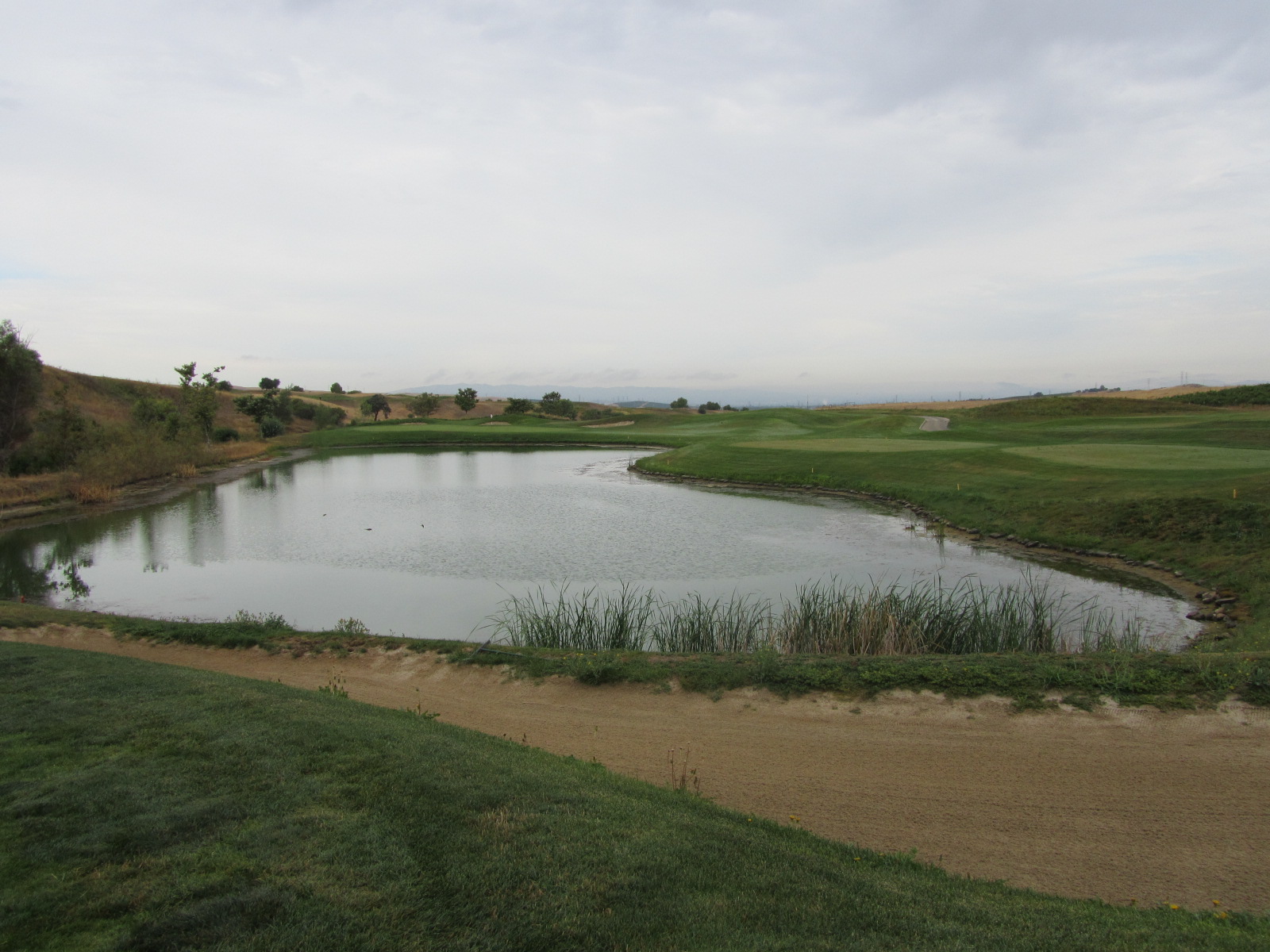
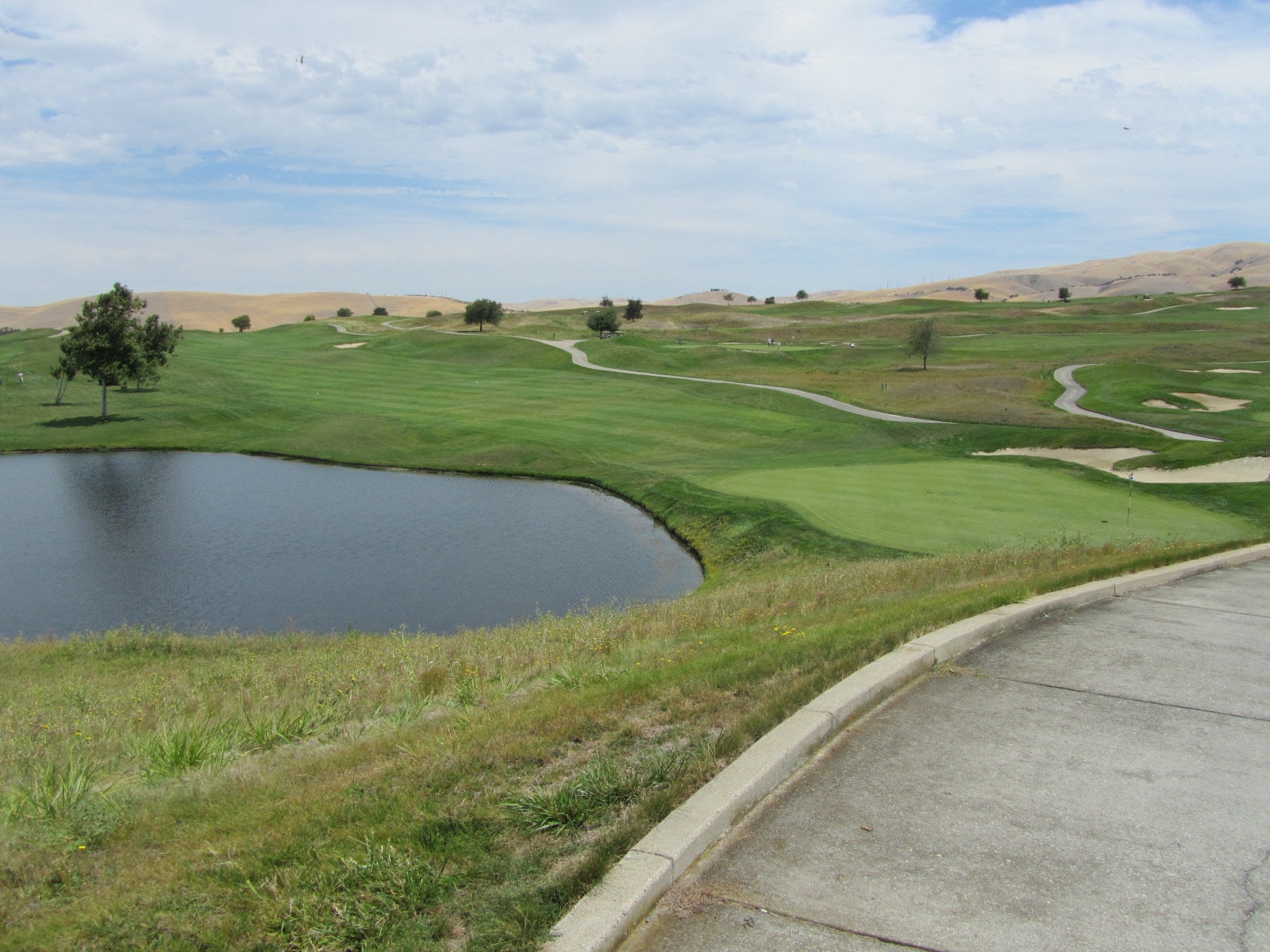
All in all – Poppy is a fantastic track. Not having to wait on a tee box, 27 championship holes, great facilities, a decent burger at the turn, and pretty solid golf conditions year round…What else could you possibly ask for? Join the NCGA and go play!

2012 PGA Championship Predictions – Glory’s Last Shot
August 7, 2012
updated Monday, 8/13
Alright, JK. It’s our last shot of the year to call ’em. The course: The Ocean Course at Kiawah Island.

LG:
Winner: Dustin Johnson T-48, +5 – winner, Rory Mcilroy
Winning Score: +2 -13
Runner Up: Tiger Woods David Lynn (who?)
Low PGA Professional: Mitch Lowe No idea
“Unknown” in the Top 10: Branden Grace M/c – how about David Lynn?
Last Year’s Winner (Keegan Bradley) Will … (Win, Top10, Make the Cut, or Miss the Cut): Top 10 Correct, T-3, -4
The Master’s Winner (Bubba) Will: MC T-11, -2
The US Open Winner (Webb) Will: MC correct
The Open Champion (Ernie Els) Will: MC T-48, +5
How many prior winners will be in the Top 10: 2 1, Keegan Bradley
1 Rory McIlroy -13 67 75 67 66 275 $1,445,000 600
2 David Lynn -5 73 74 68 68 283 $865,000 0
T3 Justin Rose -4 69 79 70 66 284 $384,500 147
T3 Keegan Bradley -4 68 77 71 68 284 $384,500 147
T3 Ian Poulter -4 70 71 74 69 284 $384,500 147
T3 Carl Pettersson -4 66 74 72 72 284 $384,500 147
T7 Blake Adams -3 71 72 75 67 285 $226,000 91
T7 Jamie Donaldson -3 69 73 73 70 285 $226,000 0
T7 Peter Hanson -3 69 75 70 71 285 $226,000 0
T7 Steve Stricker -3 74 73 67 71 285 $226,000 91
T11 Ben Curtis -2 69 77 73 67 286 $143,286 65
T11 Bubba Watson -2 73 75 70 68 286 $143,286 65
T11 Tim Clark -2 71 73 73 69 286 $143,286 65
T11 Geoff Ogilvy -2 68 78 70 70 286 $143,286 65
T11 Graeme McDowell -2 68 76 71 71 286 $143,286 65
T11 Tiger Woods -2 69 71 74 72 286 $143,286 65
T11 Adam Scott -2 68 75 70 73 286 $143,286 65
Will someone win it, or will everyone else lose it? DJ Wins it. No more bunker issues. Rory won it…period
What will be the biggest story of the tournament? John Daly making the cut. 8-shot win by Rory, although Daly was a nice story for a little while
Jason Dufner will: Top 10 T-27, +1
Tiger Woods will: Top 10 T-11, -2
Rory McIlroy will: Make cut HA!
Zach Johnson will: MC Solo 70th at +12
Steve Stricker will: Make cut T-7, -3
Dustin Johnson will: WIN!! T-48, +5
Who is most likely to “Jason Dufner” it on the 17th hole on Sunday? Jason Dufner. it didn’t matter
Adam Scott will: Go home early – MC. T-11, -2
JK
Winner: Matt Kuchar Cut with an 82 on Friday!
Winning Score: -7 -13
Runner Up: Zach Johnson took down solo 70th.
Low PGA Professional: Mitch Lowe again, no clue, but congrats to mitch for making the field
“Unknown” in the Top 10: Brenden de Jonge T-54, +6
Last Year’s Winner (Keegan Bradley) Will … (Win, Top10, Make the Cut, or Miss the Cut): Make the Cut T-3, -4
The Master’s Winner (Bubba) Will: Make the Cut Correct, T-11, -2
The US Open Winner (Webb) Will: Make the Cut nope..MC
The Open Champion (Ernie Els) Will: MC T-48, +5
How many prior winners will be in the Top 10: 2 just keegan
Will someone win it, or will everyone else lose it? Kuchar putts his way to a championship Rory does everything on his way to the championship
What will be the biggest story of the tournament? Should we ban the arm-putter? record-breaking rory
Jason Dufner will: Top 10 T-27, +1
Tiger Woods will: Top 10 close, T-11, -2
Rory McIlroy will: MC lol
Zach Johnson will: Runner up lol
Steve Stricker will: Make the Cut T-7, -3. Good showing for Strick
Dustin Johnson will: Top 10 no
Who is most likely to “Jason Dufner” it on the 17th hole on Sunday? Jason Dufner who cares?
Adam Scott will: MC. And take the long putter home with him. fail
The Big Four
July 29, 2012
Just an interesting topic to ponder amongst our readership.
Last week, the big easy earned his second British Open title, taking home the Claret jug. This marks Ernie’s fourth major. While many are lauding his performance–and feeling quite sorry for one Adam Scott–I took a moment to pause and remember the time when golf seemed more exciting than any, and, looking back, what that time in history has led to.
When was it we started calling them “The Big Four?” 2004? 2005? To think it’s been 7 or 8 years since that time frame makes it seem like we’re getting old. Nonetheless, in the historic career of one Tiger Woods, the period of “The Big Four” was one of probably his greatest areas of achievement.
Colloquially, The Big Four meant Tiger Woods, Ernie Els, Phil Mickelson, and Vijay Singh, who typically were consistent contenders and always ranked in the top 6 or 7 in the world rankings. Their attendance at tournaments drove the public eye, and sponsorship money for the Tour site of the week rose and fell with their decisions to compete or not. These men are, by and large, the reason that PGA Tour prize money is now consistently over $1MM per tournament for the winner, with each tournament seeking to draw the best in the world.
In May, the Devil Ball Golf Blog (http://sports.yahoo.com/golf/blog/devil_ball_golf/post/The-Big-Four-is-now-down-to-the-Big-One-?urn=golf,241789) opined that Mickelson was the only of The Big Four to currently be in contention. I guess things change. Tiger has held at least a share of the lead in each major since, and Ernie Els…well…won the Open.
When we were in the heat of The Big Four, however, it felt like a “Big One”–with Tiger Woods essentially dominating. Even though Phil, Ernie, and Vijay all placed well, the consistent performer was Tiger Woods. He won two majors in 05, two in 06, one in 07, and one in 08. Mickelson broke through for a major in each of 04, 05, and 06, but nothing compared to Tiger’s dominance. Els and Vijay…well…Vijay won the 2004 PGA but seemed to never really hold on to his putting.
What’s interesting to review, though, is what’s happened since. When you look at the numbers, Tiger Woods won 6 majors during that time period and 14 overall. But Phil added another major. So did Els. And when we look back, we see that two of The Big Four have won four majors (Phil and Ernie) while one owns three titles (Vijay). Collectively, these men account for 25 major championships won.
Compare that to the current streak of now 15 majors without a repeat winner (last being Padraig Harrington, 2008 PGA after the 2008 British Open), and it really puts the performance in a span of history. Els’s recent win was the first time in ten majors that the winner was not a first-time major championship.
In other words, what these players did was utterly unbelievable. They dominated the game in a way that we likely will never see again. While it appeared at the time that Tiger was the dominant force (and he probably was), think about what these men achieved. All of them will likely be in the World Golf Hall of Fame as soon as eligible (Phil already is!). And, what’s more amazing–they’re still competing at a high level almost a decade later. While the current state of golf is something to debate, looking back at the history we’ve seen, this just might have been the greatest generation of the game.
Conversation: The Belly Putter
July 26, 2012
JK: 7/24/2012 at 10:37 AM EST
Alright LG, time to put it out there.
There’s a lot of discussion lately about belly putters. More appropriately, there’s a lot of discussion about what to do about them. After going decades without single mid-length putter or long-putter winnings on Tour, now the belly putter is taking the Tour by storm. Three out of four of the current major champions used belly putters to win (Keegan Bradley, 2011 PGA; Webb Simpson, 2012 US Open; Ernie Els, 2012 British Open). Bubba Watson (2012 Masters) is the only current major champion who did not use a belly putter to win.
So there are many questions to answer here, but to me, the main point boils down to: 1) is it an advantage? if so, 2) what should be done?
Some people are just antithetical to belly putters and long putters in general. While neither you nor I use them–and I personally find them to be a bit distasteful–I do see a need in golf for them. Many amateur-level players need a way to make the game fun. Poor putting can often thwart someone’s progress as a golfer, and a long or belly putter may give them the stability they need to get over the hump. For example, when my wife’s grandfather played, he wasn’t in good enough health to lean over a putt, so he got a long putter and stopped 3-putting EVERY green (he still did 3-5 times per round, but way less than previously).
I think the more important point, though, is that belly and long putters really don’t give a “better” player much of an advantage. No matter the golfer, the person must still read the putt, account for the speed, pick the line, and set up to it properly before any mechanics of the stroke happen. The ability to do this successfully comes after hours and hours of practice that a “good” player will put in regardless of the length of putter he/she uses. To put it another way, the belly putter didn’t read the 35-footer that Keegan Bradley hit on the 17th hole at Atlanta Athletic Club–the player did. The player read it, accounted for the speed, picked the line, and let the put go on that line.

Further, I don’t think a longer putter shaft REALLY makes it all that much more stable for the better golfer. Adam Scott bogeyed the final four holes at Royal Lytham & St. Annes largely because he picked poor targets and failed to execute the mental part of his putting routine, not because he was using a long putter instead of a belly putter.

Webb Simpson’s putter didn’t make Jim Furyk pull his fairway shot in the bunker on 18 at Olympic or make Greame McDowell miss his birdie attempt by a mile and a half. Am I missing something?
Opponents of longer-length putters say it helps stabilize the stroke. That may be true, but at the same point, it prevents someone from using his or her athleticism to correct in small variations, such as when precise speed is needed, or when the player plays from the edge of the green and needs to blade the putt a little bit. I’ve practiced with a belly putter before, and I do see some stability improvement. But the stability improvement is far outweighted by the inability to control the distance, for me at least.
In my view, there is little to no real advantage in belly putters. I see it more as a mental advantage that some people will find helps their own games. Maybe some people will play better with them, but I firmly believe that others (like me) won’t. Just like all of the other equipment tweaks one can make (shaft flex, various grips and sizes, cavities vs. blades, groove changes, ball changes, etc etc etc etc etc), I see the putter shaft length and stroke method as just another option that a player can choose to make his or her game better. That’s what it’s all about, right?
What say you LG?
LG: 7/25/2012
For two reasons, I don’t think long putters should be allowed.
First, we should look to the game itself. For me, golf is about using using a club to move the ball closer to the hole. While this might seem to leave some room for a belly putter or long putter, the image just seems to go against what golf is all about. When I think “golf swing,” I can’t imagine an athletic motion taking place with an anchored club. No other club is anchored to the body in “golf,” so it makes little sense to allow it for the putter, in my view. For that reason, I don’t think it should be allowed in competition.
Second,I think there is advantage and long putters should probably not be allowed in competition. Golf is a mental game. Putting is the strongest mental test given that it requires the least athleticism. It takes a lot of skill and nerve to make short putts that matter. I am inclined to believe that long putters provide a mental crutch to players that use them on those kinds of putts because they have the knowledge that they will make a fluid stroke based upon their equipment, not their practiced routine. In that way, they provide an advantage (whether real or not). While you can pretty easily point to Adam Scott’s performance in the 2012 Open Championship to counter this, the point isn’t players with long putters can choke, but rather, he choked DESPITE having that mental advantage. Read: double choke. At the highest level in the game, the point is to test your mental fortitude, not your ability to make a 4 footer. No one in the entire world would (or should) bet against Adam Scott on any given 4 foot putt, but that putt becomes harder when it means you win or lose the title of “Champion Golfer of the Year.” For a player to have a mental advantage over another based upon the equipment they are playing rather than the time spent on the practice green is what bothers me about the long putter and why I think it should not be allowed in competition.
That being said, I think they can be great learning tools to learn a fluid putting stroke. Often, players like Ernie will switch back and forth between a standard putter and a long putter to get a feel for a good putting stroke. I’m all for using them in a practice round. I’m all for using them on the putting green. I think you and I agree on the fundamental point; Long putters just aren’t golf.
JK, 7/26:
I agree that long putters and belly putters “just aren’t golf,” but I’m less opposed than you. The entirety of golf is about selecting equipment that maximizes your game. We do it with drivers; we do it with golf balls; heck, we do it with shoes. Every little thing to get an advantage makes sense. Some people had this “ban it” mentality when metal woods came out or when cavity-back irons were developed. Slowly, those things have become part of the fabric of the game to where no one would think of using a non-metal driver and cavity-back irons are almost universal. Even the classic “PING Anser” putter was looked at with shame originally but now is the most ubiquitous design available. While I see your point, I think it’s just part of the natural progression of the game. If you’re wanting to ban something, ban the way Tommy “Two Gloves” Gainey swings a golf club. That’s way more offensive than a belly putter.


Understanding Putters: Intro
July 25, 2012
This post is an introduction to a new series we’ll be offering here on the PF in the coming months: Understanding Putters. Putting is perhaps the most important aspect of the game of golf. It’s where at least 1/3 of your strokes will be played, and it can account for a tremendous success or a horrible failure.
Unfortunately, many classics of golf literature give too scant attention to putting in general. Even the ones that discuss putting fail to discuss how the equipment one might select affects one’s putting performance. Many average golfers are unaware that there are even different types of putting strokes for which different equipment is suggested.
This program will not attempt to teach a putting stroke. Neither LG nor I am qualified to do that. However, we will discuss various theories behind putters, the purpose of different equipment specs, and how the theory integrates with the equipment. Hopefully, with more knowledge, the golfer reading these posts can select the putter that gives him or her the best chance to succeed.
Predictions: 2012 British Open
July 18, 2012
UPDATED 7/23/2012: Way to go Ernie!
I know they call it “The Open Championship,” but we’ve got one of those that’s pretty important too, so I’m going with what they used to call it. I looked back to last year’s predictions (here https://thepowerfade.com/2011/07/18/conversation-british-open-predictions/), and it’s a good thing LG and I have other careers to take besides predicting golf tournaments. Anyway, without further ado:
7/17/2012
JK:
Winner: Phil Mickelson m/c – Ernie Els
Winning Score: -3 -7
Runner Up: Lee Westwood T-45 at +6 – Adam Scott
Low Amateur: Are there really only two amateurs in the field? How about Alan Dunbar i think they both m/c
“Unknown” in the Top 10: Greg Chalmers T-45 – Nicholas Colsaerts was T-7, Alexander Noren was T-9, Thorbjorn Olessen was T-9. Other than that, actually a pretty strong Top 10:
1 Ernie Els -7
2 Adam Scott -6
T3 Tiger Woods -3
T3 Brandt Snedeker -3
T5 Luke Donald -2
T5 Graeme McDowell -2
T7 Thomas Aiken -1
T7 Nicolas Colsaerts -1
T9 Ian Poulter E
T9 Zach Johnson E
T9 Miguel Jimenez E
T9 Mark Calcavecchia E
T9 Matt Kuchar E
T9 Geoff Ogilvy E
T9 Vijay Singh E
T9 Dustin Johnson E
T9 Alexander Noren E
T9 Thorbjorn Olesen E
Last Year’s Winner (Darren Clarke) Will … (Win, Top10, Make the Cut, or Miss the Cut): Drink a lot of beer on Saturday and Sunday. M/c yah
The Master’s Winner (Bubba) Will …: wear pink socks on the plane home. M/c was in it for awhile; T-23
The US Open Winner (Webb) Will …: Stay home with his wife and potential new baby. Congrats Webb
The current PGA Champion (Keegan Bradley) will …: miss the cut. still learning how to do this thing T-34
How many prior winners will be in the Top 10: 3 YES! Tiger Woods, Ernie Els, and Marc Calcavecchia
Will someone win it, or will everyone else lose it? Someone will win it. Sans Carnoustie, the British Open is usually won by the most composed player. Els won it, but Scott defintely lost it as well
What will be the biggest story of the tournament? Phil finally comes through at the British fail
Who is most likely to “Tom Watson At Turnberry” it? Tiger he kind of did, but it was clearly Adam Scott who choked it
Will you watch on Sunday? Probably about half of it yep
Jason Dufner will: Top 10 T-31
Tiger Woods will: Top 10 Correct, T-3
Rory McIlroy will: Make the cut Correct, T-60
Zach Johnson will: Make the cut (no hating, LG) Top 10, T-9
Steve Stricker will: miss the cut T-23. Stricker played pretty well considering
Dustin Johnson will: he’s actually playing? make the cut Top 10, T-9. Good job freak of nature
LG:
Winner: TW T-3
Winning Score: -3 -7
Runner Up: Justin Rose M/c
Low Amateur: Are there really only two amateurs in the field? The one JK didn’t pick. both m/c
“Unknown” in the Top 10: Does Kevin Na count? If not, let’s go with Sam Walker. First, you know Kevin Na doesn’t count. Second, he shot 73-77 to m/c. Finally, Sam Walker shot 76-70 to m/c
Last Year’s Winner (Darren Clarke) Will … (Win, Top10, Make the Cut, or Miss the Cut): MC sorry Clarkie
The Master’s Winner (Bubba) Will …: MC T-23
The US Open Winner (Webb) Will …: MC If by “MC” you mean “not show up because he was home with his wife waiting on their new baby to arrive,” you’d be correct, but I suspect that is not the case.
The current PGA Champion (Keegan Bradley) will …: Make the cut T-34
How many prior winners will be in the Top 10: 2 3
Will someone win it, or will everyone else lose it? Hard to say – depends on the weather. Let’s go with Tiger wins it. Tiger won nothing
What will be the biggest story of the tournament? Tiger’s 15th. do you just copy/paste this from one prediction to another?
Who is most likely to “Tom Watson At Turnberry” it? Lee Westwood. Go read a book, guy. I wish it were Westwood.
Will you watch on Sunday? Yes. Live? no. did you?
Jason Dufner will: Make Cut T-31
Tiger Woods will: Win T-3
Rory McIlroy will: Top 10. T-60
Zach Johnson will: MC Top 10, T-9
Steve Stricker will: MC (sorry, Steve) T-23 (sorry, LG
Dustin Johnson will: Top 5. Top 5 isn’t a choice. He was close though. T-9
Play of the Week 36
July 13, 2012
This week’s POTW is the John Deere. Normally, we wouldn’t be worried about a “grade B” tournament, but watching the coverage of the first two rounds, I’m brought back to my childhood.
But, not by the John Deere itself–by the players.
When I was young, I was a nerd. Being a nerd, I played golf as a kid (before Tiger Woods–I got cool really fast when he jumped on the scene). I enjoyed watching the tournaments. My favorite player at the time–Nick Price–was doing a great job cleaning up majors and dominating the tour with his Ram Zebra and Goldwin AVDP. Davis Love III was in his prime, and “the greatest player never to win a major.” Phil Mickelson was young…and skinny. Harvey Penick’s Little Red Book was the best seller for golf instruction.
I thought it was odd when I saw some Tour Balata and Professional 90 golf balls on sale earlier this week. But theres something to this nostalgia thing. It helps remind you of your past and gives you a flashback to some great memories. I remember the first time I hit a Tour Balata….pretty awesome.
Apparently, I wasn’t the only person to buy some of those Professional 90s, because the guys on the leaderboard this week at the John Deere sure are the ones who know to use ’em. Let’s look at it this way: If I told you that Jeff Maggert was T-2 going into the weekend after shooting 68-62, that Lee Janzen was T-7 at -10, and that Steve Stricker was going for his 4th win, your first reaction would probably be “where’s Greg Norman on the leaderboard” followed by “hey, did you hear what the president said at the deposition? ‘It depends on what the meaning of the words “is” is.'” Yet that’s the leaderboard at the John Deere classic this year.
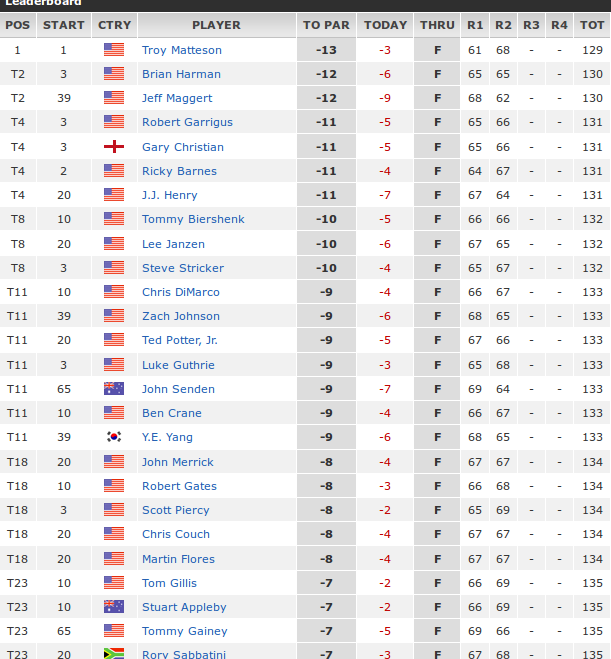
Alas, it IS 2012. Davis Love III is all but forgotten on the PGA Tour. Nick Price is on the “Champions Tour” (back when I was growing up, we called it the Senior Tour). Phil Mickelson turned out to be every bit the player everyone thought he would be and more so the eater that no one thought he would be. Goldwin and Ram are no longer companies. And if you ask a playing competitor for his “little red book,” you better be ready for some funny looks and a quiet rest of the round. Still, I love when the Tour shows up at an “easy” course, and the old-timers (short hitters) come out and show these young kids how it’s done. Even Stewart Appleby has shown up at T-23, -7.
I’m sure some of the younger kids in their Puma Monolines and Cobra Amp driver are probably thinking “what is this guy talking about?” The golfers of today just are missing something. I won’t say class, but there’s a way the game used to be played that just doesn’t exist anymore. It’s nice to see a flashback of some of these guys–I wish them all the best.
Thanks, guys, for the trip down memory lane. Now go out there and show the young guns how it’s done.


 The Power Fade Golf Blog