Review: Cobblestone Golf Course (Acworth GA)
June 13, 2011
One of the best things about having a golf blog is having the opportunity to do a write-up of great golf courses. In line with others, this week I review Cobblestone Golf Course in Acworth, GA.
I have been playing Cobblestone off and on for the last 15 or so years. Every time I go back, I am reminded that it is one of the more fun layouts near the city of Atlanta.
Cobblestone is, oddly, a municipal golf course maintained by Cobb county. Unlike many munis, however, it’s not a golf course that was just clear cut out of some trees and plopped in place. Serious earth was moved to put this course in place. The result is a layout that intrigues.
Cobblestone is placed at the very southern tip of Lake Acworth. 8 of the 18 holes play on, over, or around the lake, giving many picturesque vistas. The 11th hole (shown below–that tree is actually growing out of the marsh at the southern tip of the lake), a 436-yard par 4, plays to a wide fairway some 250-yards out, but necks down after that to only about 20 yards across. The green on the 11th sits less than 2 paces from an embankment to the lake, making for a very tough approach shot with a long iron.

At 6700 yards from the back tees, it’s not terribly long. However, the 73.5 rating (on a par-71 course) shows that it has some bite. 12 of 18 holes include hazards noted on the scorecard, and several others include treacherous shots.
The appeal of Cobblestone is not only that it is challenging, but also that it includes a good mix of golf holes. At par 71, the course includes four par 5’s that are all reachable–two that are flat that play under 530 from the back tees, and two that are well-downhill at 542 and 570. I had a 3-iron into the 570-yard par 5 9th when I played it recently. Although I’m a “big hitter,” we are talking about reaching par 5s, which short hitters would not consider. The course has a good amount of elevation change as well, which is rare for courses this close to water. Part of this can be seen from the views of the par 3 16th below.


Moreover, Cobblestone includes a good mix of holes. There are doglegs in both directions. There are holes that play over water and holes that play through the trees. There are some wide fairways and some narrow fairways. Some long par 4s (the 2nd, for example, at 472 yards, and the 14th at 461) and some driveable par 4s (the 17th, at 316 and about 60 feet downhill, and 4th at 313, shown below). Some long par 3s (the 8th at 240), and some short ones (the 16th at 133 over water). Cobblestone tests all parts of your game and gives a great opportunity to see how you play all your shots.
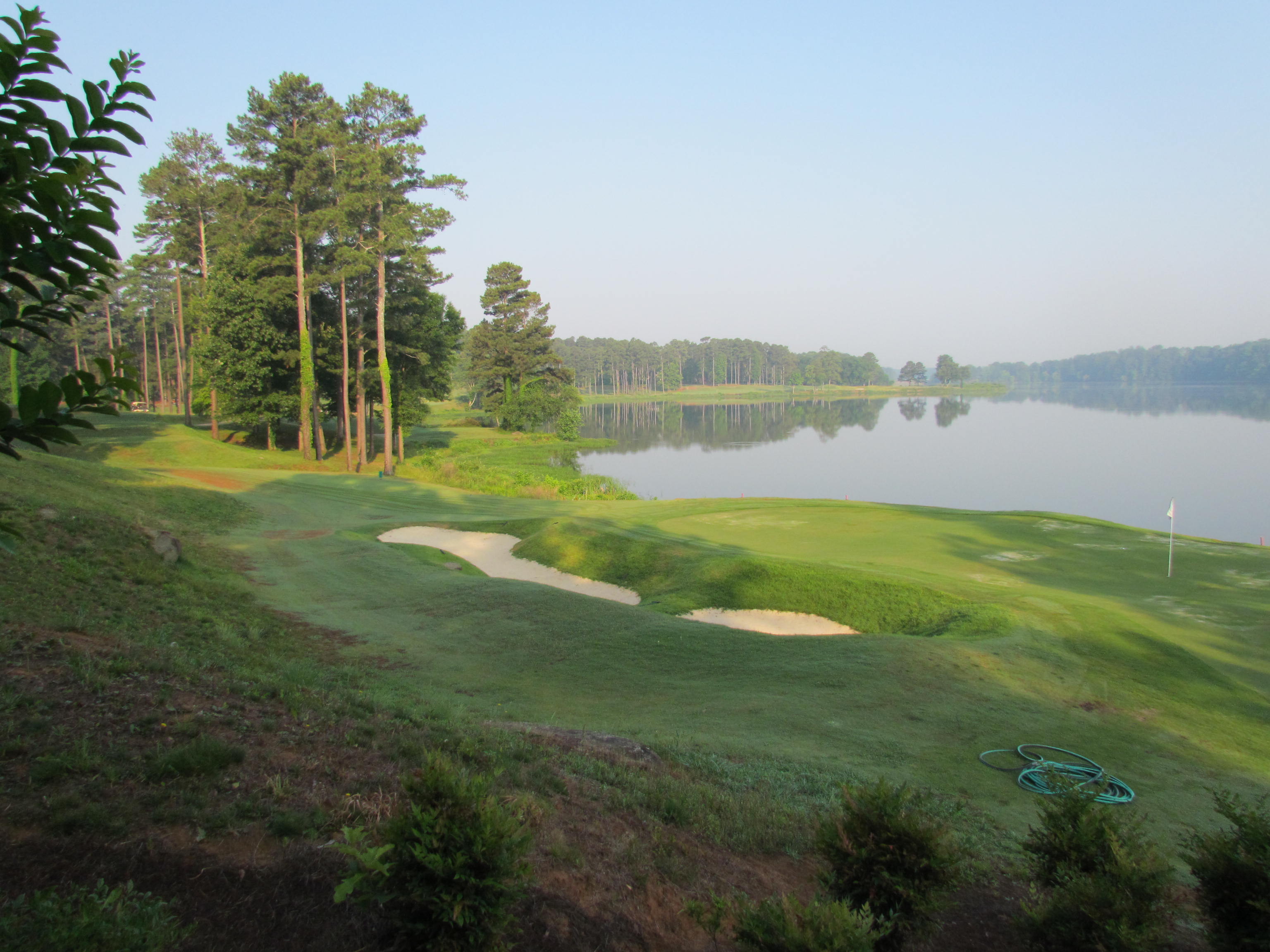

Cobblestone is a surprising muni, both for its quality and its beauty. The course is truly a gem of a layout.

There are always drawbacks, however. The condition of the course the last few times I’ve been out has been less than ideal. Far less. There was a temporary green on the 1st hole (which the staff did not warn us about). This comes less than 10 months after a full renovation where the course was converted from bent greens to bermuda (which I dislike anyway), leading me to wonder if they are capable of maintaining the course. The fairways were in good shape in many places but also had a good amount baked and dry spots as well as muddy puddles–in other words, it was very inconsistent, even when in the fairway. I guess the staff have never heard of bagging mowers, because they were still dragging the fairways to pick up the grass clippings when we teed off–not something you want to see (see the picture of the fairway at the 11th, above). Bermuda greens–I guess that’s all I have to say about that. At $56/round, I would have expected more. And it’s not exactly close to Atlanta. I guess there’s a reason why all the courses worth playing aren’t built anywhere near the city of Atlanta, but I’m starting to get sick of driving 45-minutes outside of the perimeter just to play a course worth playing. While the course is fun to play, there’s a reason why I don’t get out there but once every other golf season or so. Still, it’s always enjoyable, and I love a good layout.
Layout: 10/10
Greens: 7/10
Fairways: 7/10
Other Maintenance/Upkeep: 6/10
Cost: 5/10
Value: 6/10
Location: 7/10
Staff: 8/10
Overall: 7/10
Fail of the Week 4
June 8, 2011
This week’s FAIL is the state of golf. Currently, the game has never been less intriguing, and the reason is that we haven’t seen the dominance of the players we like and root for. Tiger has been out of contention in most tournaments (or just out of them), Phil hasn’t played well, and the big boys who made so much noise last year (DJ, Bubba) have been very quiet this year.
Don’t get me wrong, Luke Donald is a fine player. He’s currently #1 in the world rankings (which makes no sense because he hasn’t won a major, but, whatever, that’s the case). He plays measured, consistent golf and deserves the money and publicity he gets. But it really speaks to the current state of the game when THIS is what the #1 player in the world looks like:

The #1 player in the world should look like a champion. This guy looks like a pack of watermelon gum. It would be one thing if this were a rare moment, but, unfortunately, I think he might’ve borrowed his wardrobe from Ian Poulter.

My grandmother wouldn’t wear that shade of pink, much less in pants. And to pair it with a black shirt–at Harbour Towne, no less–you’re asking for trouble.
Don’t get me wrong; I like pink, when used appropriately. But, this is not appropriate. This just speaks to the state of golf. If you asked 100 people on the street who the top 3 golfers in the world were, none of them could tell you Donald, Westwood, and Kaymer in that order. Yet that’s what we have.
It’s sad, but the most in-your-face and recognizable American golfer we have is Rickie Fowler. Can anyone explain this? I mean, seriously? This is what people want to see?
Here’s Rickie Fowler looking like a prison inmate:

Here’s Rickie Fowler dressed like a grape popsickle:

Here’s Rickie Fowler’s award wardrobe for selling the most Mary Kay:

Moreover, news came out yesterday that Tiger will not be playing in the US Open, and his absence from golf is putting a further decline on the popularity of the game.
Tim Finchem, please, do something. Fast. Otherwise, you’ll be losing more than just the casual fan.
For a photo of Ian Poulter’s ungodly obsession with the color pink, see http://i.telegraph.co.uk/multimedia/archive/01583/ian-poulter_1583748c.jpg. Warning, too shockingly pink for the PF. Proceed at your own risk
Play of the Week 16
June 8, 2011
This weeks POTW goes to Steve Stricker, champion of the Memorial Tournament.
Although a little belated, Stricker’s play this weekend needs to be commended. Stricker played incredibly, including two hole-outs in a four-hole span from Friday to Saturday. Although it’s not quite as impressive as Rocco Mediate’s 4-hole-out performance at CordeValle (the subject of POTW 2 and POTW 2.5), in four holes, Stricker hit an ace and holed out from the fairway on a par 4. He is now ranked 4th in the world, and he stands as the US’s best chance to overtake one of the pesky Euros (Westwood, Donald, and Kaymer) for the #1 ranking.
Although Stricker only managed a one-shot victory, a win is a win, and we’re proud of it.

So here’s to you, Steve. We hope to see you represent us (or, US) well at Congressional.
Previously, I had reviewed Twin Warriors in New Mexico. I now review the Club at Las Campanas – The Sunrise Course.
This was the second course that I had an opportunity to play (in as many days) during my stay in New Mexico. After subjecting myself to the 7800 yard behemoth that was Twin Warriors, a brisk 7626 yards of Nicklaus’ best work should be no problem, right? Away we go!
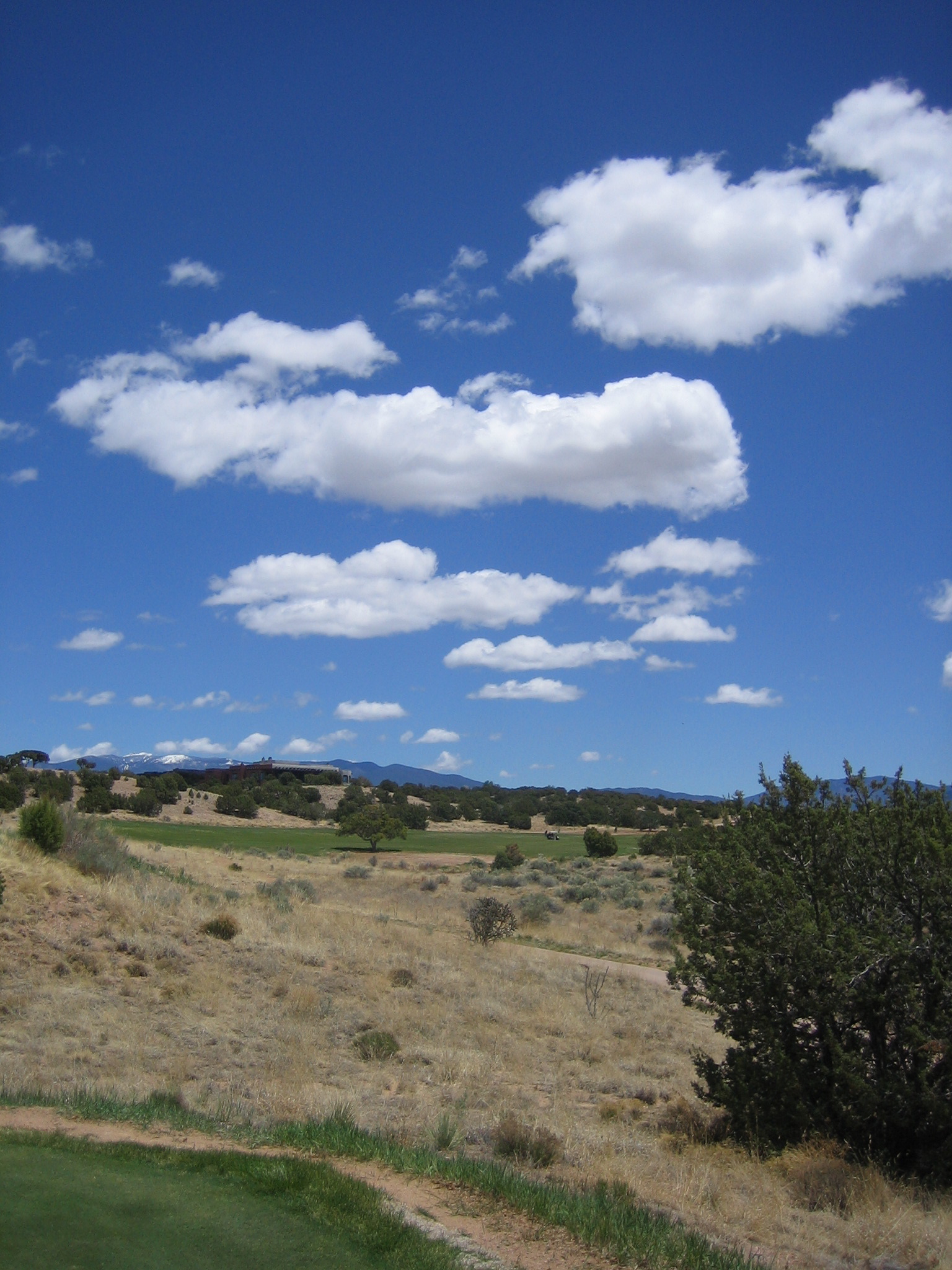
Again, we break with our stated goal of reviewing courses that the average joe can play without paying an arm and a leg by visiting one of the more exclusive clubs in New Mexico (hey, what can I say, if you can get on you’re going to play). While these courses are private, they have a distinctly resort feel to them. The drive up to the club house wanders through the prairie and has me wondering why I don’t live out in the desert. We pass tennis courts, adobe houses, and some of the back nine on two beautiful Jack Nicklaus designs. The pro shop is WELL apportioned and has a full array of titleist equipment (complete with fitting guy!). There are at least 10 different brands of clothing, any of which might be at home on the set of caddyshack. The practice facility was equally well apportioned. Grass driving range complete with pyramids of Nike practice balls and a LARGE putting green/chipping area with every contour imaginable. As for the facility:
The facility has two championship layouts. They were apparently Jack’s 99th and 100th courses respectively. Each one has a distinct character (the Sunset, I am told is slightly more of a shot makers course, while the Sunrise is the bombers course). On advice of the member who some how finagled me into the line-up, I played the Sunrise Course. Here are the stats:
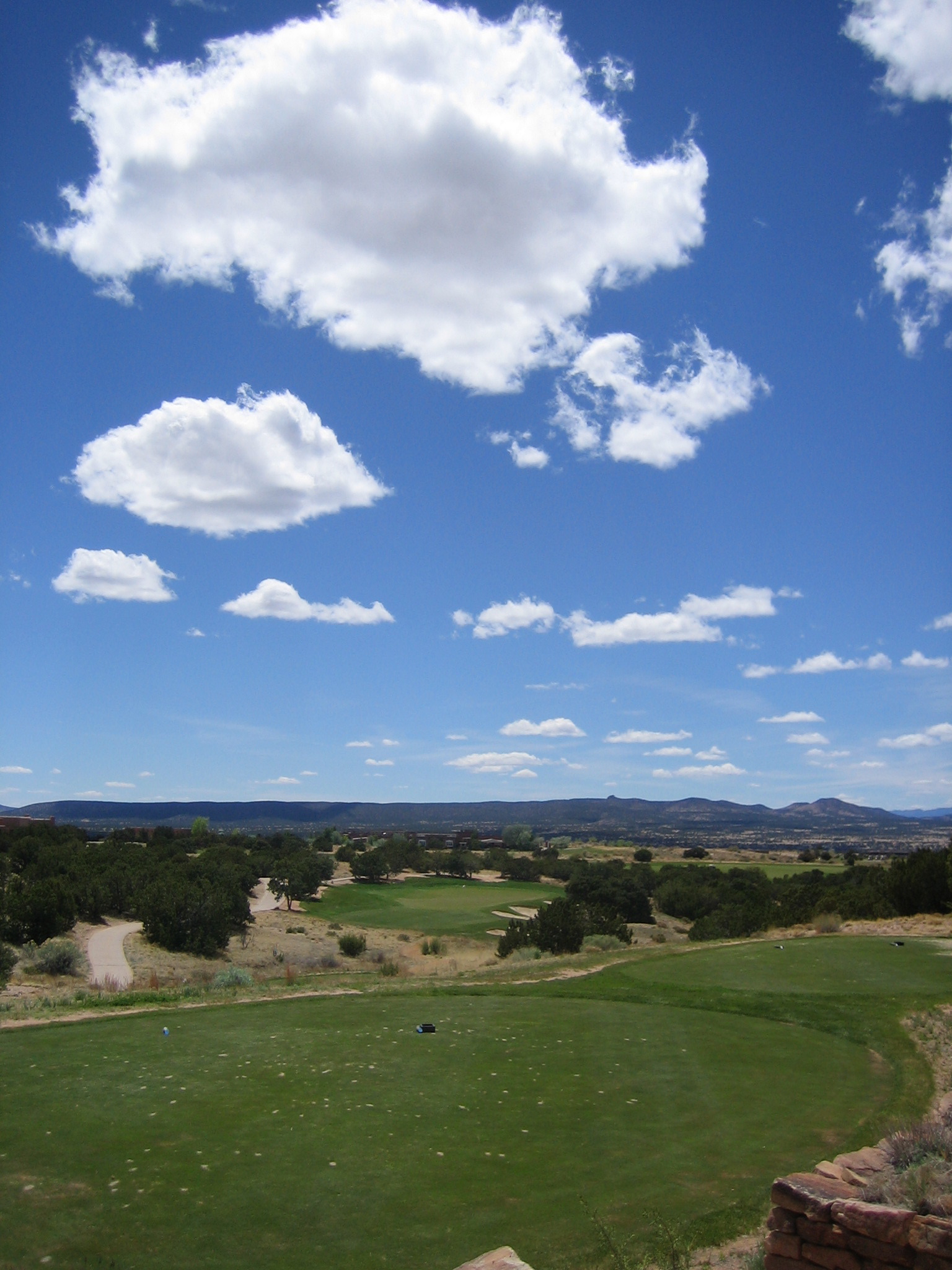
The Club at Las Campanas – The Sunrise Course:
Green Tees (Tips) 7626, 73.9/132
Gold Tees 7033, 71.0/130
Blue Tees 6462, 69.3/124
White Tees 5928, 66.4/114 (M); 71.9/132 
Red Tees 5029, 66.6/120
Because we so rarely have the time to write reviews these days here at the PF, we choose to write about winners. The Sunrise Course was precisely that. Though it listed shorter than Twin Warriors, it was certainly the more interesting of the two courses. Jack has made use of elevation change in the middle of the prairie in ways that I thought unimaginable. There were also blind drives that were rewarded by big drives and aggressive lines. See for example, the split fairway on the 9th hole.
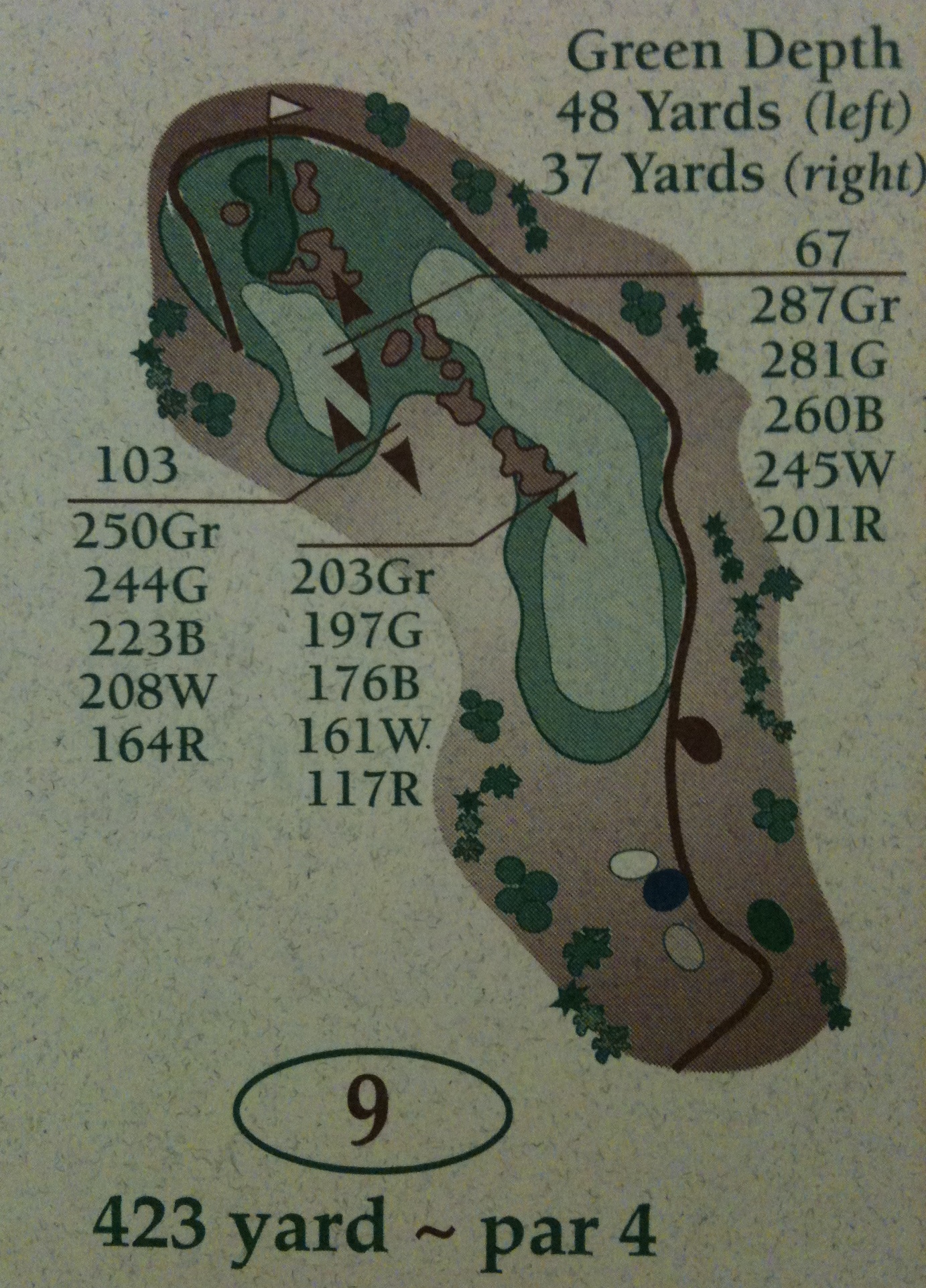
One thing about Jack’s designs that I found to be particularly true here though was that if you miss left, you were generally able to recover. Another truism of Jack’s designs is that if you are having a “loose” iron play day, you will feel the burn of the course. Thankfully, however, I was fortunate to be having a nice ball striking day. with a 42-44 = 86, I was more than pleased with my play from the Green Tees. Though my lone birdie of the day came on the 10th hole after a long drive, long three wood and chip sideways onto the tiny, well bunkered green; my favorite hole of the course was the par 3 twelfth.
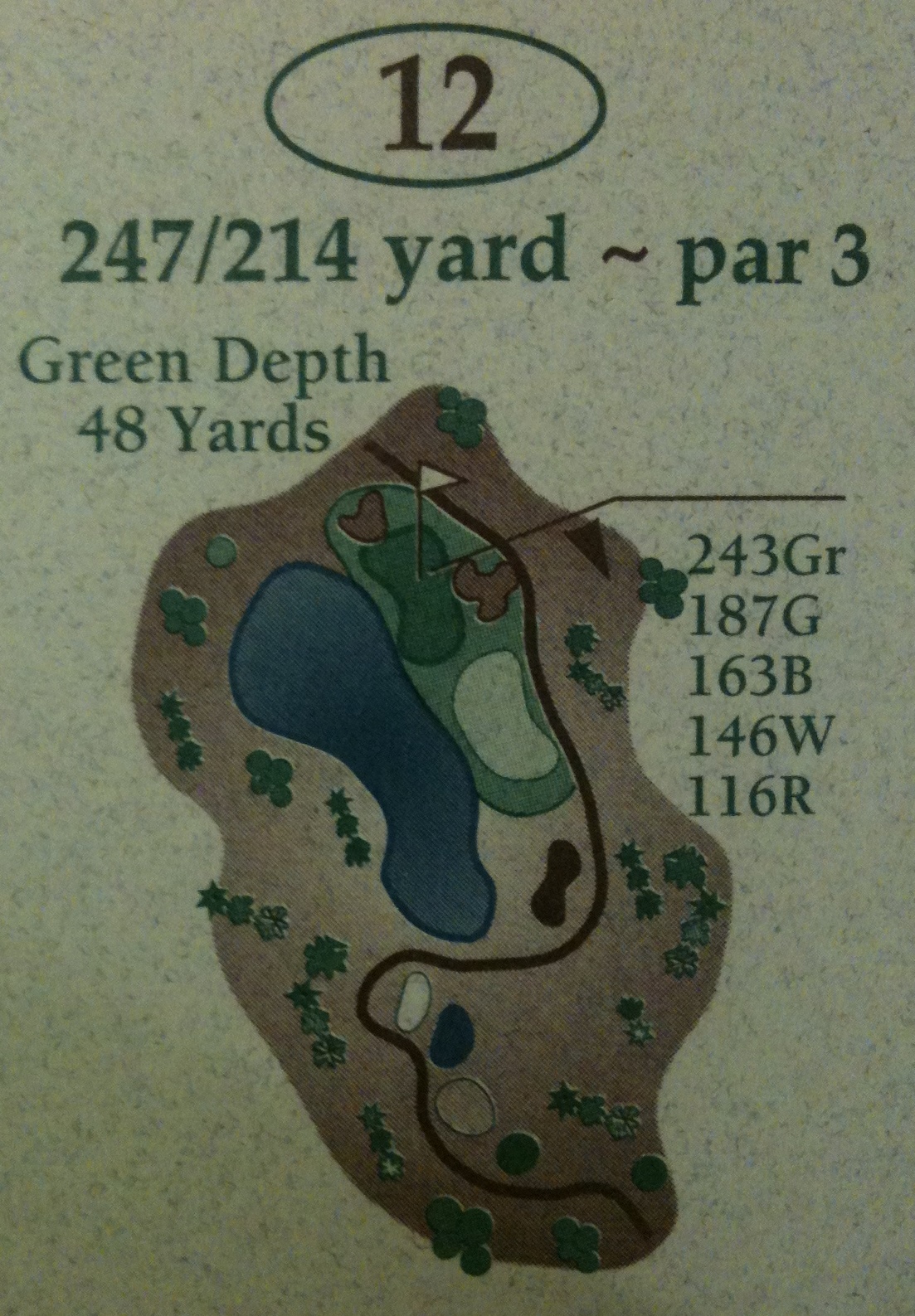
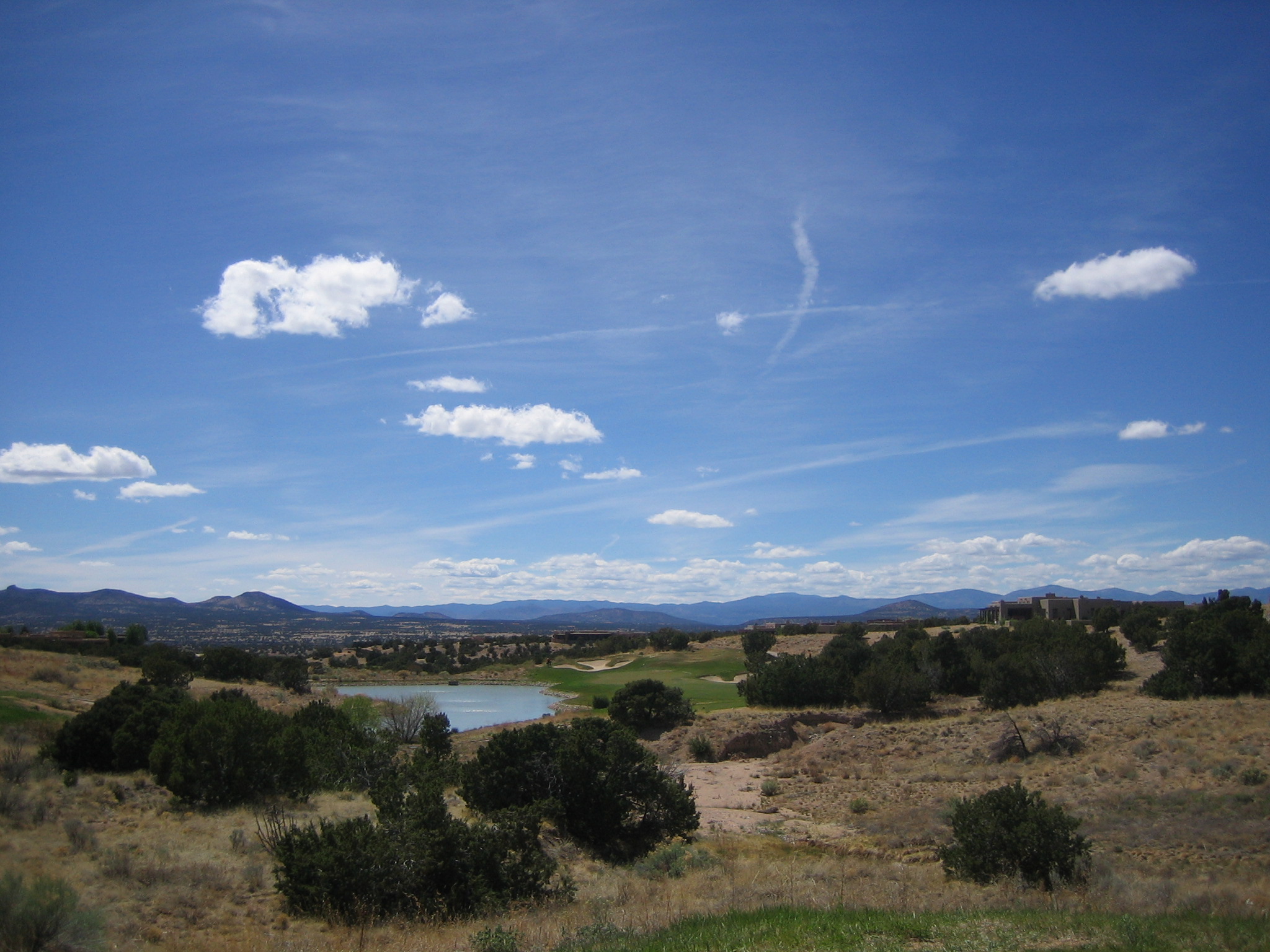
The twelfth (yardage guide and picture above from the tee) measures a stout 247 yards from the Green Tee. This monster of a par 3 affords very little in the way of forgiveness. Water left, bunkering right, and the only real bailout short into a collection area make this truly a “heroic” school of design hole. Oh, lets not forget the head wind. As if this beast was not enough pressure on its own, two of the cart boys had made their way down to watch me tee off. I guess it is rare for them to see new blood around this course (much less anyone that could reasonably be called “new”). I carefully teed up my TaylorMade Penta and gave it as smooth a ride as I could manage with my 3-wood. The instant it left the club face, I knew it was going to be pretty damn good. Below is the result that I drove up to after the long, 247 yard tee shot.
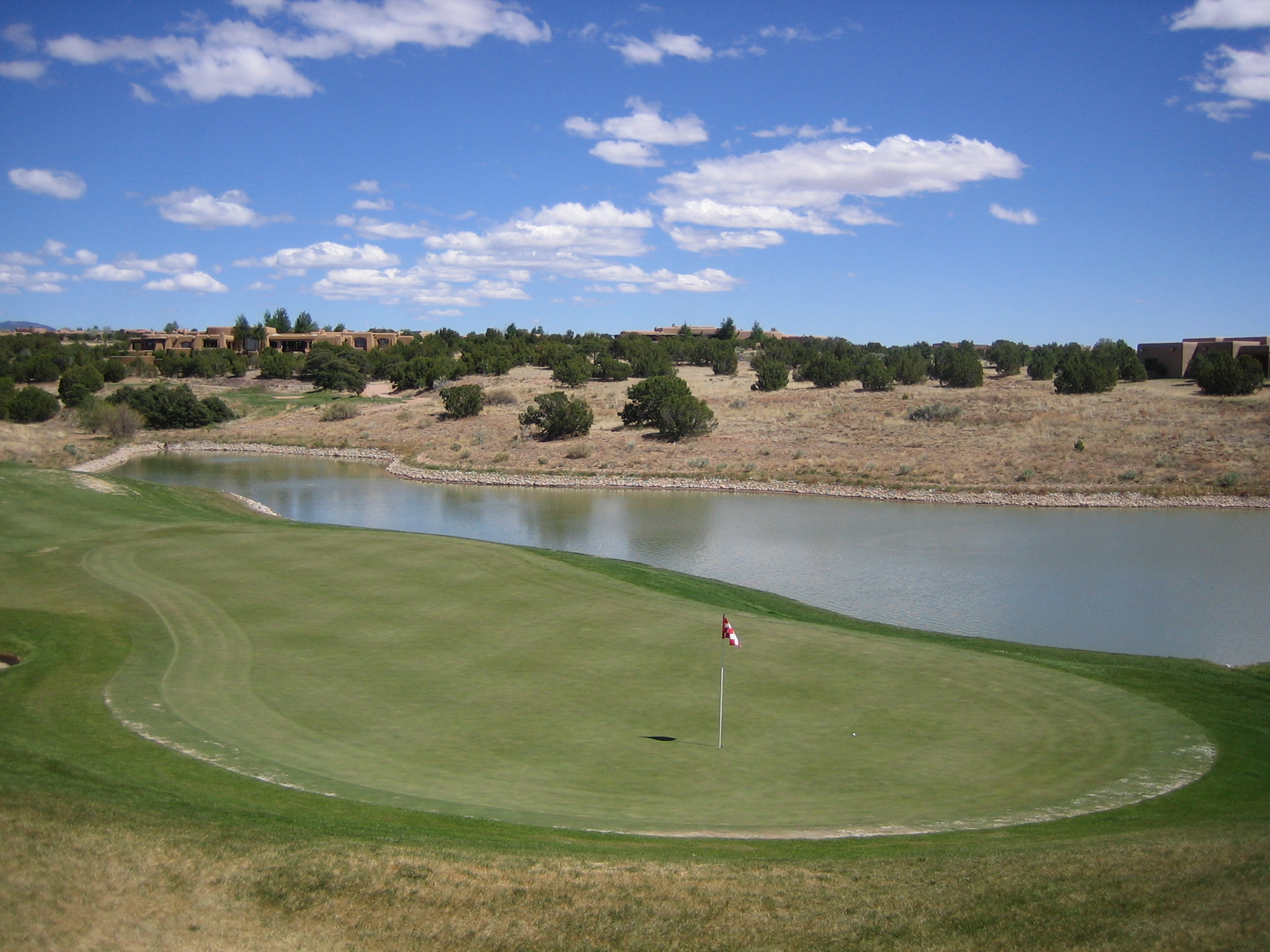
Needless to say, my round was made (unlike the putt).
The course was in impeccable condition. Parts were dry, as they should be in the desert, but for the most part, it was quite lush. The bunkering was superb and set up some fantastic aiming lines for the first time player. Though there were blind shots, I always felt as though I had a sense for where Jack wanted me to go.
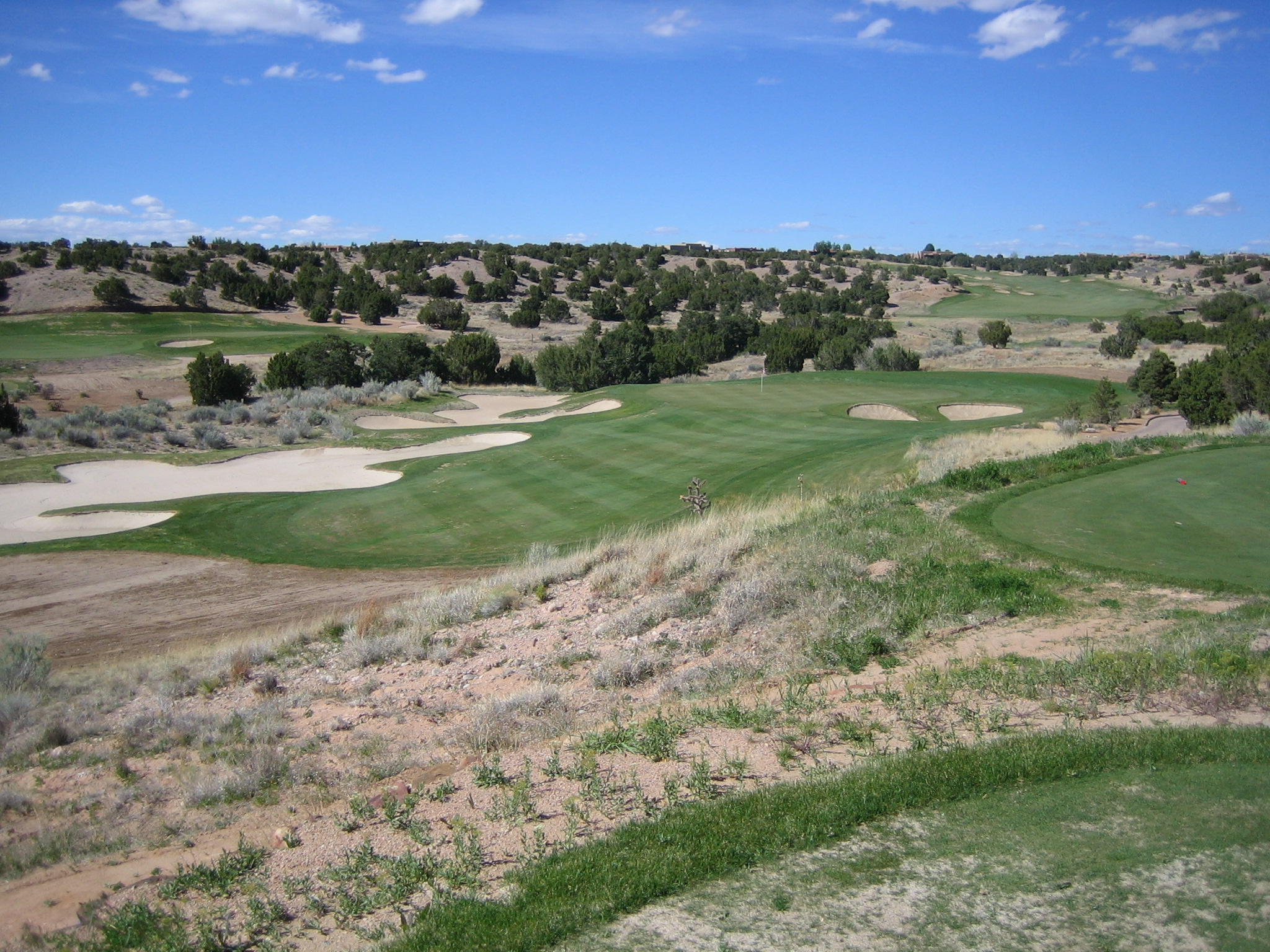
Overall, I’d have to say the Golden Bear’s 100th was clearly a monument to the prowess he has developed over years of designing courses. I truly think that this course is one that I could continue to play every day and it would never get old. Really, I can think of no higher compliment than that. There are holes that are incredibly difficult, but they are the kinds that create shots you will never forget.
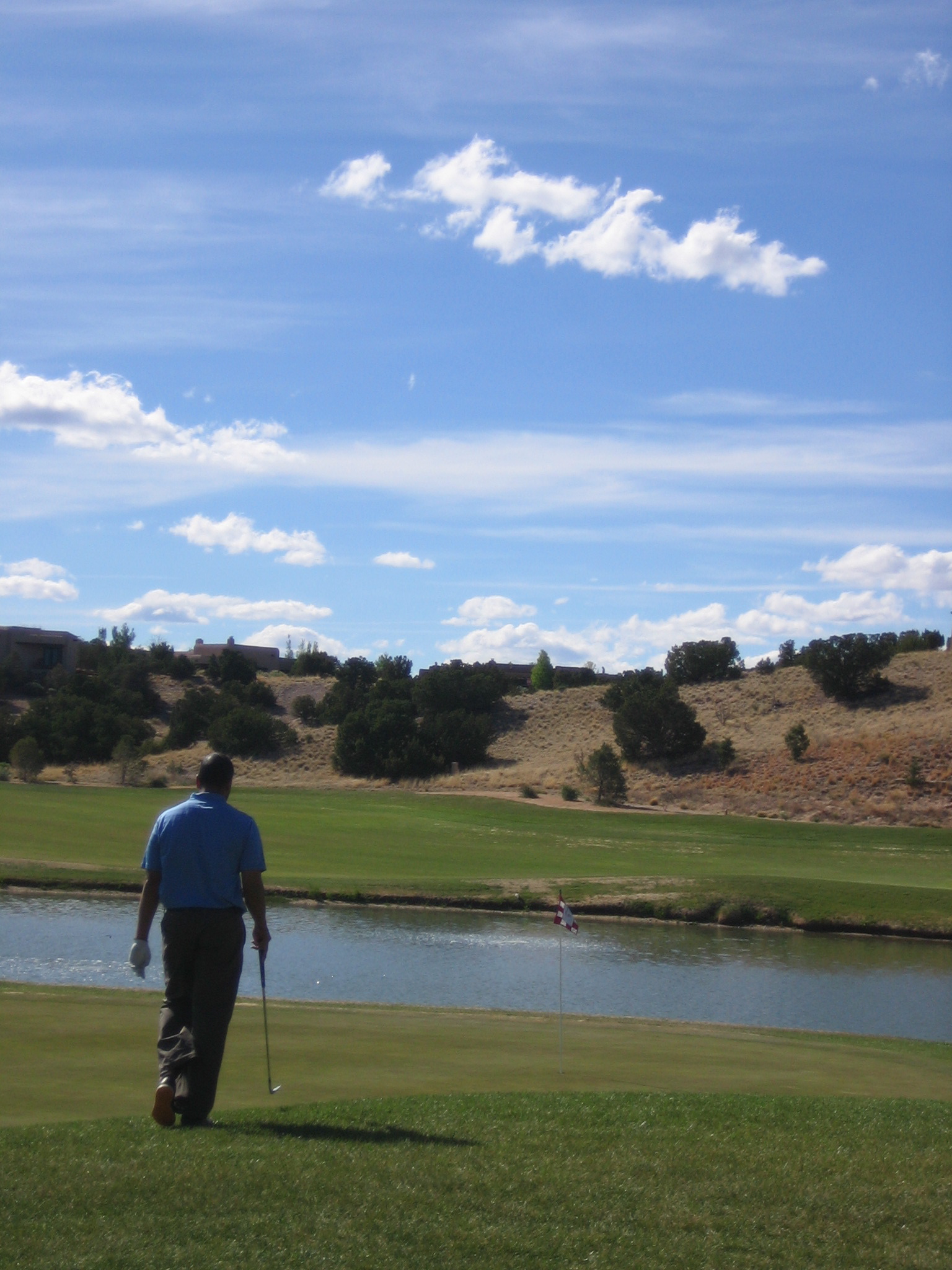
How to be Scratch
June 1, 2011
I found this post while searching GolfWRX today. Very helpful. At the least, it will help you understand some of the things that go into playing good golf. If you can do all of them, bravo–you should be on the PGA Tour. But doing some of them proficiently will definitely help.
(for original text, see http://www.golfwrx.com/forums/topic/22272-how-to-be-scratch/)
This text has been combined and modified from various posts on the internet golf forums…………….
The number one thing about getting to scratch (IMHO): Time and commitment.
You have to make a serious commitment to get better and then have the time to implement your decision. Specifically, it means playing a lot of golf. Not necessarily practicing 5 hours a day pounding balls, but playing 18 holes every day, or at least 4 times a week, or 9 holes very frequently. If you cannot afford the time, it will literally take years and years for you to accumulate the “talent”, experience, and savvy to become a scratch golfer. I say this only if you’ve never been a scratch golfer. If you’ve been a 1 handicap or scratch golfer before, you don’t need to play everyday or hit balls. You can play once a week or 2 times a month and shoot even par. But if you’ve never been there, it takes time, a passion, and a total commitment.
Play as much as you can, and play as many tournaments as possible. (I can’t emphasize this enough). When you’re not playing a tournament, make sure you are playing a competitive match with someone as often as possible, and make sure you have some money on the line. And make it enough so that if you lose, it stings a bit. I know this (the wagering part) is a bit controversial, and not everyone will agree, and that’s fine.
When you do play, make sure you play on a variety of courses with a variety of conditions. Bermuda greens, bent greens, poa annua greens. Hot, cold, rain, wind. You name it. And whatever the conditions are, those are the conditions that are just perfect for you that day. Never use the conditions as an excuse. Never.
It’s about learning how to play the game and not learning some new golf swing. Start learning how to get the most out of what you already have instead of relying on the pipe dream that some day you will “fix” your golf swing.
Try to learn something from every single experience on the golf course. Pay attention to how you feel, what your tendencies are, and your self-talk. For instance:
* What did you feel like when you hit that 100 yard sand wedge to 5 feet?
* How about before you hit it?
* How did your state of mind prior to the shot influence the outcome, if at all?
* What did you say to yourself prior to shoving that tee shot out of bounds late in that one round when you were 2-under par and about to beat your personal best?
* Why did you snap-hook that 3-iron into the water from that ball-below-your-feet lie? Isn’t the ball supposed to go right off ball-below-your-feet lies?
* Why do I always miss left from uphill lies?
* Why do I always miss left from downhill lies? (Yes, the dominant miss for many good players from uphill and downhill lies can be a pull, but for different reasons).
* Why do I leave so many 50 yard pitch shots short?
* Why do I have so much trouble on fast greens? Slow greens? Big breakers?Do not let pride get in the way of sound reasoning. Finally, don’t be judgmental – that’s a killer. Just pay attention and learn from your tendencies without beating yourself up and being overly critical. In my opinion, to become a legitimate regionally or nationally competitive amateur golfer (generally in the +1 to +4 index range month after month after month), you need to master the following:
1) Drive the ball relatively straight and relatively long (250 to 300 yards).
Spend some time perfecting a solid, repeatable swing with the driver. And you should be comfortable on right-to-left holes and left-to-right holes. This is a must. I play with lots of players that can only hit one shot with the driver – this is a recipe for disaster under pressure on a hole that doesn’t fit your eye. Notice I didn’t say you must be able to both draw and fade the driver. That’s nice, but not necessary.
You must, at a very minimum, be able to hit the ball straight when called upon if what you normally do is draw or fade the ball. Too many holes just do not fit a draw or a fade. If you can’t work the ball both ways, at least be able to hit it more-or-less straight when necessary. Even noteworthy faders of the ball like Lietzke and McCumber were able to straighten out their tee ball when necessary. You need to learn to do this also.
Be LONG. IMHO, you cannot be a scratch golfer and hit it 230-250 playing on 7,000 yd courses. You can by playing on 6300yd or 6700yd courses but not on long demanding courses. And you’ve got to trust your driver. You can’t steer it. Let it go. Freewheel it. Trust it and bomb it. Don’t be long and dumb. But it is possible to be smart and long. Too many times people equate being long with being risky or stupid. Not always true!! Look what the yardage and hole gives you and use the big dog for what it’s supposed to be used for. To gain an advantage to making your approach shot easier by having less yardage into the green.
If a hole really doesn’t fit your eye, then take out the 2-iron and rip it. One of the biggest mistakes I see otherwise good players make is that when they do decide to “play smart” off the tee, they somehow become dumb when they actually execute the shot by trying to “guide” it. Remember, the whole reason you’re hitting 2-iron instead of driver is so that you can swing freely and aggressively at it without having to worry about spraying it. That’s why you hit 2-iron instead of driver.
1.1) FW/Hybrids.
Be smart with these clubs. Use them around the green too. Expand your short game with these clubs as they will improve anyone’s short game.
2) Know your yardages!
If you don’t know your yardages, you cannot play competitive golf, and I’ll tell you why: The ability to know your yardages with each club through the bag is an invaluable tool in your fight against nerves, and nerves are an omnipresent part of tournament golf. Pros know within a couple yards how far their carry each one of their clubs. You should know within 5 yards for sure. When you know those yardages, it makes the game simpler. When the game is simpler, there are fewer things to worry about.
And you need to keep track of how your yardages change with the seasons. For instance, I hit my 7-iron 165-170 during the cold winter months, but 170-175 during the summer months when the ball carries farther. You need to know this.
3) Hit the ball solidly with reasonable accuracy and repeatability from 130-179 yards.
So work a bit on your ball striking with 6-iron to pitching wedge. But don’t get too caught up spending time here. You will yield much better results by spending your practice time on the driver, full and three-quarter wedges, putting, and chipping/pitching.
4) Be a great full wedge player (80-120 yards).
This means when you have gap wedge, sand wedge, or lob wedge in your hands from the fairway, you should expect to get the ball within 30 feet almost every time. PGA Tour average from 75 to 100 yards is 18 feet. The very best on Tour in 2004 was Scott Hoch at 13-feet. If you want to be a scratch player, you should certainly average 25 feet or so, which means eliminating the horrible wedge shots from your bag. Absolutely zero: chunks, skulls, shanks, or duffs.
You must be rock solid with a wedge in your hands and feel like you have a better chance of knocking it in the hole, than missing the green. Now will you occasionally blade one or chunk one? Sure, but for most scratch players, that should be a very rare occurrence indeed.
You’ve got to be able to hit the green from 100-135 yds EVERY SINGLE TIME. Not once should you chunk, blade or skull a wedge from this distance. Hitting the green is crucial here.
5) Be able to hit the ball solidly from 180 to 220.
You certainly don’t need to spend much time here, you really only need to be able to make consistent contact such that your distance is repeatable with the longer clubs. You’re not going to hit a lot of greens from this distance, so don’t fret when you miss from here. Just use your short game to get up and down, and try to stay away from the short side – especially in tournament play since the rough is usually up.
From 140-175, you should strive for 50% minimum. You’ve got to feel like you can hit greens from here half the time at the least. 175- on up is a crapshoot. You’ve got to get it on or near and feel like your short game will take care of the rest. Missing the green from this distance doesn’t bother you in the least because you know you will get up and down.
6) Have a good to great short game.
Spend lots of time on the practice green, and when you’re there, use your imagination! Practice some short pitches and chips, and ask yourself how many different ways there are to play the same shot – then execute each and every one of them. I’m talking bunkers, long rough, nasty lies, boring standard chip shots, downhill chips, flops, you name it. You’ve got to feel like you can get up and down from anywhere. Experiment, and don’t be afraid to look bad. Just get creative and do it! High, low, cut spin, go spin, bump it through the fringe, flop it up and stop it on a dime. You name it.
If you’re good enough to be a 2-handicap, you can play all of these shots, but can you play them when it counts? That’s the question. If you don’t practice them, you don’t own them. And to have a great short game, you need to own all the different shots. If there is ANY time where you feel you CANNOT get up and down from ANWHERE around the green, then you need to practice that/those particular shots until you feel you can get up and down from ANYWHERE.
One quick caveat: Do not fall in love with the flop shot. It’s a valuable tool to have in your “golf belt,” but it is over-used by many near scratch players that learn it and then want to use it every time there’s an opportunity. I’m not saying that you shouldn’t use the lob wedge – I’m saying don’t use it to flop the ball, unless the situation demands it.
Find wedges that you like then stick with them. Don’t change. Find your wedges then rely on them and trust them. They won’t let you down.
7) Be a good lag putter, which means controlling distance and seeing the line on longish putts.
The longer and tougher a putt is, the more conservative you must be with your line. And when I say conservative, I mean erring on the high side. On many tough putts, you should really visualize the ball slowing down and literally trickling into the hole from the very top of the breaking point.
The reason? Balls coming in from the high side are working toward the hole, whereas balls on the low side are working away from the hole. It’s amazing, but this seemingly simple little distinction eludes so many otherwise good players.
8) Be good inside 6 feet with the putter.
All I can say here is: Practice, practice, practice. Groove a stroke, and become confident with it. Practice at home, practice at work, practice anywhere you can. There is no “correct” putting stroke, period. Find one that works for you and that you feel comfortable with and groove it. And don’t be afraid to switch to a mid-putter or a long-putter if necessary to fight off the occasional bout with the yips. I’ve done that several times in my life, always with excellent success.
8.1) Putting Mentality
5 feet and in, you’ve got to feel invinceable. But realize no matter how good you are or will get, you’ll still miss 2 and 3 footers. It happens to everyone. Don’t beat yourself up. Be positive, creative, and mentally strong. Bob Rotella says the heart of the game, the essence of golf is putting. You’ve got to LOVE putting. He says if you think of putting as kind of a side game, or not really that important, what you’re really saying is that you don’t really love golf.
You’ve got to love putting. Embrace it. Look forward to it. LOVE IT. That’s the best advice I could give you on putting. Of course putting well means making more putts. Anyone can tell you that. But try loving it!! It’s damn hard because putting can be brutal on the mind and soul. But it is, I feel, one of the secrets to not only becoming a scratch golfer, but becoming a scratch golfer quicker. Truly love putting and the challenge of making all your putts!
9) Keep detailed stats on your rounds.
It really helps when you can look back over 40 rounds or more at your strengths and weaknesses, since many of us have a skewed view of our games. For instance, if you think you have a pretty good short game, but you’re only getting up and down 45% of the time from inside 30 yards, then you’re really not as good as you think. Keeping meticulous, detailed stats will tell you where you really are, not where you think you are.
And set some goals with your stats. My goals are for all of my stats to be in the middle of the PGA Tour pack, and most of mine are except driving distance, which I don’t track anyway. Now of course I’m not playing courses that are 7,100 to 7,500 yards long with 3-inch to 4-inch rough every week, so the numbers are misleading if you compare them to PGA Tour pros. But I think those numbers are realistic for good players to attain playing most of their golf on courses in the 6,500 to 7,200 yard range with light to moderate rough.
10) Read plenty of stuff on the mental game:
Golf is Not a Game of Perfect
Extraordinary Golf
Pressure Golf
Zen Golf
Going Low
Golf: How Good Do You Want to Be?
Etc. etc.I saved this for last, but at the near-scratch level, developing and improving the mental game is probably the most important. Learning to control your emotions and your mind on the golf course is absolutely crucial to playing your best golf.
There are thousands of golfers out there with the athletic and ball-striking ability to compete at the regional/national amateur level or even the mini-tour professional level that will never know how good they can be. Why? Because they refuse to conquer the inconsistent thinking that leads to so many of their poor decisions and shots.
Mental. This is the biggest hurdle if you will. Number 1, you’ve got to believe in yourself. Not David Leadbetter, not Butch, not Hank, but YOU. Your way. Your rules, your swing, your strength, your ability, your passion. And don’t go searching for the perfect swing. Doesn’t exist and nobody has one. Your swing is the best. Not Tiger’s, not Adam’s, but YOURS. Do you realize there were literally thousands of pros and teachers who sneered and snickered at Jim Furyk? Look at him now. They said with that swing, he’d never make it. Look at him now. Believe what you’re doing and stick to it. Don’t waver. I”m not saying don’t get a teacher or don’t use video. They can obviously help. But believe in yourself and good things will happen.
Finally, have a support group. Your friends, your family. They’ll keep you grounded. Trying to get to scratch can lead to burnout, stress, and even anger. This game is truly what you make it. As long as it’s still a game, it’ll be fun. Rotella also says to make the journey the fun part, make the practicing, the hours the fun part. Don’t wait until you get to the end of your journey expecting then you’ll enjoy the benefits and rewards. It won’t truly satisfy you. At the end of the rainbow, you may be scratch and find that what you thought would be there when you arrived actually isn’t even there at all. As they say, be careful what you wish for, it may come true. That’s what makes this game great isn’t it? It’s a beautiful, beautiful game. The hardest game to truly excel at.
Course Review: Twin Warriors
May 27, 2011
I recently had a chance to visit the beautiful state of New Mexico. Though I went for a much more important reason, that reason understands my obsession with this crazy game, and for some reason, encourages it. Before I get to the specifics of the course, I must say that I could very easily write a “Play of the Week” for the whole state. If you haven’t been, you must go. Green chile, staggering views, a wonderful farmers market in Santa fe, a rustic downtown, and phenomenal weather are a few of the things that await. For golf, this state is a hidden gem. I’ll admit, prior to going, I wasn’t hopeful. When was the last time there was a lush green course out in the desert? (I can hear JK screaming Wolf Creek).
As for Twin Warriors, all I can say is wow. Twin warriors is located about 1/2 way between Albuquerque and Santa Fe just off I-25. This casino course was rated Number 10 on the list of top 40 casino courses by Golf Digest, and recently played host to the US Open qualifier for this area. From the clubhouse to the 18th green, this place lived up to the hype. Here’s the rundown:

Scorecard:
One great thing about casino courses, they almost always have a plethora of tees.
Tips (Tour) – 7736 75.4/140
Championship – 7284 73.5/140
Back – 6715 71.1/136
Resort – 6131 68.9/126 (74.1/133)
Forward – 5100 67.0/116 (Note, the 10th hole plays as a par 3 instead of a par
NOTE: Though these yardages seem extreme, the area is roughly 7,000 feet above sea level, thus the ball flies a little further.
Driving range, full practice facility ($25 daily use fee) with practice bunker, large putting green.
Excellent pro shop with all sorts of Twin Warriors gear and full selection of various brands of clothing.
Though the rate can be as high as $79 to play this track, resort guests and NM residents pay significantly less. I was able to get a tee time as a walk in for $39 (NM rate) at around 3pm. Since the sun goes down around 8, this was certainly early enough to be one of the last groups coming in. This course was also completely empty on a Friday afternoon.
The review:
This course was phenomenal. I played from the tips to get a real feel for this Gary Panks Signature design. The first hole is a 563 yard par 5 that doglegs slightly right. This hole plays directly into a prevailing wind that was blowing about 20 MPH when I teed off. Needless to say, it took a pretty good driver and a perfect three wood to be within chipping distance. Though this course measured 7800 yards, it was very playable from the tips. The elevation change really helps increase distance off the tee, but any mistake is magnified that much more. One problem that I’ve had in the past with desert courses is the need for a “rock” club for those occasions when I’m not lucky enough to find the fairway. No such club was required at Twin Warriors. If you are not fortunate enough to find the grass, you are likely hitting out of the largest bunker you’ve ever been in. The sand was soft and never threatened to dent my beautiful Mizuno irons.
The course itself was very interesting. Though the course sports wide fairways that beg for hard hit drivers, heaven forbid you miss them. When I was playing, the wind made this easier said than done. The wind certainly turned this into a shot-makers course and required you to find the correct level of the green if you had a hope of two-putting. The greens were also in phenomenal condition – probably the best greens I’ve played all year.
As far as the surrounding beauty, well I’ll let you be the judge…
One of the best holes on the course was the Par-3 fourth:
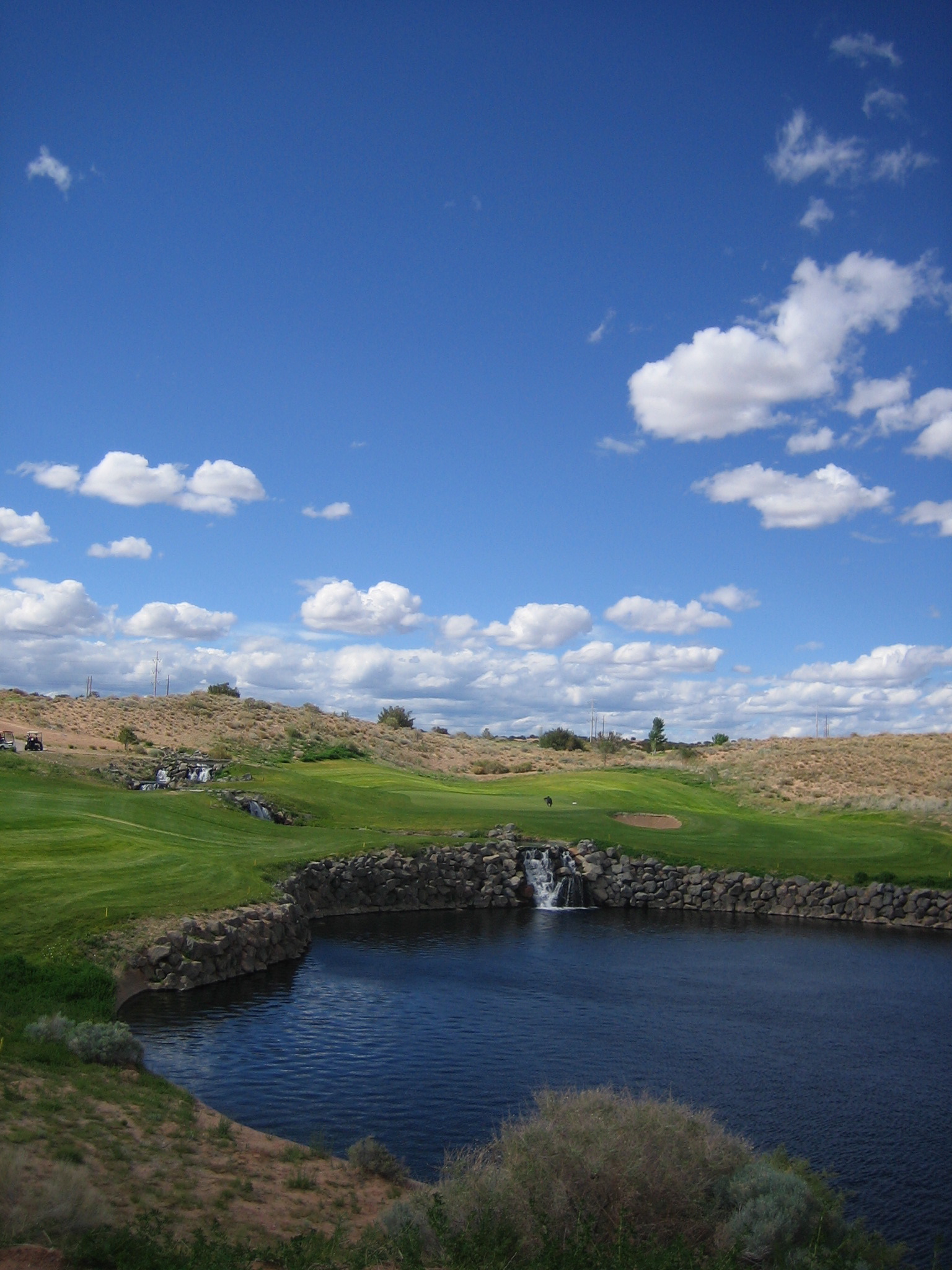
Yes folks, that’s the real hole. This is not a painting, and I have no idea how to use Photoshop. The views on this course are just that good. This photo was taken from the back tee which measures 197 yards. The hole plays directly into the prevailing wind and certainly typifies the “heroic” school of golf course design. I hit a very flush three iron and landed about 20 feet passed the middle right hole location (as per my plan). Once I got on the green, I realized that I had essentially guaranteed myself a bogey with this play because I was on a shelf that dropped 2.5 feet to the hole. I ended up putting sideways to avoid rolling off the green with the direct round and two putted from roughly 15 feet coming back up the hill. Local knowledge would have helped here. By the way, you don’t want to go in the bunker on the right. It’s actually 5-6 feet below the level of the green. See below:

My favorite hole on the course was probably the Par-5 sixteenth. This hole measures a whopping 648 yards from the tips. Fortunately, there is a significant elevation change that is in the player’s favor. I hit driver about 365 yards on a string to have 280 left to the back right pin location. A 3/4 three wood short of a deep collection area short of the green left me about 65 yards in. After a slightly pulled approach, I two putted for a neat little par on this monster of a hole. I must give JK a tip of the cap here: 4 out of the 5 shots that I hit were due to clubs that JK essentially put into my bag.
I must also mention the Par-3 15th. This 244 yard monster was the only hole that I felt was a little too long even from the tips. I hit an 18* hybrid off the tee about as well as I could and was still about 10 yards shy of the green. Though it was more likely that I was just between clubs (between a hybrid and a three wood?!?), this hole just felt a little too long. The part of the green that you actually can see from the tee is quite small and pretty heavily contoured. Also, it is exceedingly punitive if you go over the back of the green (you’re basically over a cliff). One cool thing about this hole, though, is that it is constructed right next to an extinct volcano.
All in all, this track was fantastic. If you get a chance, I highly recommend playing Twin Warriors. Don’t be discouraged by the length either! This course will help you out along the way if you can keep it between the ditches.
Greens: 9/10 (hey, they’re not Augusta)
Fairways: 7/10
Other course maintenance: 7/10
Value: 10/10
Pace of Play: 9/10
Pro shop/clubhouse: 8/10
Overall: 8.5/10
The Verdict: Fantastic casino course. Break out the 100’s boys, we got a track worth gamblin’ on.

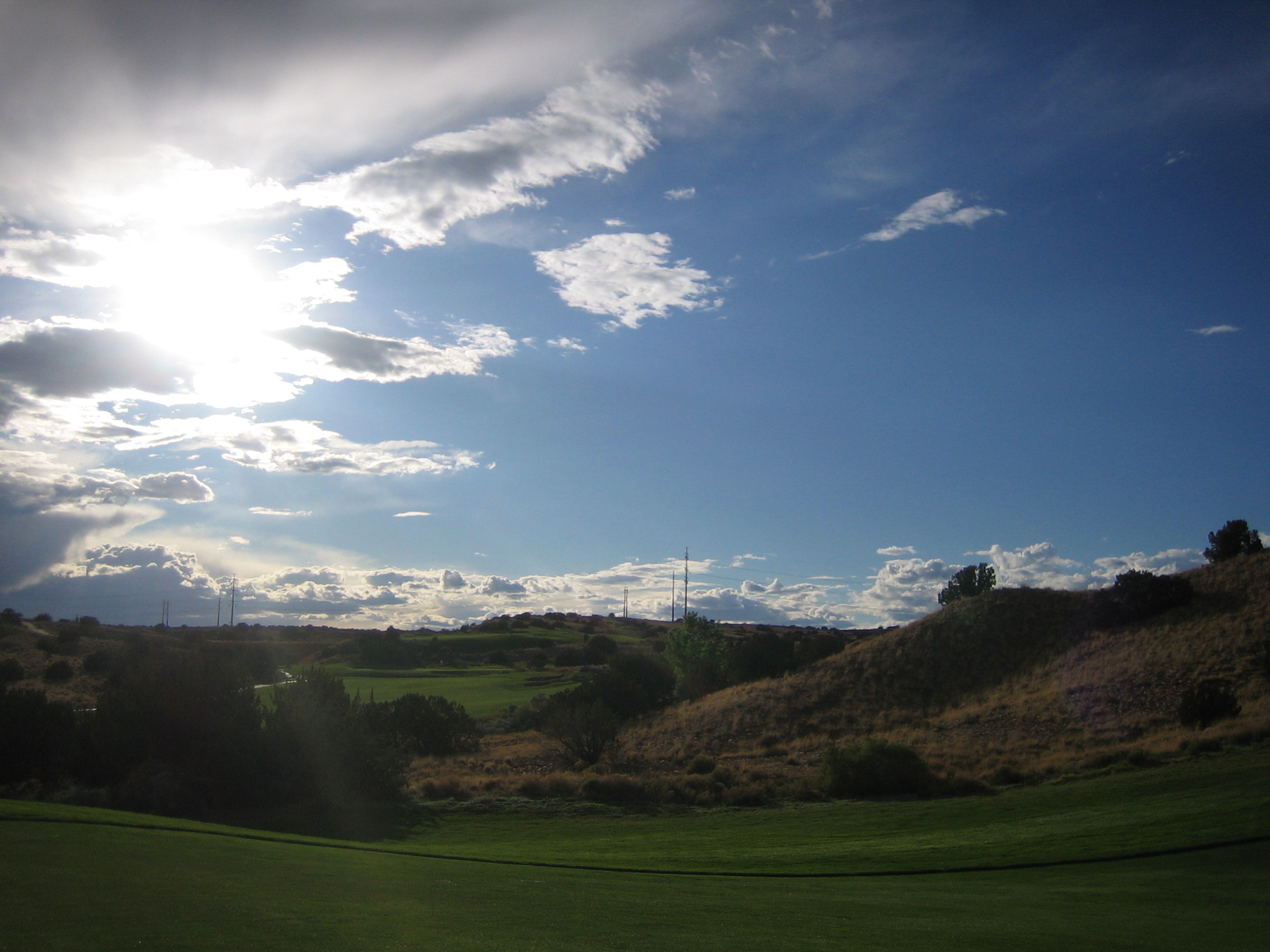
This was one other ridiculously cool picture I had to include. One awesome thing about the desert was watching it rain without the rain actually hitting the ground! During my round, however, I was blitzed by a freak rain shower on the 13th green. I was so happy to be out there though, I made my longest putt of the day (17 feet) while it was raining on me sideways!
Fail of the Week 3
May 26, 2011
Sometimes, it doesn’t matter how good you are; you fail. So, with great rumination, this week’s FAIL goes to LG.
LG, our PF readers have to ask: where are you? Of the last 11 posts, only 2 were authored by LG: FAIL 1, authored 4/30/2011, and Tip of the Cap (in honor of Seve Ballesteros), authored 5/7/2011. Now (5/26/2011, btw), I could be understanding and not crucify our comrade for burning the midnight (and early morning) oil in patent litigation, but….seriously dude. Our readers love your work–your course review on Pebble Beach is our highest rated post. The PF needs you. I can show them how to sand down a putter, but, seriously, how many of them are actually going to do that?
So, to you, LG, I salute you with FAIL 3.
Maybe this way I can get you to contribute with a response….or something
Play of the Week 15
May 24, 2011
This week’s play of the week goes to the great David Toms.
After 5 years of virtual anonymity, David Toms gathered a win on the PGA tour. The 44-year-old Toms won the 2001 PGA Championship (at Atlanta Athletic Club), but has been a non-factor for years. Last week, we gave a mention to Toms in POTW 14, where he played brilliantly but ultimately lost the Players Championship with a poor decision on the 70th hole and a 3-putt in a playoff with KJ Choi. Disappointing as it could have been, Toms didn’t shy away, but came right back this week to capture another championship.
The story was in the works last week. Announcers at The Players started building it up, speaking of how David Toms had lost his love for the game of golf; the described how his son, Carter, had inspired his comeback by just wanting to spend time on the golf course with his dad. The 3-putt deflated that balloon.
But Toms proved his metal, playing beautifully at Colonial. And, just as he did in the final round of the 2001 PGA Championship, Toms holed-out for eagle in the final round, garnering a 1-shot victory. As so rarely happens in sports, Toms was redeemed, and he shared the moment with his inspiration, his son.

So here’s to you, David Toms, champion of the Crowne Plaza Invitational at Colonial. You did what so few can do–you came back from a heartbreaking disappointment to win the next week. We at the PowerFade salute your courage.
It’s just too bad you had to wear that awful jacket.

PS.
In a side note, we at the PF would also like to salute KJ Choi, the subject of last week’s POTW 14. After winning The Players Championship, Choi did what no one expected and donated $200,000 of his winnings to aid in tornado relief in response to the devastating tornadoes in the southeast US. “While winning the Players Championship was a defining point in my life, there were those who were going through their low point,” Choi stated. “I want the victims of the tornadoes to know that their misfortunes will not be ignored.” A classy move from one of the class acts of the PGA Tour. Here’s to you, KJ.
Play of the Week 14
May 16, 2011
This week’s POTW goes twofold, in that we recognize not only the player, but also the venue.
First, hats off to KJ Choi, champion of The Players Championship. KJ played solidly as ever, never wavering even when under extreme pressure of the field chasing him and trying to keep up with weeklong leader, David Toms. At -12, the leaders approached the tee of what is perhaps the most famous–and the most treacherous–par 3 in golf. With it all on the line, KJ Choi, cool as ice, struck a perfect ball to the island green within 12 feet, then sank the putt to go to -13, eventually winning the tournament.

I’ve always liked KJ. He’s a consistent player that doesn’t get caught up in the emotions of the moment. Although his stroke isn’t anything to emulate, he gets the job done year after year. At 40 years old, KJ showed the young guys how to do it. Here’s to you, KJ.

However, I have to give a nod, as well, to the tournament itself. The Players Championship this year gave us what golf has been missing for awhile: a true chase for a championship. Striking to me was the number of experienced golfers who were at the top of the field–Toms, Choi, Stricker, Goydos, and DLIII all had a legitimate shot of contending. Moreover, at the end of Saturday, there were 12 players within 2 shots of the leader (Toms). Perhaps its the course setup–with water on 14 of 18 holes–that prevents the younger “bomb and gouge” type players from overpowering the course. Perhaps its the severely undulating greens where the older players have better feel. Perhaps its the true risk/reward nature of the course, with so many pins hanging over water, where stronger iron players can gain an advantage over long hitters. Whatever the cause, the tightened field inherently leads to drama, and this year was no exception.
Moreover, what we saw–for the first time since Tiger and Phil went at it at Doral a few years back–was a true duel to the finish. Toms, leading by 1, decided to try to put the dagger on 16, coming out of a hybrid and leaving it well-short, leading to bogey and a tie with Choi going to 17. Choi responded with the aforementioned man-up shot of the year that eventually earned him the crystal. With the tournament on the line, Toms, one-down to Choi, stood on the 18th tee (which I have always contended is a more difficult hole than 17 and perhaps the best finishing hole in all of golf) pondering what he had to do. Lesser men would fold to this pressure. Toms striped the drive of his life down the middle. His shot was not rewarded: his ball found a sand-filled divot. Again, lesser men would fold, but Toms placed his approach to 15 feet. Then, with the tournament on the line, he rolled a beautiful 15-footer for birdie on the last to pull even with Choi. It was just the fourth birdie of the day at 18. Choi, faced with his own pressure, rolled a tricky 5-footer for to save par and force the playoff.
Although Toms 3-putted from 15 feet on the playoff, the drama of the event was the best we’ve seen this year. Players on all ends of the course had a chance to win. By Sunday, no one even acknowledged that Tiger Woods, the marquee player at any event, had pulled out of the first 9 holes on Thursday and was absent from the tournament. It’s hard to envision a tournament that is so exciting of itself that everyone forgets about Tiger; this was the one.
At the end of the Sunday, Choi walked away with the crystal, but the true champion was The Players Championship. Once again, here’s to you KJ Choi. But also, here’s to The Players Championship, and to Sawgrass and Pete Dye for a course that can host this type of event. We’ve been waiting for this for awhile. Thanks for providing it.
Tip of the Cap
May 7, 2011
Today, the Power Fade mourns the loss of one of the greatest short game artists of all time, Seve Ballesteros. Seve, you could do more with a 3-iron than any of us could hope to do with a sand wedge. You were one of the greats. You did more to bring European golf to the prominence it enjoys today than any modern player. You, sir, were a great champion.

“El Momento” – Seve wins the 1984 Open Championship at St. Andrews.
For more details:


 The Power Fade Golf Blog
