Book Review: The Downhill Lie
October 28, 2010
Though I generally do enough reading on a daily basis to never want to read anything “for pleasure,” Carl Hiaasen’s The Downhill Lie caught my eye. Before I begin raving about the wonderful writing, (actually) laugh-out-loud jokes, and truly touching story that Hiaasen has composed, I should provide a disclaimer: Hiaasen attended Emory University which is also my alma mater. I have no shame in admitting that this fact is the reason I purchased this book from the $5 shelf at borders. That fact aside, I would recommend this book to anyone who is interested in feeling better about their own golf game.
Hiaasen describes his return to golf after a 32-year long break. His entry to golf, like many, was due to his father. He entered the game as a boy and never really took to it. Like many children, he found the game difficult and frustrating. After his father passed, however, he felt as though this might be a way for him to reconnect with him through the game he loved. With dry wit and imagery I have yet to find in another golf book, he describes his triumphs, travails, obsessions, and follies that nearly every person demented enough to play this game experiences. Ultimately, Hiaasen concludes his journey by realizing that passing the game on to his own son is truly his “contribution” to golf. If you have time, I highly recommend reading The Downhill Lie.
From the book flap: “Hiaasen’s chronicle of his shaky return to this bedeviling pastime and the ensuing demolition of his self-esteem – culminating with the savage 45-hole tournament – will have you rolling with laughter. Yet the bittersweet memories of playing with his own father and the glow he feels when watching his own young son belt the ball down the fairway will also touch your heart. Forget Tiger, Phil and Ernie. If you want to understand the true lure of golf, turn to Carl Hiaasen, who has written an extraordinary book for the ordinary hacker.”

Buy the book here
Review: Lake Chabot
October 26, 2010
Expectation has a lot to do with perception. How often have you expected something great–either because you heard great things or because you were just excited about it–only to be let down by the experience? The nice thing, though, is that the expectation dichotomy applies just as equally to under-estimated experiences.
With that in mind, one of the most overperforming golf courses I’ve ever played is a dinky little public course called Lake Chabot (in Oakland/Berkeley, CA). I got out there on a Saturday. The first thing I noticed is that the driveway actually runs through the course (the front 9). When you’re playing, you have to make sure no cars are coming–and, when you’re driving in, you have to stop between each hole to make sure no golf balls are flying into your window! Kind of wierd.
The second thing I noticed was how hilly it was. I knew this was going to be a walk.
Other than that, I didn’t expect much. I randomely paired up with some people, paid $25, grabbed my bag, and started out. At $25, the main reason I went to the course was the price. Nowhere else in the entire bay is a green fee so inexpensive.
The course had a lot of short par 4s, which I found to be a lot of fun (trying to hit in 1). At around 68.5, it’s not Read the rest of this entry »
The First Tee – A Mental Process
October 24, 2010
The following is a posting string found at http://www.golfwrx.com/forums/topic/418293-thoughts-for-the-first-tee. This is one approach that you can take, and, ultimately, you have to find a mental game that works for you, but, hopefully the interaction will give you a good start on finding a thought process for your golf round
——————————————————————————————–
Original Post:
Whilst the Mrs was shopping today I popped into a bookshop for a coffee and flicked through a copy of ‘Zen Golf’ by Dr Joe Parent.
The following passage caught my eye, I’m going from memory here so it’s not word for word but I hope the message is clear.
I thought it was good.
Congratulations on your perfect swing.
Sure, with practice and learning you might improve it, but for today’s round it’s the only swing you’ve got and if you allow it, it will get you round in the lowest possible number of shots.
Picture the scene, you hit a poor shot, so after thinking about your swing you come up with a ‘fix’, you hit a couple of decent shots and then another bad one, you come up with another ‘fix’, so you’ve a ‘fix’ sat on a ‘fix’. So on and so forth until you end up with a ‘fix’ on a ‘fix’ on a ‘fix’ on a ‘fix’ and you’ve completely forgotten how to ‘swing’ the golf club.
You get to the 16th tee so fed up you forget everything and just swing the club, you play your best golf for the remaining holes and think “if only I could start all over again playing like that!”
So, what if, after that first poor shot instead of thinking ‘what was wrong with my swing?’ you think ‘what in my mind prevented me from making my perfect swing’ and fix your head not your swing.
——————————————————————————————–
Response:
Not a bad thought. For me, it’s a slight variation. I work on my swing in practice. I spend time trying to get it as good as it can be. I know it has flaws, but knowing those flaws helps me play better golf. Instead of fighting them, I embrace them. I know when I should back off a shot because, if I make my usual miss, it’s a lost ball. I know when I should go for a shot because my usual miss will be OK. I don’t fight myself when playing golf–there’s enough other things out there to fight against.
More importantly, the first tee has to be a positive thing. If I know where my swing faults are, I can walk up to the first tee and “see the shot” that I’m going to hit. I know what a good one would be, I know what a bad one would be, and I see the good one. Even if I miss a little bit, I’m still OK. I don’t go for too much, and I don’t play it too safe.
Thinking about my game this way has helped me tremendously. I used to go out on the golf course and assume that if I didn’t hit every shot dead at the pin or straight down the fairway, I was terrible at golf. Now, I accept my flaws and use them to my advantage, helping me form a strategy that works for me. It helps me score better, and it makes the game more fun, because I’m not hating myself during the round.
I hope that helps someone out there. BTW, in the past two years I’ve gone from 4.5 hdcp to 1.1.
POW!
October 23, 2010
Hands down, the cheesiest, most BS attempt to scam golfers…..ever…..
http://www.youtube.com/watch?v=lg0ef3VN3DA
What crap. But, it cracks me up every time. Almost like the ShakeWeight. Enjoy, PF readers!
Play of the Week 3
October 22, 2010
This week’s POTW focuses on a guy you’ve probably never heard of: Robert Garrigus. From his name, you would suspect he’s an Irish blacksmith rather than a golfer. And, with the strength of the great Garrigus blacksmiths, Robert currently ranks #1 on the PGA Tour in driving distance–that’s right, it’s not Bubba, not DJ, not JB or Boo; it’s Garrigus.
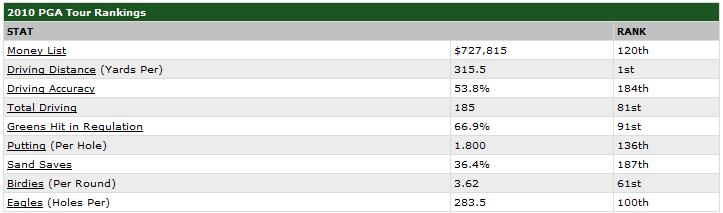
(taken from Garrigus’s ESPN profile, http://sports.espn.go.com/golf/players/profile?playerId=1254)
Garrigus (along with 4 others) shot 7-under-par 64 at the Justin Timberlake Shriners Hospitals for Children Open. So why is Garrigus the spotlight of this weeks POTW? Well, earlier this year, Garrigus suffered what is perhaps the most epic collapse in PGA Tour history. Greg Norman’s Masters collapse in 1996 covered the entire 18 holes of the final round, and it was due largely to Nick Faldo’s incredible 67 on the final 18. (see http://www.usatoday.com/sports/golf/mastshrk.htm) Van de Velde’s loss at the British Open was a 2-shot lead on the 18th hole. While it did occur in a major, with Van de Velde standing on the 18th tee at Carnoustie, it was foreseeable that he could make a 6 on that golf hole.
But Garrigus tops these all, in my humble opinion. Garrigus carried a 3-shot lead into the final hole of the St. Jude Classic. I watched in epic horror as Garrigus quickly and painfully dissected his lead. See the clips below.
One shot blocked far left into the water off the tee. Drop. A terrible attempt at a hero shot, luckily hits a tree and doesn’t go in the water. Chip out from there. Onto the green. 2 putts. Unbelievable. I couldn’t believe what I was seeing. Here was a guy who had never won on Tour; he had played beautifully all week; at the last moment, it was spoiled.
But he had a playoff. He could still win. Then, as a sign of his inevitable doom, Garrigus ripped a 300+ yard 3-wood, the ball landing directly behind a tree. He had no shot to the green. He chipped out, played up to the green, and then, from 25 feet, barely missed the putt, rolling over the edge.
Now, don’t get me wrong; there are a lot of reasons not to like Garrigus: his unbelievably Irish grill to match his name (although he is American, oddly enough), his bobby-stick of a putter (28″ long–about the size of a big Mag-Lite), or, just plain envy of his unbelievable ability to kill the golf ball. But you couldn’t help but hurt for the guy, seeing this go down; his one chance to win, to be guaranteed a spot at the Masters (from ranking/money list); it was all gone. Sure, he made a good paycheck–but he lost over $500,000 by making a 7 on the last hole.
Since the PF’s encouragement last week led Rocco to victory (see POTW 2 and 2.5), Robert, we’re pulling for ya! Even though it’s not a regular Tour event, I hope you can avenge some of the demons that rose on the 72nd hole of the St. Jude.
Keep bombing ’em!

————————————————————————————————————
Comments from LG: See “Conversation: POTW 3 – Garrigus vs. Van de Velde” above
Shout Out to A Funny Post
October 21, 2010
This is a shout out from the Power Fade to one of the best posts I’ve seen on a forum.
http://www.golfwrx.com/forums/topic/212955-i-have-to-come-clean-to-the-golfwrx-community/
Just goes to show you, it doesn’t matter the name on the club, as long as you get the job done.
Titleist Ball Review
October 19, 2010
Earlier in the month, I received an email from Titleist informing me that I was going to be a part of a “Test Ball” panel to evaluate a prototype golf ball. In all likelihood, the ball sent to me was the 2011 version of the Pro-V1, as its cover and general playability resembled the 2010 version. In the email, Titleist asked players to evaluate certain aspects of the ball:
As part of this test panel, we are looking to get your feedback on all shot types so it is best to use these golf balls during a normal round of golf, rather than at a practice facility. Consider your entire game tee-to-green when conducting your on-course testing with the Titleist prototype golf ball and the golf ball you currently play most often.
We also suggest that you conduct your evaluation on a familiar golf course. Knowing the golf course helps you assess if you have successfully executed the shot, and makes it easier to identify your preference when you know what clubs you generally hit into greens, how quickly the ball usually stops, etc.
Since you will likely want to hit one or two extra shots each hole, we encourage you to conduct your evaluation when your golf course has limited play. If that is not an option, we recommend playing 9-holes with the Titleist prototype golf ball and 9-holes with your current golf ball to evaluate and compare preference.
In addition, here are some questions to keep in mind while you are playing:
– How did each golf ball perform around the green (on approach shots from 100 yards, partial swing shots, pitches and chips)? Which golf ball did you prefer?
– Which golf ball spins more on shots into the green? Do you have a preference?
– How did each golf ball perform on full-swing approach shots from 150 yards and out?
– Which golf ball is longer with irons? If one is longer, how many yards?
– Which golf ball is longer off the tee? If one is longer, how many yards?
– How does each golf ball feel? Do you have a preference?
– Based upon the overall performance of the two golf balls, which one do you prefer?
When you finish product testing, please visit the link below to provide your feedback via a short survey. To access this site, you will need to input your Team Titleist username and password.Our goal is to have all surveys completed within two weeks of the on-course evaluations and we appreciate your effort in helping us reach that goal. We will send you a follow-up email in a few weeks as a reminder to complete the survey.

As stated, the test ball was most likely a 2011 version of the Pro-V1. I usually play a Pro-V1x, and, as such, that is my basis of comparison for this review.
On initial inspection, the cover felt “springier,” almost as if it were softer. However, I learned by playing the ball (by landing one on the cart path) that its resistence to cutting was comparable or even superior to the Pro-V1x, especially considering the softness of the cover. The soft cover also contributed to a more muted sound off of each club, driver down to putter, for all shots. In some cases, this was preferable. In others, not.
Play of the Week 2.5
October 18, 2010
While this is supposed to be a weekly post, extraordinary circumstances call for extraordinary responses.
4 Eagles (one hole-in-one and three fairway hole outs) resulted in a win for Rocco Mediate today at the Frys.com Open at CoredeValle. If you didn’t get a chance to watch any of the action, you missed out on some of the most thrilling golf that was played this year. Watch those highlights!
From us at the Power Fade, Congratulations, Rocco! We can’t think of someone that deserves this win more.

Replacing a Shaft: How I Do Club Repair (and you can too!)
October 17, 2010
For the masses, golf club repair is black hole. How the club manages to stay together is mystery of modern science, best left to the professionals at the pro shop. Unfortunately, those professionals are in the business of club repair to make money off of this mentality, and the fees for simple tasks (changing a grip) are too much for the average golfer to experiment with different types of equipment.
For me, clubmaking and club customization was always something I wanted to understand, because I knew it would be helpful to avoid these fees if I were to find the equipment combination that worked best for me. Simple club repairs–like replacing grips, spikes, broken shafts, etc.–can save a great deal of money on golf equipment. Moreover, if you’re the kind of person that likes to try different things, understanding how to change equipment components by yourself can be the difference between trying a few things versus staying with equipment you really don’t like because it would be too expensive to change.
Today, I will change the shaft of a club I purchased on ebay. The club is a Sonartec NP-99 fairway wood. The model is a few years old, but I bought it for $8.50 on ebay, and it was exactly the head I wanted. The stock shaft (although a very nice Aldila NV) was not what I wanted, so I needed to change it out. I purchased a used Grafalloy ProLaunch Red on ebay for $10 and decided to switch out the shafts. Here’s is the procedure. (For a list of materials, skip down to the end of the post).
Play of the Week 2
October 16, 2010
For those nuts like LG and me who are still following the game well into the off-season, this week’s POTW doesn’t come as a surprise. Although it could just as easily be a post from the 2008 US Open season, once again, I cannot help but state the obvious: Rocco Mediate amazes me.
One of the true “good guys” in the game, Rocco seems to have an amazing sense of humor and touch of class to everything he does. Like Matt Kuchar or the John Daly of old, it’s hard to root against a guy who seems so much the underdog on such a grand scale.
To look at Rocco, you get the sense that he’s a tax attorney trying to tell you about his grandchildren. He doesn’t look like a professional athlete, and certainly not like a man who dominated the field and almost got by Tiger Woods at golf’s ultimate challenge two years ago. Although we here at the PF have always been fans of the greatness of Tiger Woods (even in spite of his golf game), the first time I honestly rooted against Tiger Woods came at the 08 US Open. Although it seemed that Tiger was destined to win, Rocco had him against the ropes so many times and just came up a little short.
After such a close call and such a heartbreaking loss–perhaps the best chance to win a major that Rocco will ever get–what did he have to say? “Tiger is unreal. I would have loved to have won, but it was a great day. They wanted a show and they got one.”
But it didn’t stop at that. He could’ve gone the way of Van de Velde, never to be heard from again. But Rocco decided it was just as well for him to point out that he wasn’t Tiger Woods, and that Tiger Woods was something special. In a series of advertisements, it was clear–Rocco just wasn’t Tiger.
After coming so close, Rocco could sit back and easily say “I didn’t win, but that was the best day of my life,” living to smile about it and remember it fondly. This level of class so often eludes the world today.
So, after seeing the leaderboard at the Fry’s.com Open today, a tingle of happiness filled my heart to know that Rocco still has game. At -13, Rocco leads the field of some of the world’s best by 3 shots with two rounds to play. Although golf leads are never truly safe, I can honestly say I hope to see him pull away even more.
But best of all is the way Rocco made it to such a commanding lead. On Thursday, Rocco made eagle with a hole-in-one on the par 3 third hole. On Friday, he followed it up with an eagle with a 160-yard 7-iron on the par 4, 426-yard 6th hole. But his enormous class showed afterward: “That was my record by miles, 34 holes without a bogey. I was so disappointed, but how could I be that angry? I wanted to go at least 36 holes.” And even better, Rocco gave credit to Lee Trevino for a putting lesson Trevino game him in May. “It was priceless [the lesson]. I didn’t want to leave.”

So here’s to you Rocco. Two eagles in two days is amazing. Your outstanding class is something far beyond that. Although you may never have won the US Open, you are a true champion.


 The Power Fade Golf Blog