Conversation: Masters Predictions (with answers)
April 11, 2011
Correct answers provided in block quote below:
Winner: Charl Schwartzel (JK & LG both said Tiger Woods, finished T4)
Winning Score: -14 (JK said -7, LG said -4)
Runner Up: Jason Day and Adam Scott (JK said Nick Watney, +4, LG said Steve Stricker, -5 (T11))
Low Amateur: Matsuyama (JK & LG said Uileihn)
“Unknown” in the Top 10: (JK said Charl Schwartzel–obviously right; LG said Anthony Kim, MC)
Most difficult hole vs. par: 11 (JK said 11, LG said 12)
Easiest hole vs. par: (JK & LG said 15–no confirmation yet)
Last Year’s Winner (Phil Mickelson): made the cut, but outside of the Top 10 (JK said Make the cut but outside of Top 10, LG said Top 10).
Sandy Lyle: missed the cut (JK & LG said this)
How many prior winners were in the Top 10: 2 (Woods & Cabrera) (JK said 3, LG said 4)
Was there a hole-in-one: I don’t think so (JK & LG said yes)
…Which hole: if there wasn’t one, then there wouldn’t be a hole.
Did Phil switch back to one driver: Yes, before the tourney started (JK said No, LG said probably not)
Which putter did Tiger use: Method (JK said Scotty Cameron, LG said start with Method then switch to Cameron)
All-in-all, not too bad.
———————————————————————————-
4/7/2011
OK LG, I thought it would be fun to put in writing our predictions for the Masters Tournament. I await your guesses (which will probably be as bad as mine).
JK:
Winner: Tiger Woods
Winning Score: -7
Runner Up: Nick Watney
Low Amateur: Peter Uihlein
“Unknown” in the Top 10: Charl Schwartzel
Most difficult hole vs. par: 11
Easiest hole vs. par: 15
Last Year’s Winner (Phil Mickelson) Will … (Win, Top10, Make the Cut, or Miss the Cut): make the cut, but be outside of the Top 10.
Sandy Lyle Will…(Win, Top10, Make the Cut, or Miss the Cut): miss the cut
How many prior winners will be in the Top 10: 3
Will there be a hole in one: yes
…Which hole: 16
Will Phil switch back to one driver: No, Callaway pays him way too much.
Which putter with Tiger use: Custom Newport 2 that won most of his majors
I’ll bet my guesses are at least 4 times better than yours. (whatever better means)
LG:
Winner: TW
Winning Score: -4
Runner Up: Steve Stricker
Low Amateur: Peter Uihlein
“Unknown” in the Top 10: Anthony Kim? (does this count?)
Most difficult hole vs. par: 12
Easiest hole vs. par: 15
Last Year’s Winner (Phil Mickelson) Will … (Win, Top10, Make the Cut, or Miss the Cut): Top 10
Sandy Lyle Will…(Win, Top10, Make the Cut, or Miss the Cut): miss the cut (sorry, Sandy)
How many prior winners will be in the Top 10: 4
Will there be a hole in one: YES!
…Which hole: 16
Will Phil switch back to one driver: Probably not, but he probably should…
Which putter will Tiger use: The Method on day 1, the Scotty for the rest of the tournament.
Play of the DAY!
April 8, 2011
Here’s a virtual high-five for my partner in crime, JK.
He’s currently tied for 1st with 5 other people in ESPN’s Masters Best Ball Challenge! Get’em JK!!
(For a frame of reference, I’m currently tied for about 20,000th at -22)

Play of the Week 10
April 6, 2011
This week’s play of the week has to go to one obvious choice. Although one of the greatest times of the year–March Madness–has passed us by, the first week of April will always be Masters week.
I’ve had the opportunity to go to the Masters twice: once on Saturday in 1997 and once on Wednesday in 2006. I can honestly say that few experiences are so memorable or incredible. A more beautiful place does not exist on this earth. And a classier event you will never find. There are too many good things to point out about the Masters and Augusta National, so please enjoy the tranquility of the course. We’re looking forward to posting about this year’s tournament.
The 13th, “Azalea”

The 16th, “Redbud”–my personal favorite

The 10th, “Camelia”

The signature 12th, “Golden Bell”

The final tee shot, 18, “Holly”

So as the field gets set to play the Par 3 tournament today, the excitement truly begins. This is going to be a great year for Augusta.
From us here at the PF, our hats are off to you, Augusta National. Thank you for making this the most exciting week in golf.
Course Review: Southland (Atlanta, GA)
April 4, 2011
I recently played Southland Golf Course in Stone Mountain/Lithonia, Georgia, and am providing this review to the readers of the PF.
At the PF, we strive to provide (when we can) a review of a course for the average Joe who just wants to get value out his Sunday round. Although a spectacular review, LG’s post about Pebble Beach (located here, if you want to check it out) is the exception for what we intend to review. As such, today’s review will not be in the clouds of playing a spectacular golf course, but rather will be giving the general reader an honest review of a course he or she might play this weekend. Without further ado, I review Southland.

A little background–I grew up not far from Southland. When I was in high school a friend landed a job there and often got me onto the course for little cost. Obviously, I’ve become familiar with the course over time and have an understanding of the layout that comes only with a sustained ability to play a course consistently.
In the 90s, Southland was a private club sustained by the neighborhood surrounding it. It opened its doors to the public around 2000 and was shortly thereafter bought by a group called “Eagle Greens.” Many in the Atlanta area will remember Eagle Greens for its buying and revitalizing of many courses in the area. The business model was to hire young, fresh-out-of-college superintendents so that the courses could pay them lower salaries and, thereby, become profitable. The business model must not have worked in the long run, because Eagle Greens is now defunct. During the height of Southland’s membership with Eagle Greens, the course was spectacular; in fantastic shape, manicured, with lots of perks and inexpensive. They had GPS on the carts (in the early and mid 2000s, when GPS was kind of chic), and the cost of a round was only in the $35-ish range (with cart on a weekend!).
However, long before Eagle Greens went away, the group sold Southland to Korean Air Lines. KAL has a habit of purchasing courses and running them into the ground. They make no attempt to maintain the courses, and they basically make profits off of the goodwill that the courses have had with players before until no one patronizes the course anymore. KAL killed the first course where I first broke 80 (Atlanta International, shooting 77). They ran Southland into the ground. I played it several years ago–2008 or 2009, probably–and was told by the pro shop that the course was in nice shape, only to find that every green had been aerated and was COVERED with sand. I vowed not to go back.
However, nostalgia go the best of me. A friend told me it was getting better, and–frankly–they had the earliest tee time this Sunday, so I decided to bite.

Because I grew up playing the (largely) wide-open public courses in the city of Atlanta, Southland is a course that bothers me. The heavily-wooded course contains a number of blind shots, dead spots, and traps (not sand, although it has those too). For my review, I tend to think that Southland over-penalizes mishits in many cases. A shot that is 10-yards offline could cost you 3 strokes trying to get out of the woods and back into play. Generally, the course is narrow, and the layout can be a little crazy. For example, the 8th hole (pictured above) is a 300+ yard straightaway hole from the white tees–pretty simple, just over water. From the blue tees, however, you actually have to hit down a hill to the area where the white tees are located and then hit from (basically right in front of) the white tees to the green, 260+ yards away. The shot from the blues to the white tees is about 180 yards. So, for me, I played a par 4 hitting 6-iron then 3-wood. That doesn’t make a lot of sense, no matter which course/hole you’re playing. This is but one example. Another would be the 11th hole, where a simply 340-yard par 4 can be a nightmare if you try to “go for it.” Playing a 3-iron off the tee is FAR better, as virtually any shot hit with the driver will be lost (for reasons that are difficult to explain). And the 15th includes a fairway bunker bounded by trees that is less than 100 yards from the green; thus, if you’re in that bunker, there is no way to get out without losing shots–unless you are incredibly skilled at hitting 70-yard cut and punched 5-irons out of bunkers. This kind of course bothers me, as my game is typically not defined by exacting precision, but is closer to a “bomb and gouge” style. If I bomb on Southland, there’s no way to gouge, unfortunately.
Such criticisms could be levied at some of the greatest courses in the world: Pine Valley, Cypress Point, Harbour Town, Bethpage, and Pinehurst could all be called “unfair” for the same or similar reasons; that’s just a gripe that my game is a square peg for the round hole that is this type of golf (I’m working on it, but the process is tedious).

However, KAL did some real damage to Southland. Although it is under new management that is trying to bring it back, it simply isn’t maintained to the level it needs to be. The greens were better than many places in Atlanta, considering many places lost their greens last year. Moreover, Southland doesn’t get much play since many of the patrons were completely turned off by KAL’s management that they wrote the course off completely (and now patronize nearby Mystery Valley, which I will review later). So those are some benefits. However, there is little or no sand in most of the bunkers. The bunker edges are not trimmed and, in fact, show signs of water erosion. There is pooling of water in fairways for no apparent reason. The course is muddy in places and baked in others. Months-old grass clippings are all over the fairways, piled in lines by rainwaters flowing down the fairways at some point. Many tee boxes are unlevel, lack grass, and have inordinate amounts of sand on them. Such maintenance issues make the course difficult and unenjoyable, as it’s nearly impossible to find a consistent lie, even in the best fairway. Also, although the pro shop has a collection of….let’s call them “vintage”….equipment for which you can haggel a deal, there is no food service in the pro shop, cart staff, beverage cart, food at the turn, etc.,etc. At $30 on a Sunday morning with a cart, it might be worth it if you were late trying to get a tee time, but if you’re able to play elsewhere, it’s probably be a better bet not to play Southland.
Greens: 8/10
Fairways: 3/10
Other course maintenance: 2/10
Cost: 7/10
Value: 5/10
Pace of Play: 9/10
Pro shop/clubhouse: 1/10
Overall: 4/10
How to Swingweight a Set
March 23, 2011
This particular article will be helpful for LG, so I decided to go ahead and build up a post about this.
I recently swingweighted my iron set–KZG ZO blades. The shafts were shorter than I was used to, so I decided I wanted them to play at a higher swingweight in order to make up the lost leverage.
First things first, get your supplies in order:
1. Two-part epoxy – depends on size, but enough for this job is $5 or so.
2. ferrules – make sure you get the right size for your irons, which can range from .335 to .370; I bought mine on ebay, and you can really spend any amount of money you want to on them. Approximately $5, we’ll say. Search on ebay for “ferrule .XXX” where .XXX is the tip diameter you need.
3. Swingweights. This part is a little more difficult, and can be expensive. A full set of swingweights isn’t a good idea. I would recommend you figure out what you need first and then go online and buy them. I got brass weights on ebay from a great seller todd1186 (he’ll combine shipping if you just ask, see http://cgi.ebay.com/6-Gram-Brass-Tip-Weights-370-Steel-Iron-1-Dozen-/250722289456?pt=LH_DefaultDomain_0&hash=item3a60368730).
4. A swingweight scale. These can be anywhere from $20 used up to hundreds. If you’d prefer not to use one, you can always take them to your local golfsmith or edwin watts store and ask them to spec it out for you. If they’re not busy, they might actually do it, especially if you’re telling them you’re considering having them swingweighted.
5. Acetone. $4 at home depot
6. A kitchen/postal scale. $4-$6 on ebay
7. Lead tape (or other weight)
Now, that’s about it for supplies–sans paper towels, newspaper, and other cheap stuff.
Once you know what your current swingweight is, you can decide what you want it to go to. Typically, you will want to increase swingweight because OEM sets are typically a little light on the scale. Typical sets will run D0 or lighter. Most pros like Read the rest of this entry »
Restoring a TeI3 Long Neck
March 16, 2011
Those who frequent the PF know how much I appreciate the ability to perform your own customization and repair work. Especially given the winter weather, I’ve spent a lot of time indoors and have had time to work on equipment (and posts about that work). Today’s post is no different.
I recently got a wild hare when I saw a post on GolfWRX about restoring a Scotty Cameron TeI3 putter (in 2 hours!). The pictures are gone, but the instructions still hold: http://www.golfwrx.com/forums/topic/444256-how-to-restore-a-scotty-tei3-in-2-hours/.
Following this advice, I got out the sandpaper (from the repainting thread, https://thepowerfade.wordpress.com/2010/11/30/repainting-a-club/) and purchased Birchwood Casey Super Blue and Alex Ultra (for elastomer). The B/C cost me about $9 (which was overprice–it should have been under $6, but it was convenient) and the elastomer cost me $4. I also purchased Sally Hansen Hard As Nails fingernail paint to do the paint fill ($2).
The instructions do an excellent job of laying out what to do, but I also got some personal attention from the OP. I purchased a TeI3 with a problem and decided to set myself to work. Here is what it originally looked like:
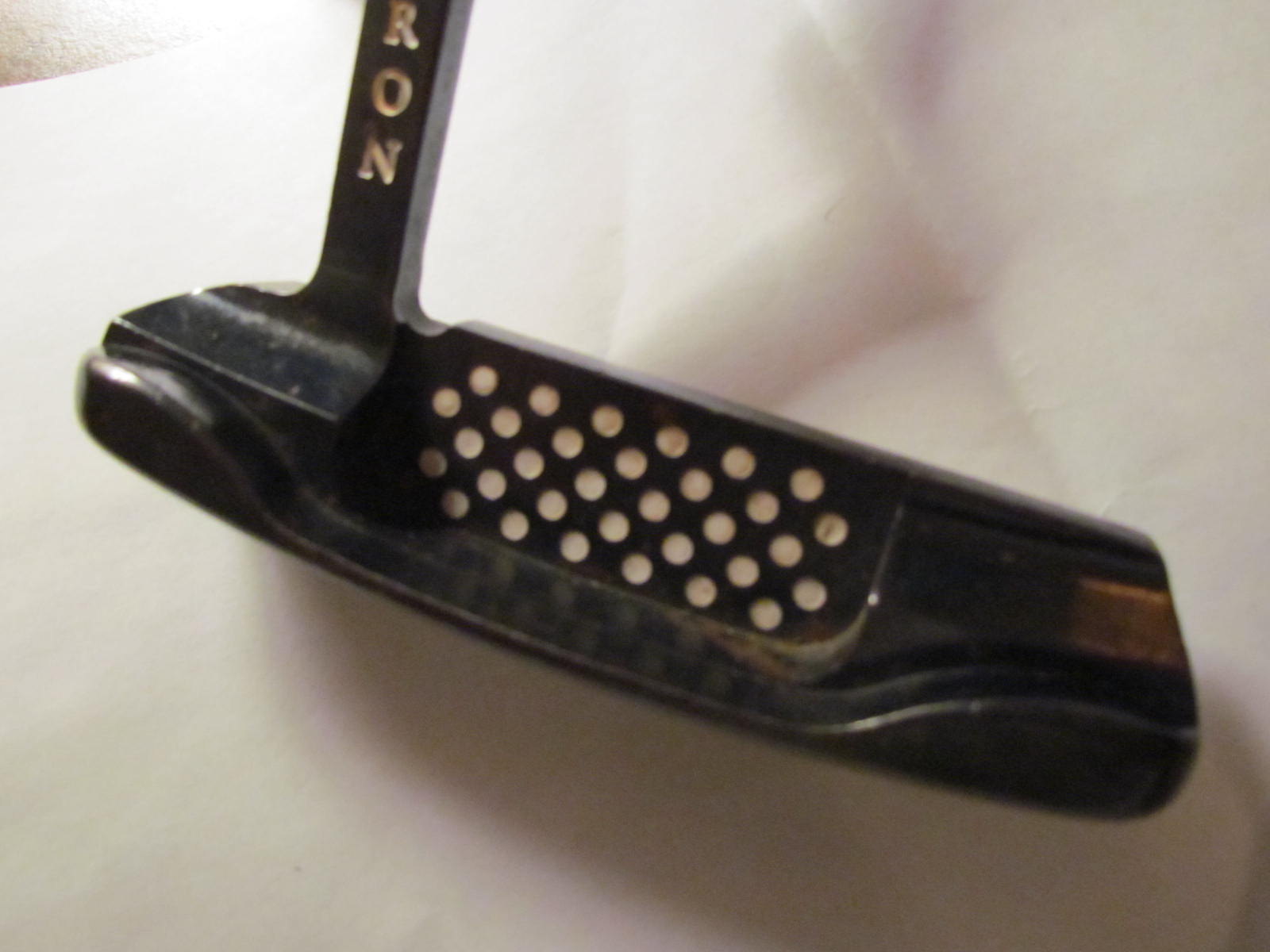
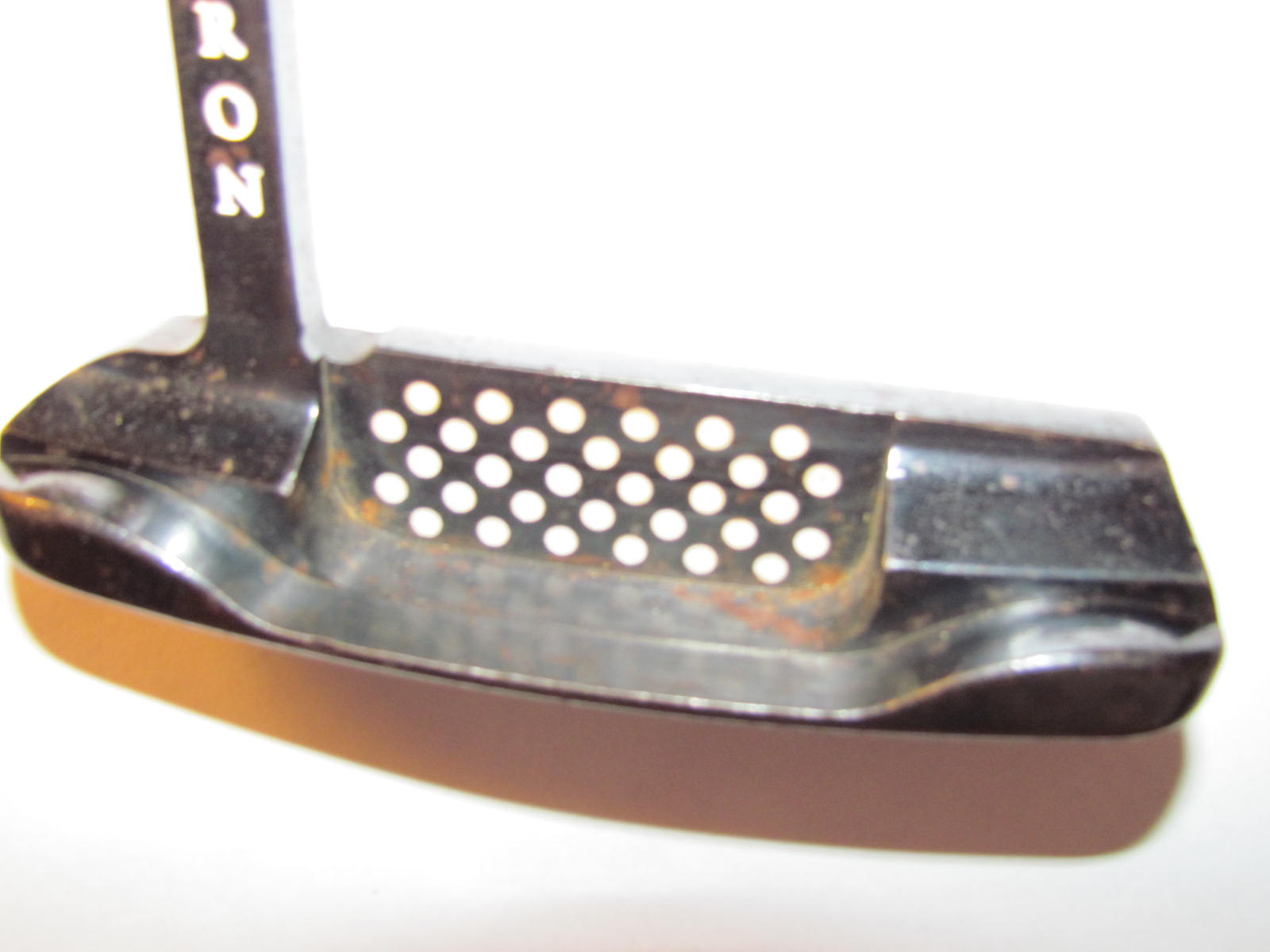


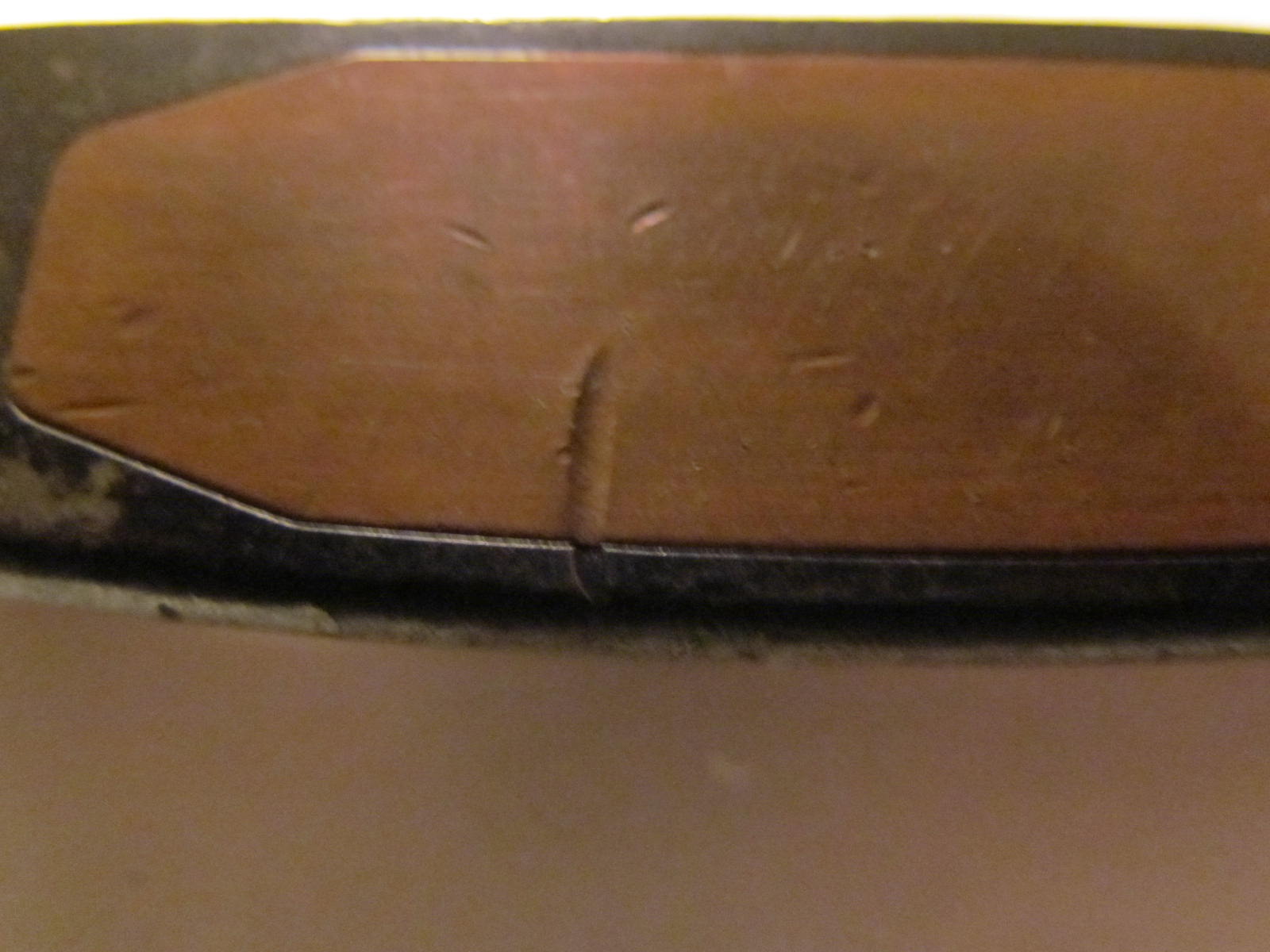
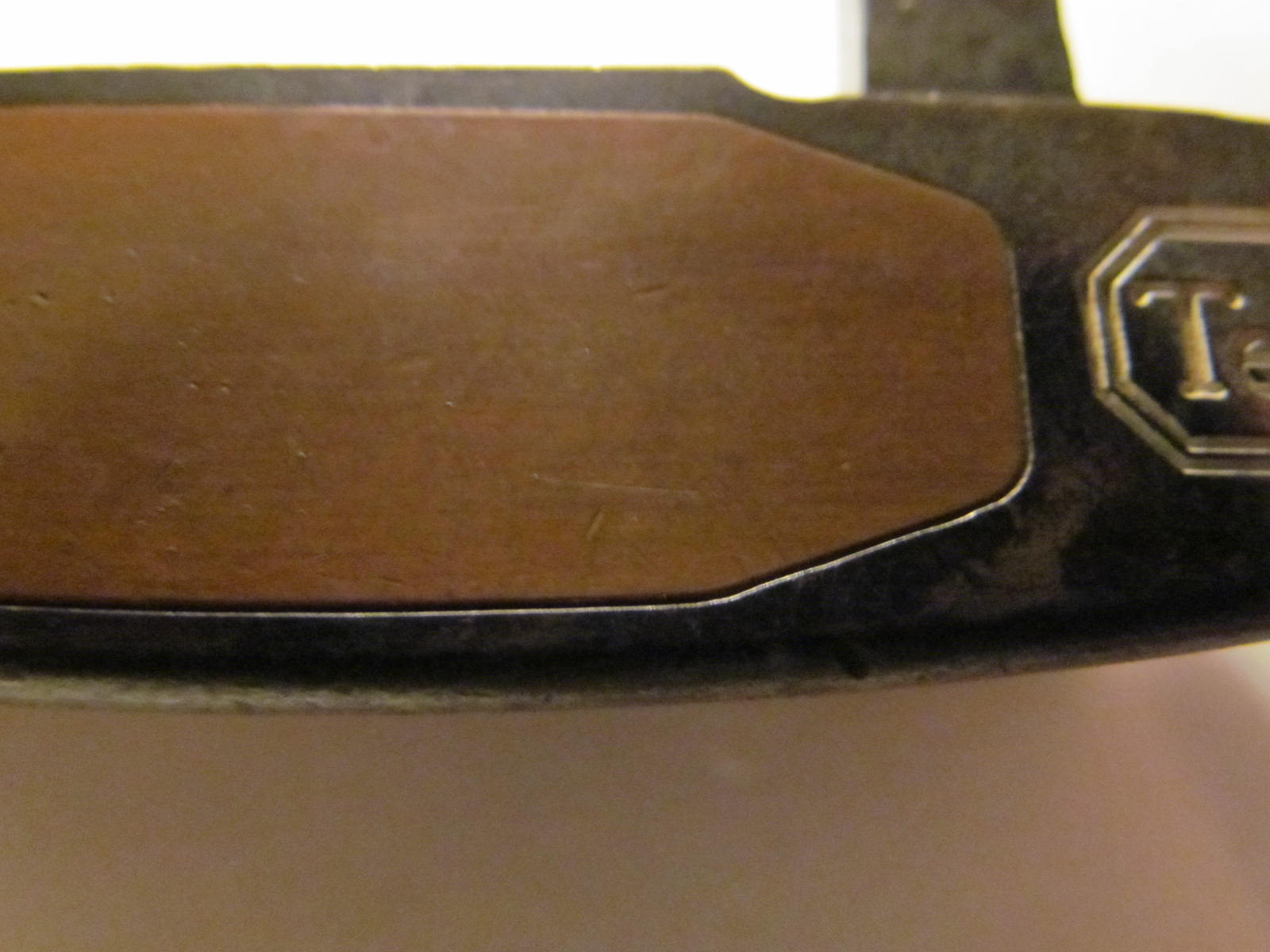

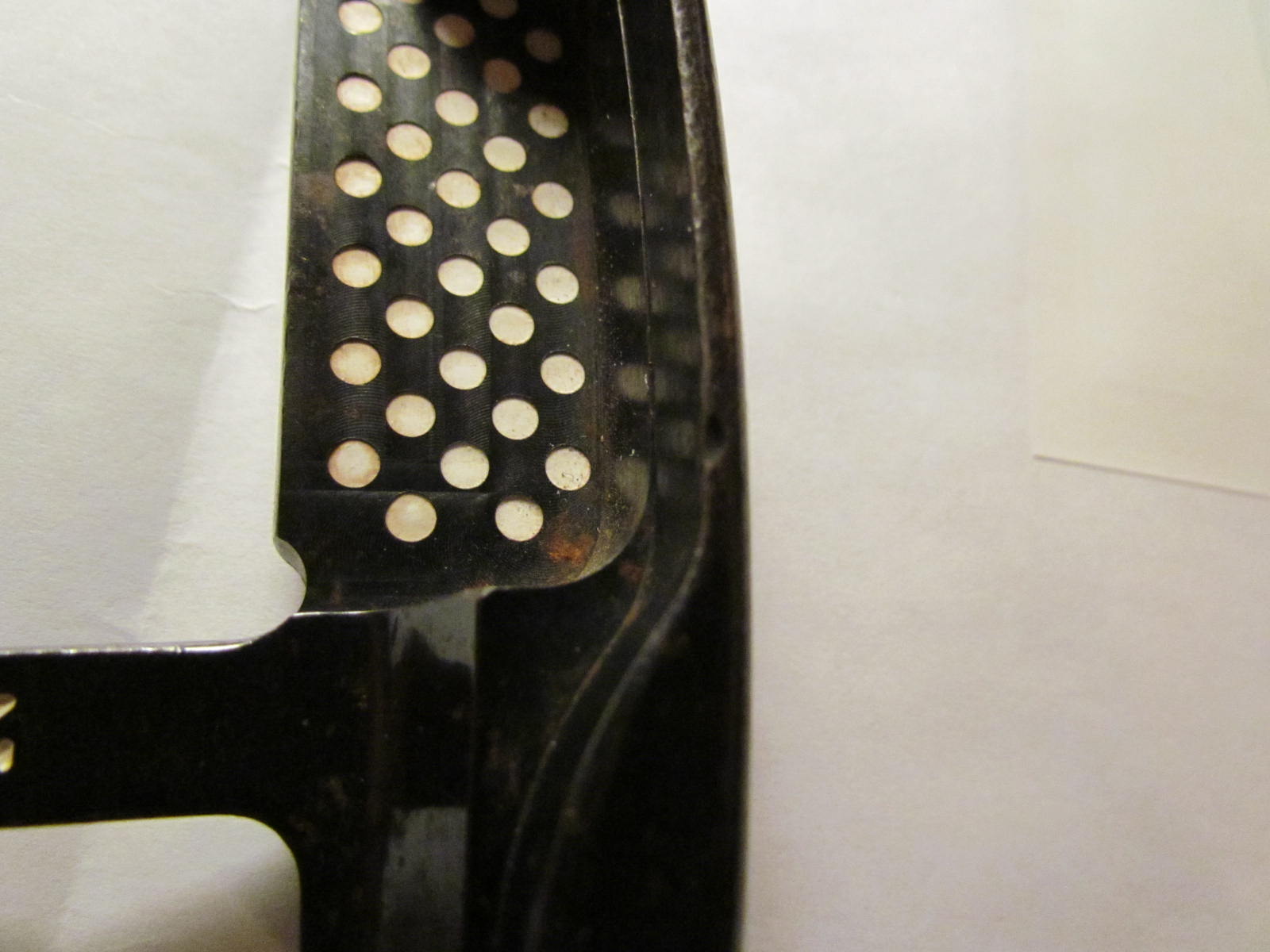

As you can see, there are rust spots and a few dings, including one on the rear flange and a pretty significant one on the face.
I started by taking a single bastard file (that’s what it’s called…really) which is basically just a flat file with only one line of “cutters.” As stated in the WRX post, I left the insert in the cavity while filing to make sure they were at least planed with respect to each other. The difficult part is getting it consistent without making big scratch marks. I found that the dings came out pretty easily, but the file itself left scratch marks that I had to massage with light pressure on the file and progressive grits of sandpaper to get smooth.
Once I had the dings out, the KEY is to make sure you POLISH IT with sandpaper–and do it EVERYWHERE. Don’t skimp. All the little crannies, all the surfaces, make sure each of them SHINE with at least 800 grit. I went up to 1000 or 1500 (cant remember which) just to be sure. It hurts. It takes forever. At this point, I was thinking “why the hell did I do this.”
Then, you blue it with B/C. In my experience, this was awful. I could never get it dark enough to make it look like either (1) original or (2) how the OP on WRX did. You have to put the gun blue on, then wait 30 seconds, wash with cold water, then smooth with steel wool, then rub with degreaser (I used Simple Green), then wash the degreaser off with cold water, then dry with a hairdryer until bone dry, and then reapply until the color is as dark as you want. However, I got to the point where I would put the blue on, work with the steel wool, and the color would come right back off with the steel wool. I finally resigned myself to the fact that it wasn’t going to get any darker and it looked OK as a light brown finish. After some more smoothing with steel wool, I cleaned it, oiled with baby oil, and degreased to make a nice clean surface. I put in the elastomer (as per the WRX post), screwed the insert in, and cleaned off. Then I applied the white “paint fill” (nail polish) and the gold paint fill (gold instead of copper because I had some gold lying around). The result is below:

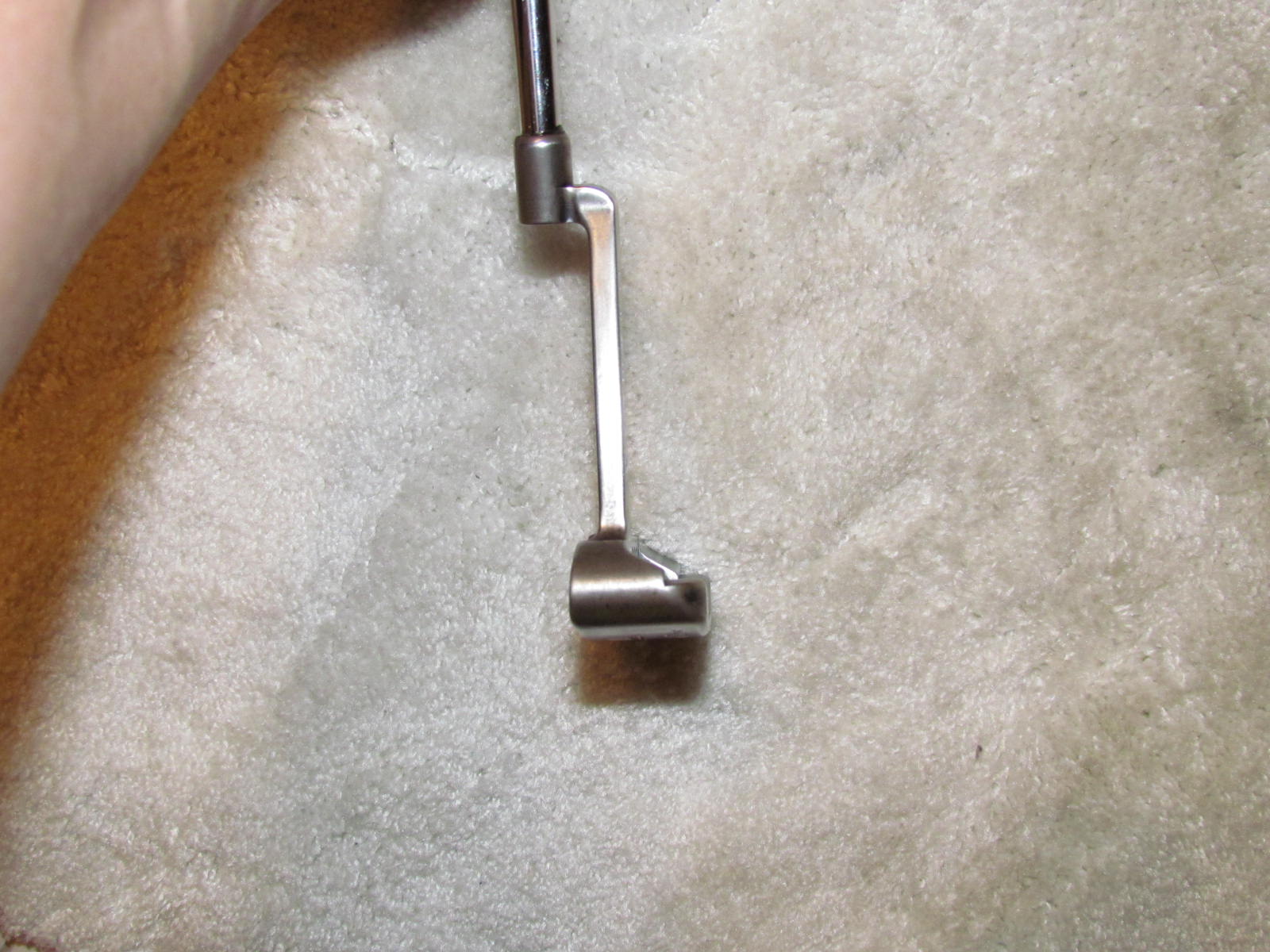

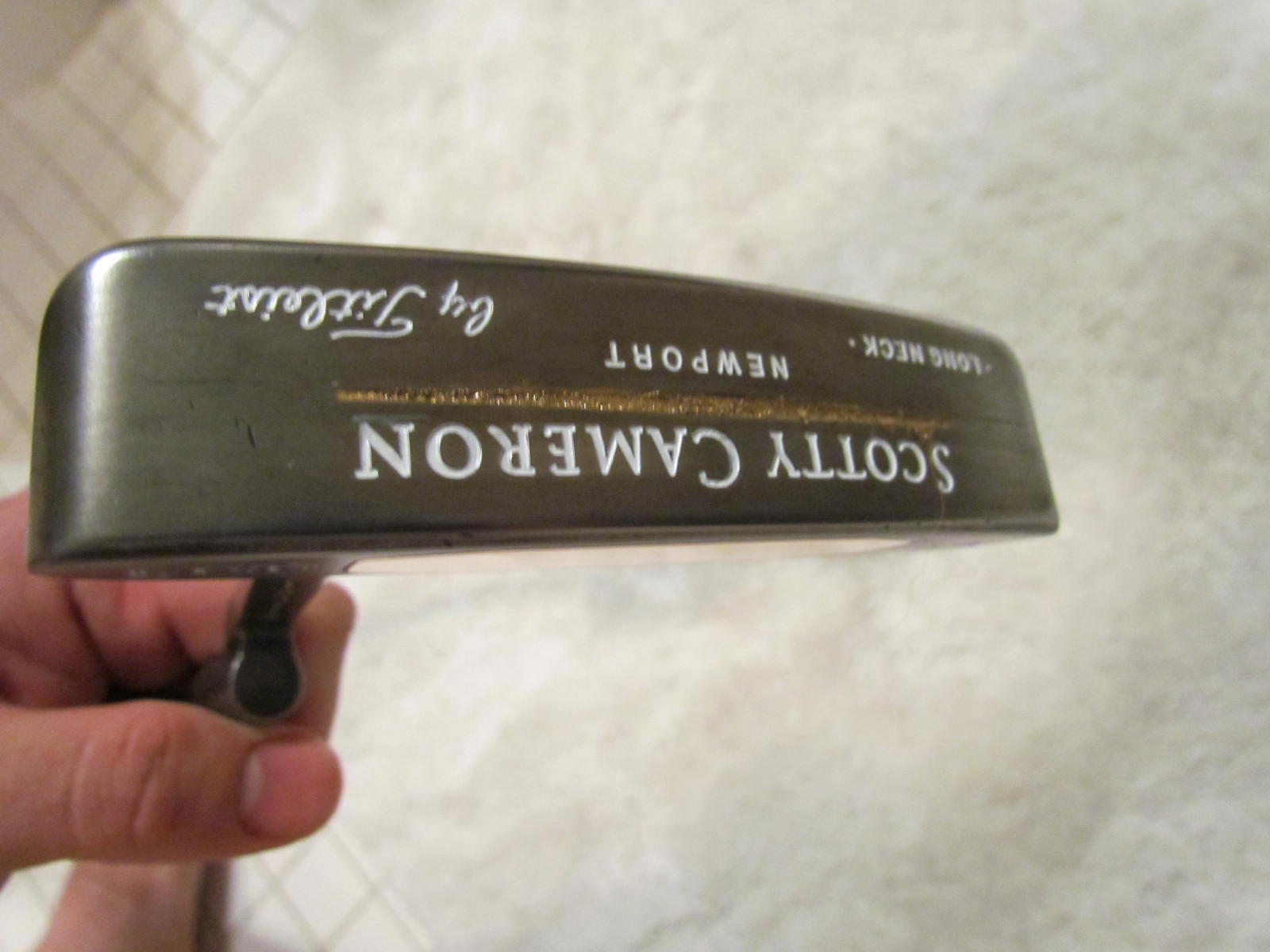
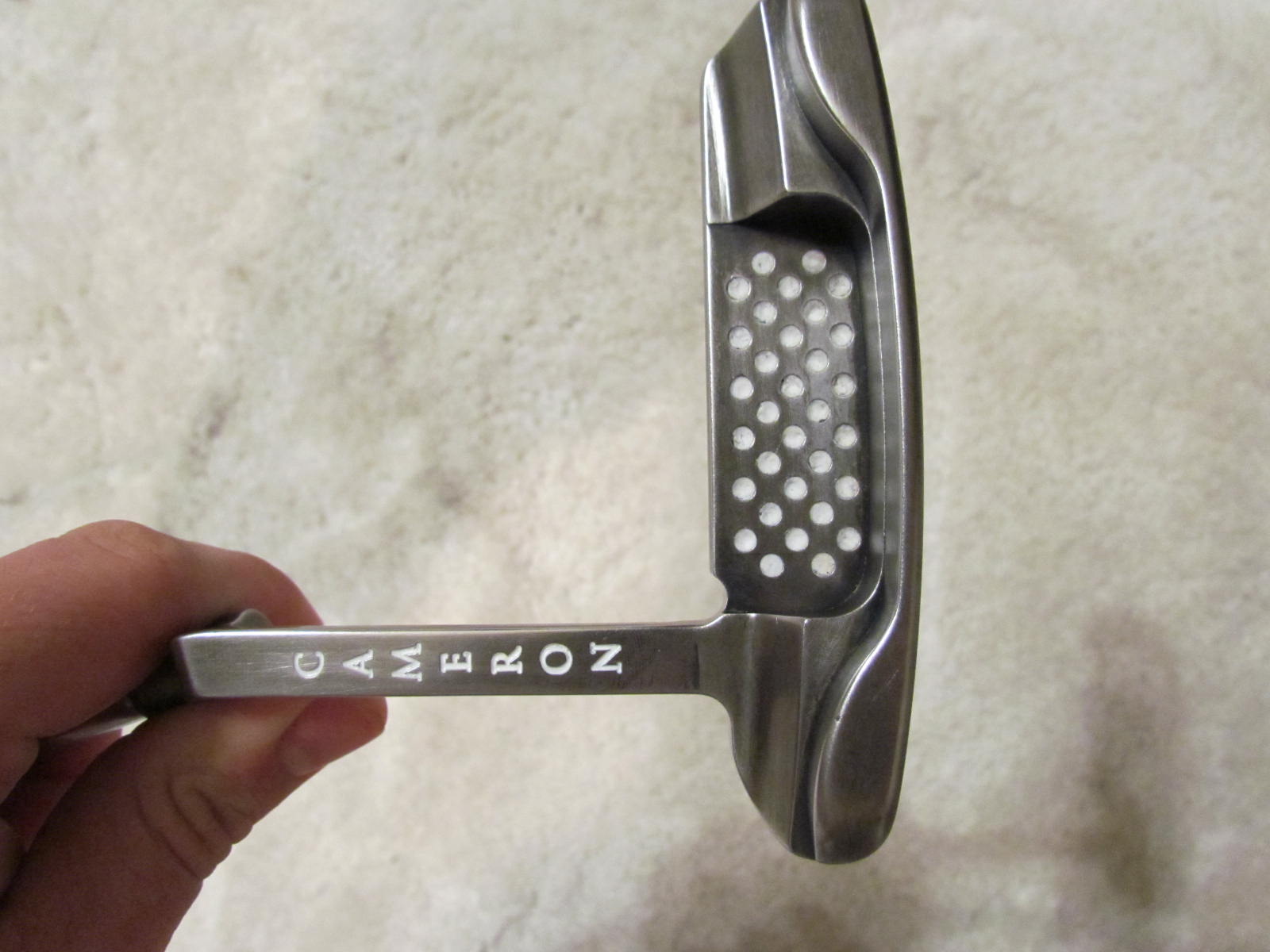
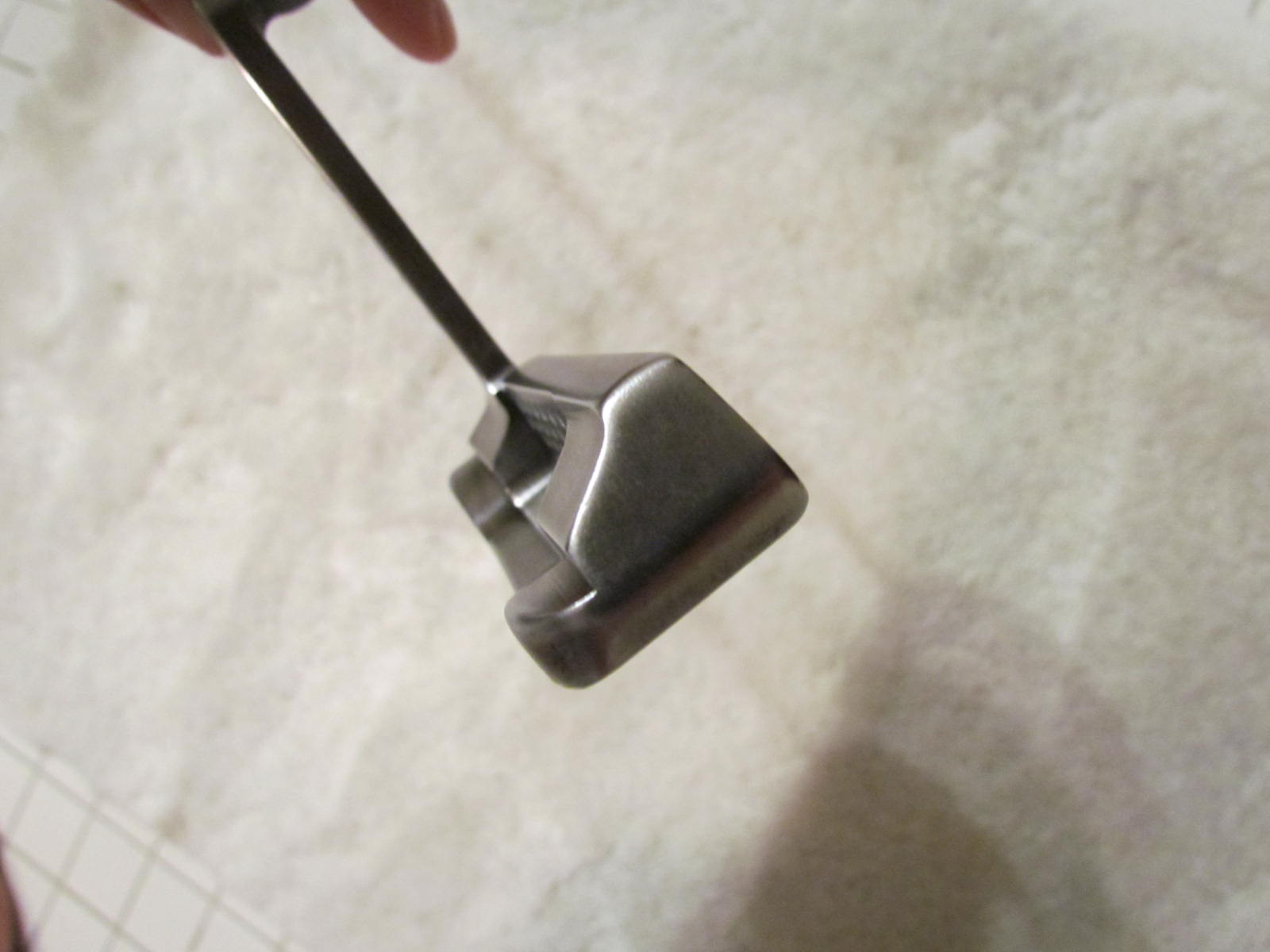


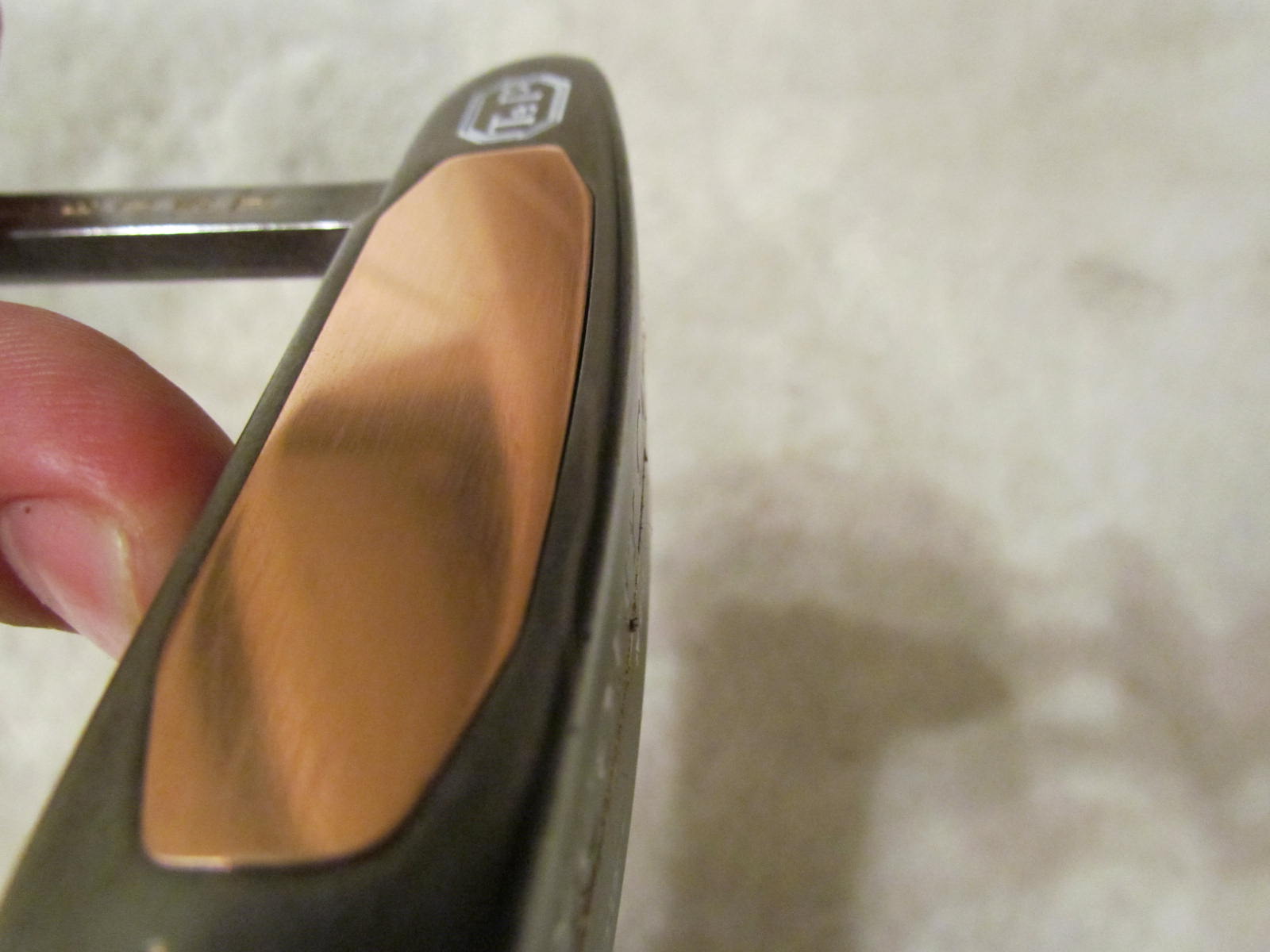


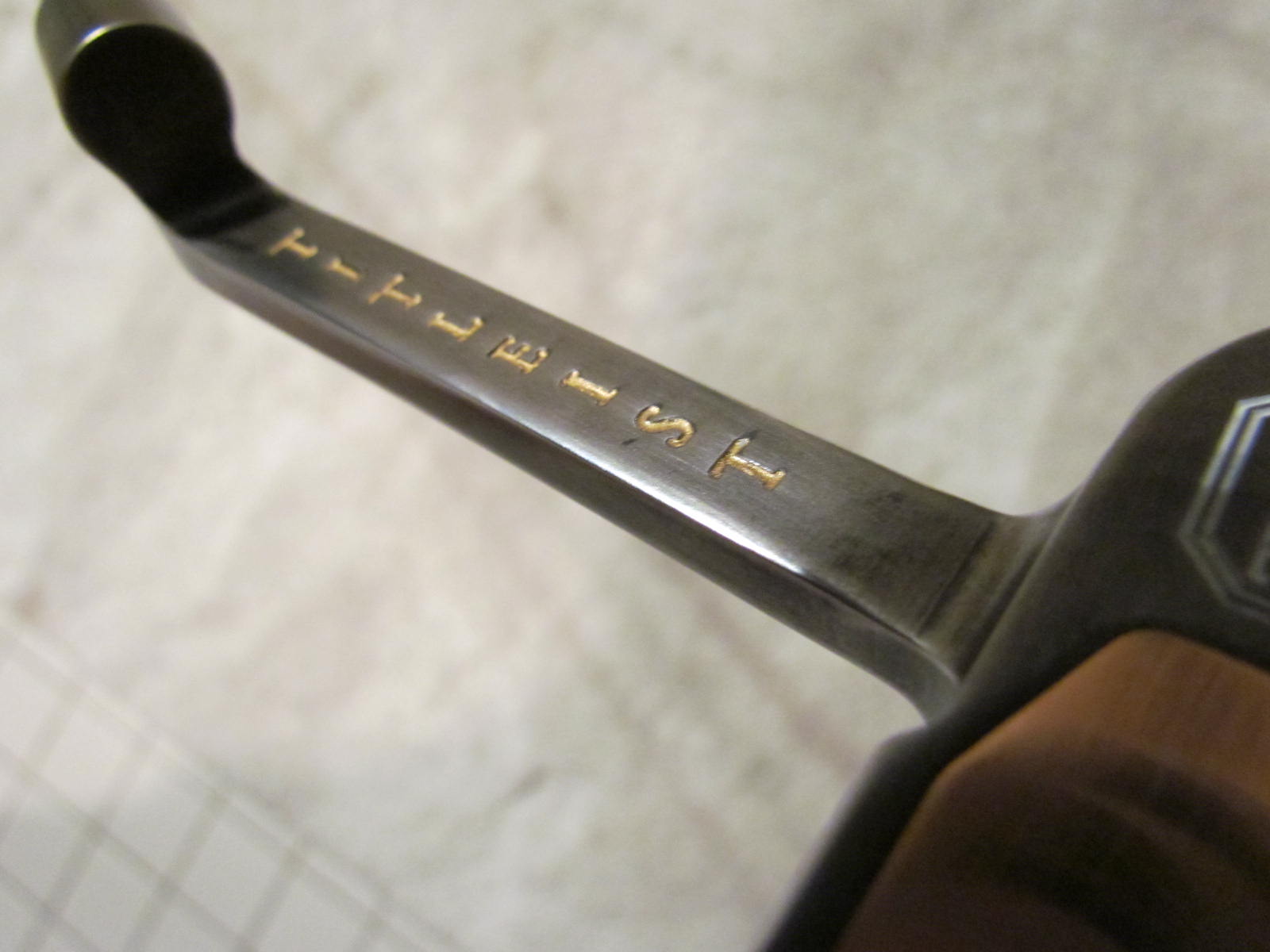
Practice pointer here: if you’re using gun blue, WEAR THE GLOVES like the OP says. Otherwise, your hands end up smelling like cat piss for about 3 days (I know), and you can’t wash it off. Further, do the sanding outside/somewhere ventilated. And, most importantly, don’t be afraid to take your time. The project is kind of complicated (especially the first time). In fact, I’d recommend you don’t do it, but, then again, I did it, so I can’t prevent you from it. Hopefully it will turn out better for you. I just didn’t know how to gun blue. All in all, though, I’m actually pretty happy.
What it costs/what I needed:
1) a TeI3 putter (anywhere from $70 to $170 depending on how bad it is)
2) gun blue ($6)
3) elastomer ($4)
4) “paint” (about $5)
5) sandpaper (already had from previous postings, but about $10)
6) steel wool (about $3)
7) a hair dryer (you should probably have one)
8) paper towels (minimal)
For those of you who don’t follow PGA Tour policy changes, you’re missing out on a “hot” debate at the moment. Camps are split on whether PGA Tour members should be required to play every event on the tour schedule at some point within a certain number of years. Essentially, the point of such a rule is to give a sponsor some assurance that, if they sign a long-term promotional deal, the top players on the Tour will play in their event.
The center of the debate is, of course, Tiger Woods. Fans will know not only that Tiger does not play every event; he rarely plays what could be considered a full schedule for a regular touring pro. Because he prefers to be in top form for each event he plays, he has set his annual schedule up so that he “peaks” for certain events. This schedule has centered largely on a few choice events and the majors. Tiger is not the only pro to take this tack to the Tour. Rarely will any of the top players be found playing events such as the Viking Classic in Madison, MS.
My personal feeling is that such a rule is misguided. Though I understand the desire to make the Tour’s product more valuable to potential sponsors, such a rule only pollutes the quality of the available product. While we watch in awe as these players decimate the hardest courses weekend after weekend, we must realize that very few (if any) players currently play every event on the schedule in any number of years. We think these pros would have no problem on any course they ever play, and while that’s true, they are only able to shoot those scores in the low 60s with local knowledge they develop from years of playing the same courses. Tiger’s schedule has afforded him the opportunity to learn the courses that really “fit his eye” and shoot amazingly low scores year in and year out. Consider the difference in your own game if you were to only play one course for an entire year versus playing a different course every single weekend. True, professionals are much better and should play any course significantly better the first time around than we do, but the difference between shooting 72 and 67 is nearly all in putting, which can be largely dependent on local knowledge.
—————————————————————————————
Response from JK:
I agree somewhat and disagree somewhat. I agree with you that the overall product of such a rule might dilute the quality of the Tour. Part of why we watch is to see those rare moments when the best battle the best and the chase comes down to the wire. Plus, implementation of such a rule would be very difficult–what happens if you don’t play in the required tournaments? You get fined? Kicked off the Tour? Forced to go to Q-School?
Still, I hesitate to agree with your disdain for such a plan. As I’ve already stated, the fun in viewing a PGA event is seeing the best in the world going head-to-head. That seems to be a MORE LIKELY occurrence if the best in the world are forced to play more often. In years gone by, it seemed like every week held a new battle. These battles led to some of the best and most infamous moments in the history of the Tour: Billy Mayfair dueling Tiger; Bob May’s duel with Tiger; Fred Couples’s magicly sticky ball at Augusta; Craig Stadler’s towel incident. Not all of these things happened in majors.
More importantly, the Tour as a whole benefits from such a rule. First, it attracts far better sponsors because those sponsors are guaranteed that they will have the best in the world at some point, creating a bigger viewing audience. Moreover, I think it helps the players themselves. Right now, there’s a lot of young talent that gets lost in the mix because the top 3, 4, or 5 players in the world dominate the air during any given tournament that has any field worth viewing. If the field were dispersed, you might see Anthony Kim win 2 tournaments in California then see Dustin Johnson win two in Florida, while Bubba Watson was in a duel with Phil Mickelson in another tournament. How much publicity would that generate leading into the Masters? The viewing public would think there were many horses in the race, which makes it far more interesting. Right now, the viewing public thinks there are only a few good players at the top and, otherwise, a pretty lacking field. Whether true or not, such an arrangement would make the game more exciting for everyone.
Just my opinion, though.
—————————————
Reply from LG:
I agree with you, JK, that the value of any given sponsorship would increase. It certainly enticing to think that every single player on the Tour would be required to play in your event at some point during the next three years. What we really need to resolve this issue is some data that tells us how much a “premium” tournament sponsorship goes for versus a “regular” tournament sponsorship is worth. (Any help on that front, PGA Tour?) With respect to enforcement, I think such a rule could be enforced through sanctions, fines, and peer pressure much as any other rule is enforced. (See, for example, the groove rule).
As far as the epic battles, I think the reduction in the quality of play would limit the number of these kinds of epic battles. If players don’t know the course as well, how can they make those huge putts? Also, If everyone is required to play every event, it seems less likely that the top players’ paths will cross in any event. Wouldn’t it be a shame if Tiger or Phil had to miss the WGC-Accenture Match Play to play in the Mayakoba Classic?!
Review: Byron Morgan California Flatsticks
February 28, 2011
I recently had the pleasure of discovering one of the best finds of my golfing career: Byron Morgan putters. LG did a cursory POTW several months back when he got his first Byron, but this post aims to give a little more information.

Byron Morgan is a putter maker out of Huntington Beach, California. He is famous among golf equipment aficionados for his custom-made putter designs. If you own a Byron Morgan, chances are no one in the world will own a putter that is exactly like yours. Although he does make production runs, they typically end at 25 or so putters maximum, and his custom options allow him to create for his customers a truly one-of-a-kind piece of artwork.

Byron makes putters of all different models. His most popular models are probably the heel-toe weighted options
the 006, which looks much like a Newport 2 or Anser 2

the DH-89, which looks like a Scotty Cameron 009 (or Newport) and looks like (and is named after) the Scottsdale Anser;

and, the 007, which looks like something between the previous two.

Byron also makes other models (the Channel Island, Bombora, and others), and is willing to provide different neck options above and beyond the standard plumber’s neck of his options. There is no “Off-The-Rack” Byron Morgan Flatstick. And, unless specified otherwise, Byron’s putters come with his unique “twilight zone” milled face.
Byron offers a wide variety of material, finish, and stamping options in addition to his other customizable features. You can purchase a sound-slotted terryllium copper 007 with a slant neck and your name stamped on the toe in a polished finish at 350 grams; you can order a stainless steel DH-89 with blue oil flame finish and a flow neck with a raised sight dot and a stamp on the bumpers that says “drop” and “bombs”; you can get a center shafted 006 in carbon steel with a lightning bolt striking a four-leaf clover stamped on the face and “Xander” stamped in the cavity with an oil can finish. The options are virtually endless.
Unlike some of the more well-known putter makers, though, the cost will not break your bank. Ask Scotty Cameron to make you a custom putter to exactly your specs, and he’ll send you a bill for $5,000.00 (that’s right, five thousand). Plus, it’s likely he won’t give you all the stamping options you really want.
Byron will do almost anything you want (see http://www.golfwrx.com/forums/topic/208308-byron-morgan-library-of-photos/ for a listing of some of his custom putters). His 007 and 006 models start at $300; the DH-89 models start at $500. While this may seem like a lot to the typical Sunday golfer, consider the equipment you have in your bag. You pay almost $400 for a driver that you hit 14 or so times each round, max. Meanwhile, you’ll take at least 24 shots with your putter over the same round–and 24 would be a GREAT round. A good putter is a very important part of the game. Then, consider the other options out there. A Scotty Cameron off-the-rack is $300 without any customization; it’s not even bent to your preferred loft and lie options, and if you want something other than 33, 34, or 35 inches, better get the shop involved, which means extra money; and I hope you like 330 grams, because that’s all Scotty makes (unless you get one with removable weights in it).
Meanwhile, you can get a Byron Morgan customized to look like what you want it to, at the length you want it to, at the weight you want it (that’s right, he’ll make it from 330 to 370 grams, no problem), milled to the loft and lie you want (not bent, like your Scotty–unless you happen to need the standard 71 lie angle and 4 loft of a Cameron), made out of the metal you want (Scotty gives you one option–which kind of means you don’t have an option), and made to the exact shaft length you want.
Plus, they look darn cool!
I was a bit skeptical at first. I thought they looked a little to hand-crafted. I thought they couldn’t really be as good as Scotty’s putters because…I mean, Scotty is endorsed by one of the best big companies, Titleist. He’s gotta be making the best, right?
I am so happy I tried Byron’s putters. I’ve never owned another putter that gets the ball rolling so quickly as my 007 does. It’s weighted and balanced so much better than my Newport Beach was. It gives me exactly what I need from a putter–confidence.
Moreover, the used market is not much different between Scotty’s putters and Byron’s. Obviously, you can find a Scotty Cameron on eBay for anywhere from $100 up to thousands–and, typically, a well-conditioned Byron Morgan putter is in the $200 range. But there are deals to be had. I’ve purchased Byron putters for $170 and $135 in very, very good condition.
However, that leads me to the second aspect of why I love Byron Morgan putters. In addition to making an amazing product, Byron is unbelievably accessible. Try to get customer service with Scotty Cameron and I think you might find it difficult. If you have a Cameron putter to send in for restoration, a staff member will email you and tell you what to do. And you’d better not have a lot of customization requests, because the Cameron shop will just ignore them and send you what they think you want.
What Scotty Cameron thinks is “customization”:
Meanwhile, I sent my current gamer in to Byron for work along with a letter stating what I wanted. Something didn’t work quite the way he thought it would, so, guess what? HE CALLED ME! Personally! I think my exact words were “I can’t believe I’m talking to you.” I spoke with him on the phone for about 20 minutes about what was going on with my putter in his shop as he worked on it by hand. He gave me a few ideas and told me what to expect. Amazing. Then, he called me again to tell me it was finished and even sent pictures to my email to let me know how it was going. In the end, I got about the closest thing I could to a custom putter.
My putter before:
See the big, ugly, non-circular sight dot? Guess what happens…
My putter after:


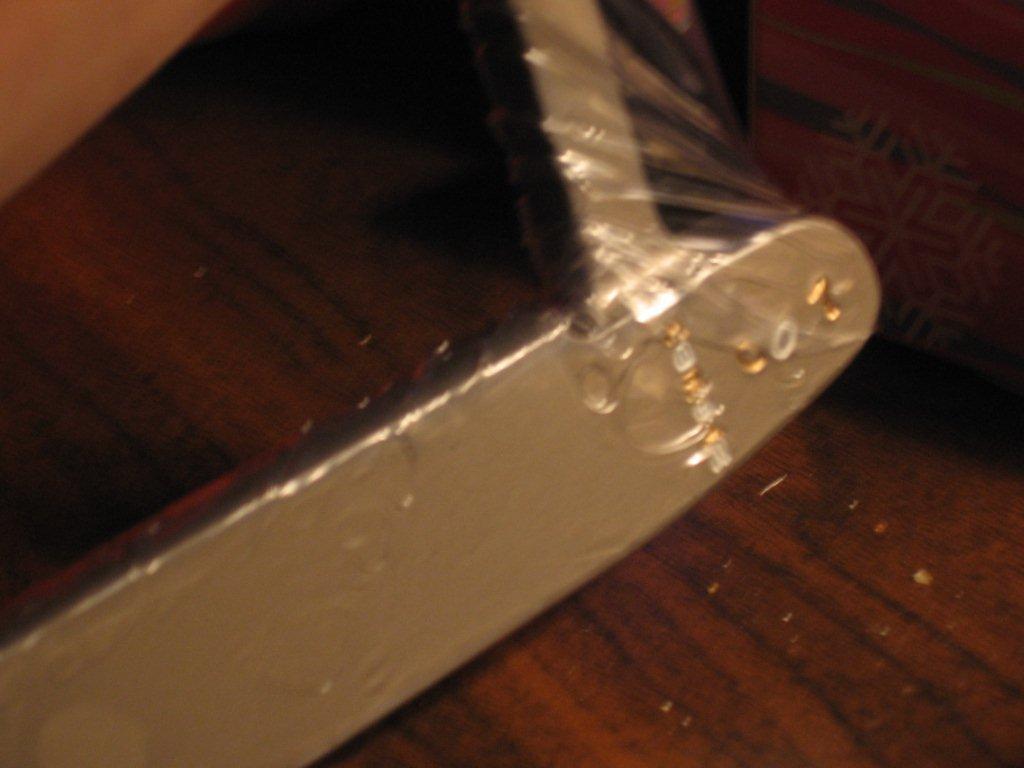
But that’s not all–I sent Byron the head by itself–in other words, with the shaft removed. Byron not only reshafted the putter for me with a new grip and a shaft, but he also replaced the paint fill–in custom colors that I asked for! All of this was included, and I didn’t even know it!
Now, Byron’s work is not for everyone. I understand some people just need to have a name that other people recognize. But the reason so many tour pros play the 009 from Cameron is that it is a high quality and custom made putter. Take the stamping off, and the Cameron 009 is totally indistinguishable from the DH-89. I have owned four Byron Morgans and I can say that, without a doubt, each one was better than any other putter I’ve ever played.
So, with all my reviews, there has to be a downside section. This is hard to come up with. If you’re ordering a custom putter, the major downside is trying to figure out what you want. And, once you do make an order, it can take some time (2 months). I’ve never experienced that, but almost certainly will one day when I have Byron make my custom putter. Availability is low since you typically can’t find them in a store, so you have to either buy one to try it or get involved with Byron’s demo program, which usually fills up the second it is released. However, that’s not really a downside because you can sell the things back for the same price you paid for them in almost every case. So, the most you’ll lose is the Paypal fees for selling them to someone else. BFD. It was a little difficult trying to figure out who to get in touch wtih and how to get in touch with them in order to get the work done. But, a little searching on GolfWRX or PutterTalk will get you in touch with Steve (Z-Man), who is Byron’s right-hand-man.
I can’t say enough good things.
Quality: 10
Looks: 10
Customization: 10
Customer Service: 9
“Cool factor”: 10
Value (cost vs. quality): 10
Overall: 9/10
Review: Lesson with PGA Professional Mitch Lowe and the Fleming Course at Harding Park
February 22, 2011
As you may recall, last October I posted a “preview” of a review for a lesson with Mitch Lowe. I finally had occasion to take Mitch up on the lesson I purchased all those months ago.
Saturday Morning in San Francisco was a picture perfect day: clear blue sky with streaky clouds. Since I haven’t had a chance to play as much as I’d like prior to getting a lesson, I thought I’d get Mitch some “hard data” by playing a few holes and developing some statistics for him to analyze my game. This was also a wonderful excuse to check out Harding Park’s Gem of a short course – the Fleming 9-hole. This short course is composed of three par-4s and six par-3s. The holes vary in length from 140 to 235 yards for the par-3s and 260 to 425 for the par-4s. Having played few short courses, I was keen to try this one out to expand my horizons on this fantastic idea. There aren’t enough good things to say about this short course. It is set directly in the middle of the back nine of the famous TPC Harding Park. The big course is prominently featured on the Champions Tour and was the site of one of the most dramatic Presidents Cups ever played (I was actually there!). From my limited experience, I have gleaned that short courses generally get the low end of the maintenance support when compared to the marquee course. I was happily dispelled of that notion at the Fleming Course. The greens were impeccable and the fairways were trimmed as though the Presidents Cup were about to return. Also, the Fleming 9 were not short on the scenic views that Harding offers. The beautiful cypress trees that line the big course also have their counterparts on the short course. This truly felt like a mini-Harding experience. For $31 total, the deal could not be beat. No reservation required, just walk up and request to go out.

Having played a decent warm-up round, I went over to the range to meet up with Mitch at the appointed hour. At the beginning of my lesson, he asked me what I wanted to accomplish. I told him my goal was to work on my spotty iron play and to have a plan for improving my consistency and distance. He took these goals and ran with them. I started off hitting a few wedges and Mitch took video on his iPhone and quickly deciphered that my weak fade and spotty iron play was due to casting of the club. Sadly, this much I had gleaned from my own video before. Mitch, however, had a solution. His method focuses purely on getting the club to the right position at impact. Rather than focusing on the positions that my body might have been in, he focused more on getting the club square at impact with forward shaft lean. The videos he showed me proved that though my hands were fast enough to square the club and hit a straight shot, I was essentially turning my 7-iron into a 9-iron by adding loft and having a backward leaning shaft at impact. After a few adjustments, the later videos showed that I had indeed moved from a backward leaning shaft to a forward leaning shaft and was having to rely less on my hands to square the club. In the end, Mitch accomplished what few instructors actually accomplish: he created a plan for me that would lead me to achieving the goals I had set out at the beginning of the lesson.
As far as a review: Mitch was a consummate professional. He entertained my questions about playing in the PGA Championship as well as kept me on track with the principles he was attempting to convey. I believe his style works for me in that we discussed the thought or principle to me that he wanted me to think about during the swing and let me implement it by experimentation. I also watched him work with a beginner prior to my lesson. During that lesson, he was much more hands on and was interested in helping the beginner simply make contact. His style changes as the situation requires, which I find valuable in an instructor. He is very knowledgeable about the game and conveys his knowledge in an accessible and easy to understand manner. He also conveys a true love of the game. Toward the end of my lesson I asked how often he teaches lessons. His response was a big smile and said that it was his full time job. He truly enjoys giving lessons and the game. I would highly recommend him for anyone that needs a tune-up or introduction to the game, and I plan to continue taking lessons from him.

How to Grind a Wedge
February 14, 2011
To start, I always like to point to my references. GolfWRX provides the background again:
http://www.golfwrx.com/forums/topic/53415-diary-of-a-wedge-grind/
http://www.golfwrx.com/forums/topic/22167-grinding-a-wedge/
Grinding a wedge is a pretty neat process. It takes a lot of patience, care, and confidence to do it right. But making a club that’s exactly to your own specs is pretty amazing–and, of course, I wouldn’t do it if it weren’t at least a little fun.
I started with an old wedge–Tommy Armour. It had an ungodly amount of bounce, so I decided it was a good test piece. If you don’t have a wedge you want to sacrifice, Golfsmith sells grinding blanks for $10/head (see http://www.golfsmith.com/products/SE2886/Snake_Eyes/Custom_Grind_Wedge_Head). Pics of my starting wedge below:
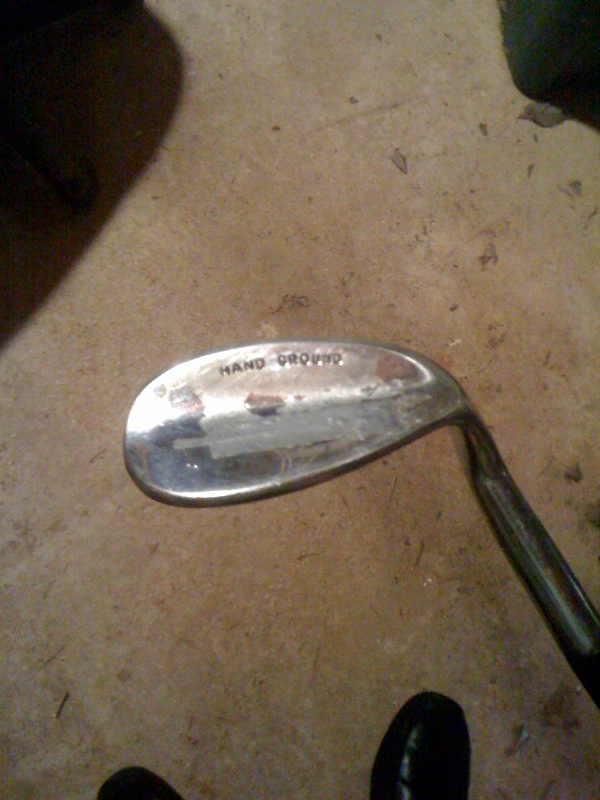
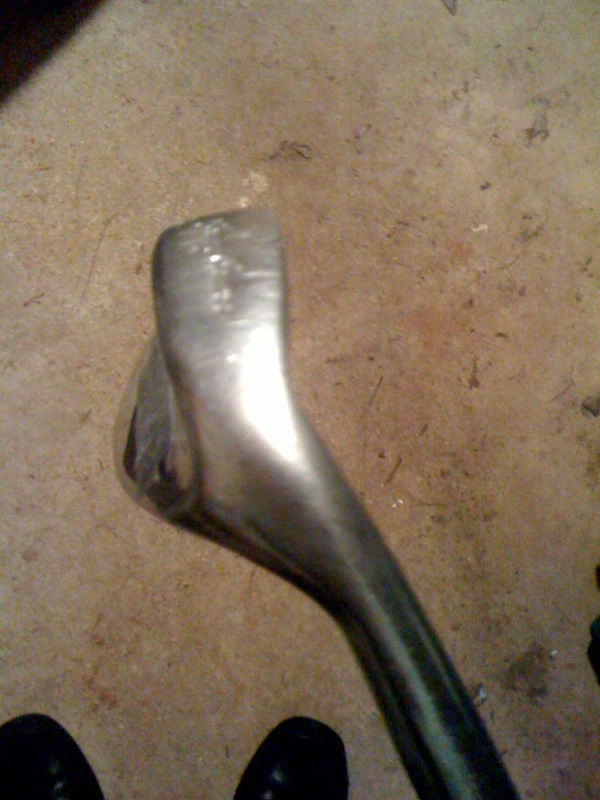
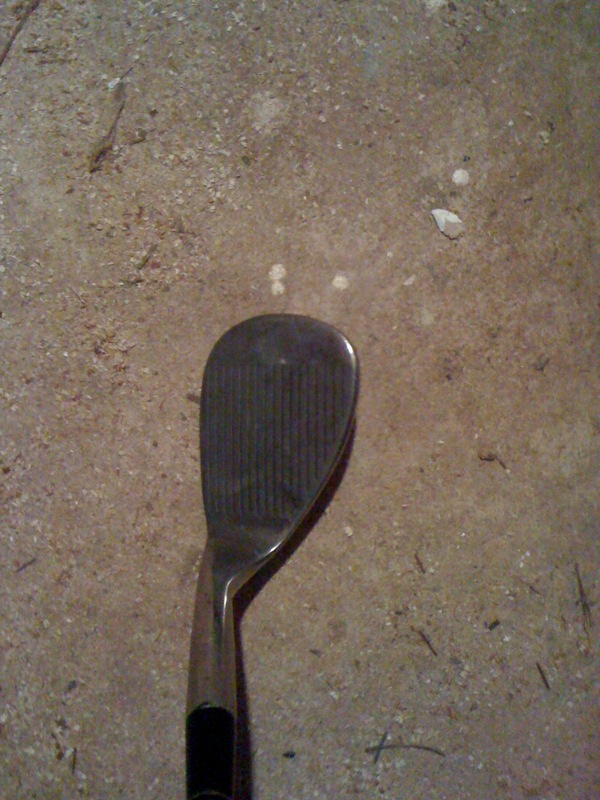
Before starting, you need:
1) either a belt sander or a grinding wheel
2) a sharpie
3) gloves
4) safety glasses
For my wedge grind, I decided to pull the shaft from the head, as it’s usually easier to maneuver the head by itself without the shaft.
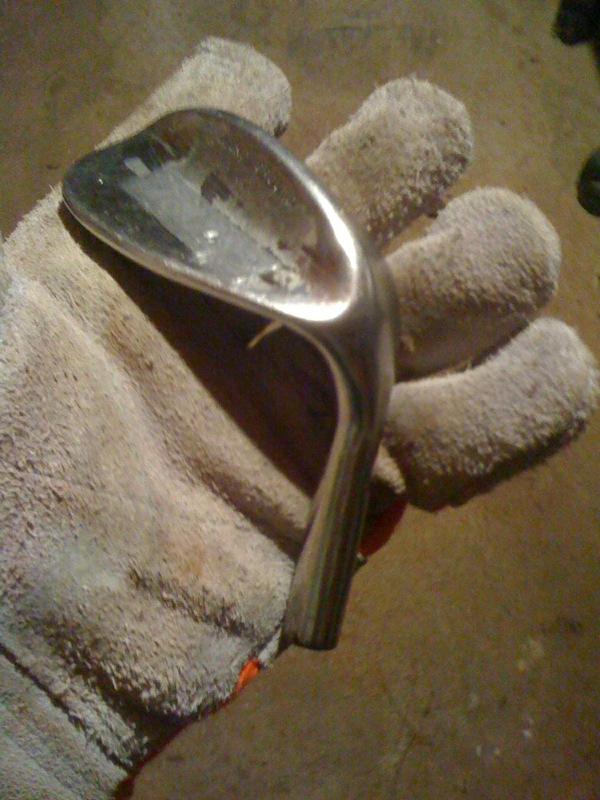

As shown in the references, the next thing to do is mark the grind with a sharpie. My goal was to replicate the Chikara wedge grind. Photos below show the Chikaras and my sharpie marking.


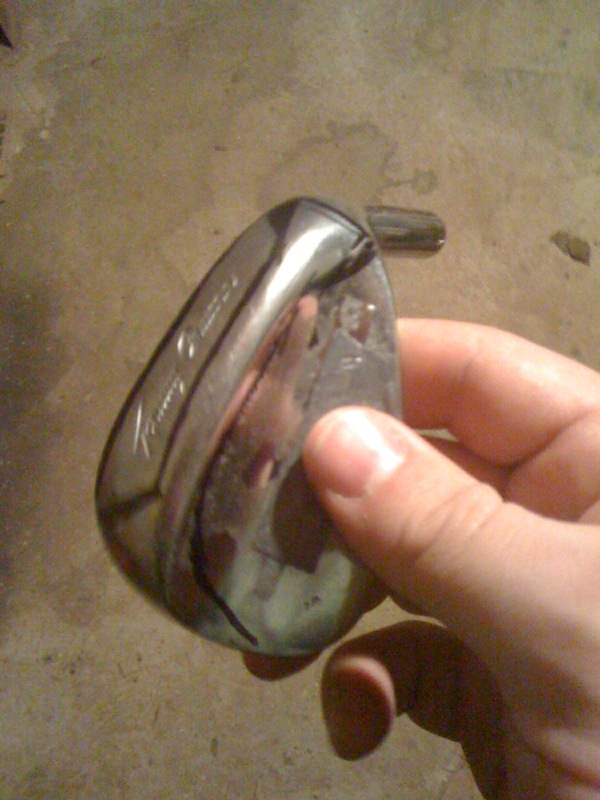
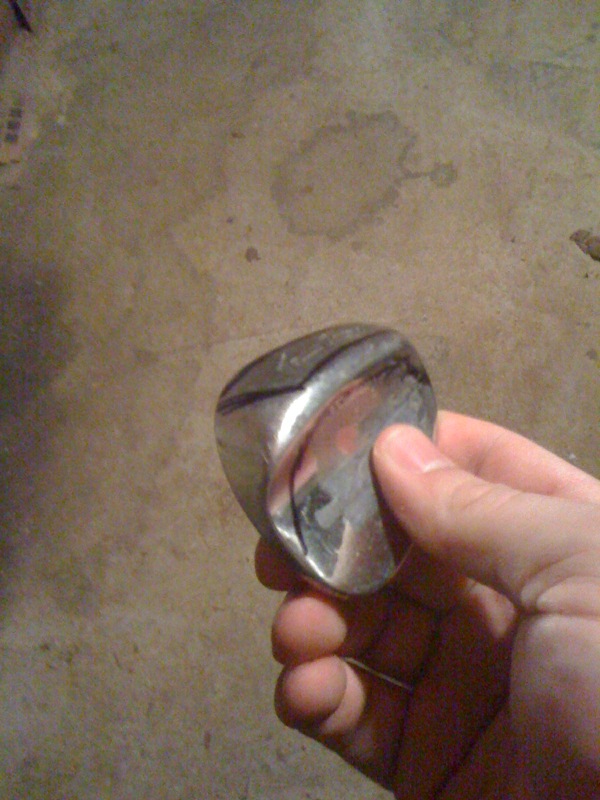
The advice from the WRX postings is to start where you have the most room to mess up–or, in other words, start with the place where the most material will be taken off, as you can fix a problem there easily. This was GREAT advice, as you really need to get a feel for it as you go.
I added the passes in relation to the shapie markings. The result…less than stunning.
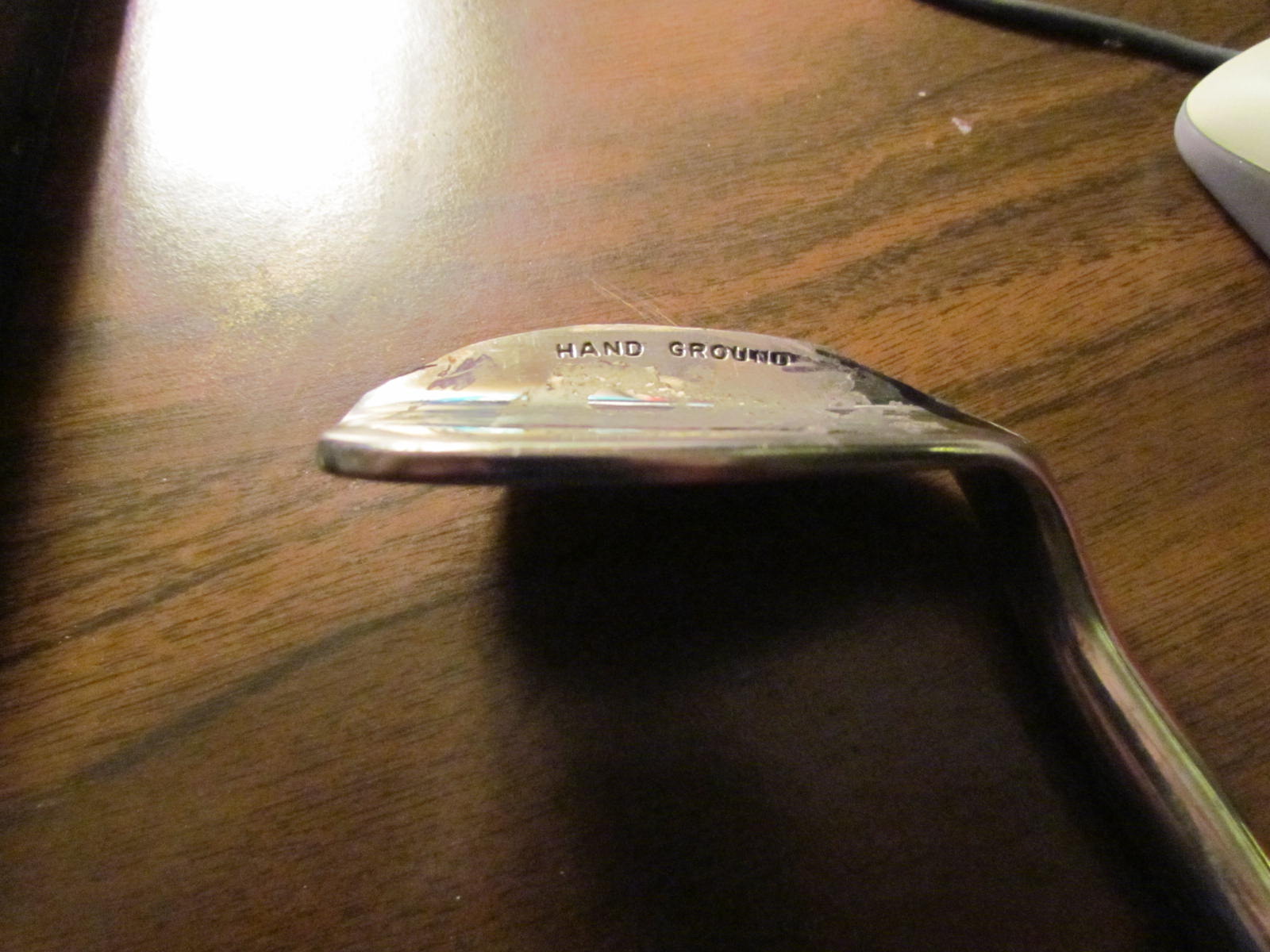
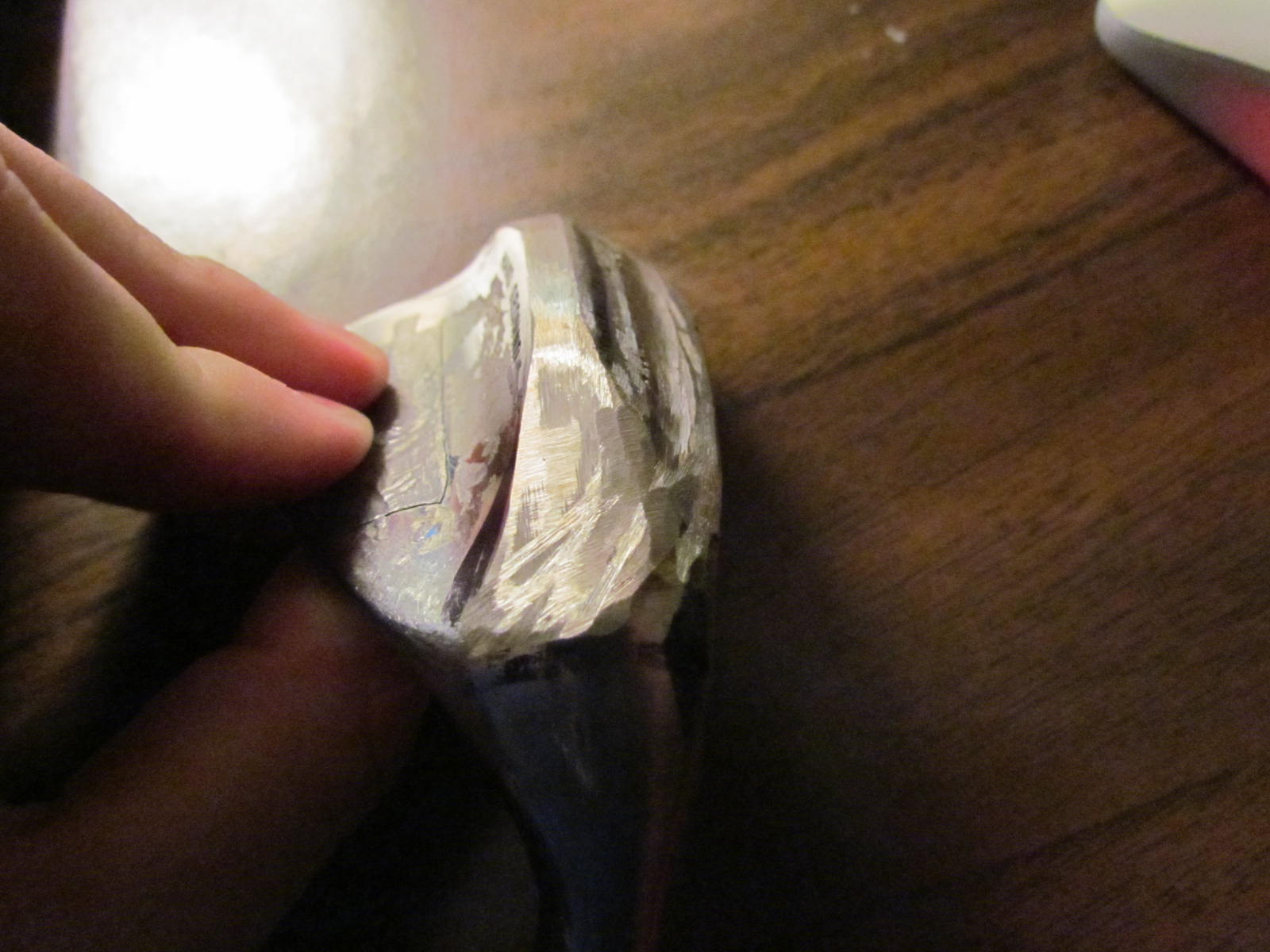


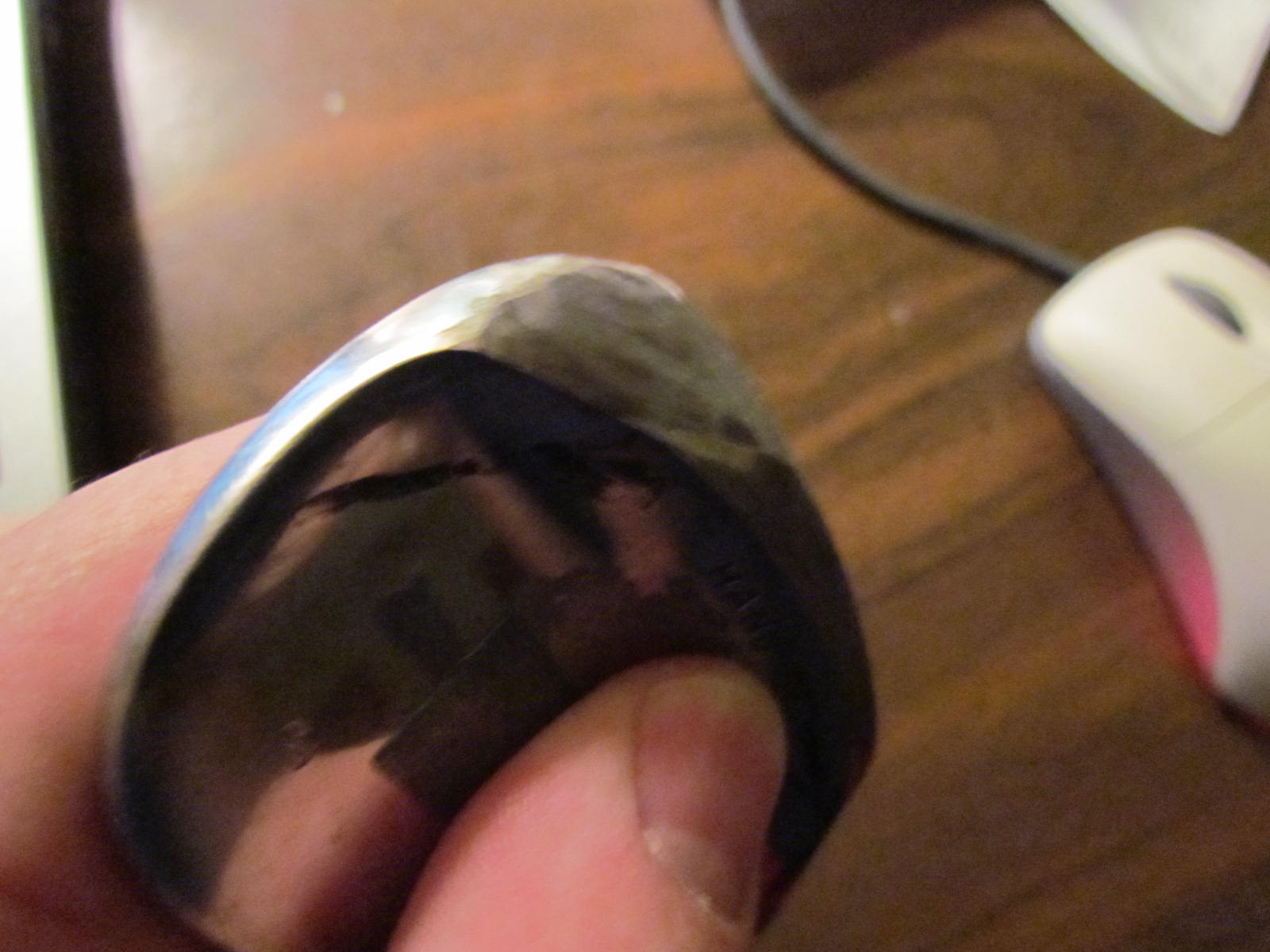

The reason for the “bad” results was that I used a grinder. A stationary belt sander would work a whole lot better and make a much smoother cut.
However, not to worry. A WRX’er suggested that I use a metal file to smooth out the bumps. After some elbow grease, the grind looked smooth and consistent.
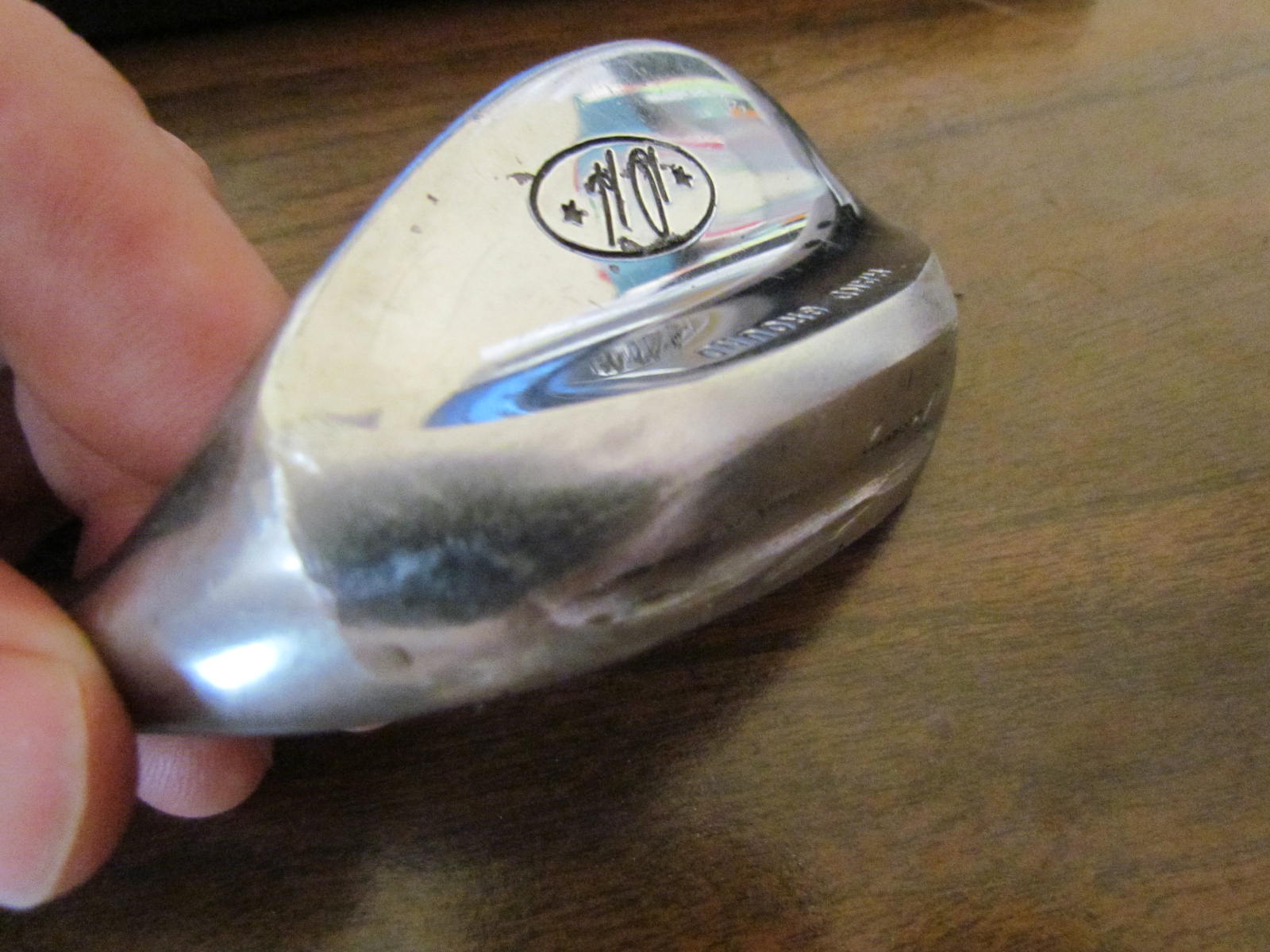
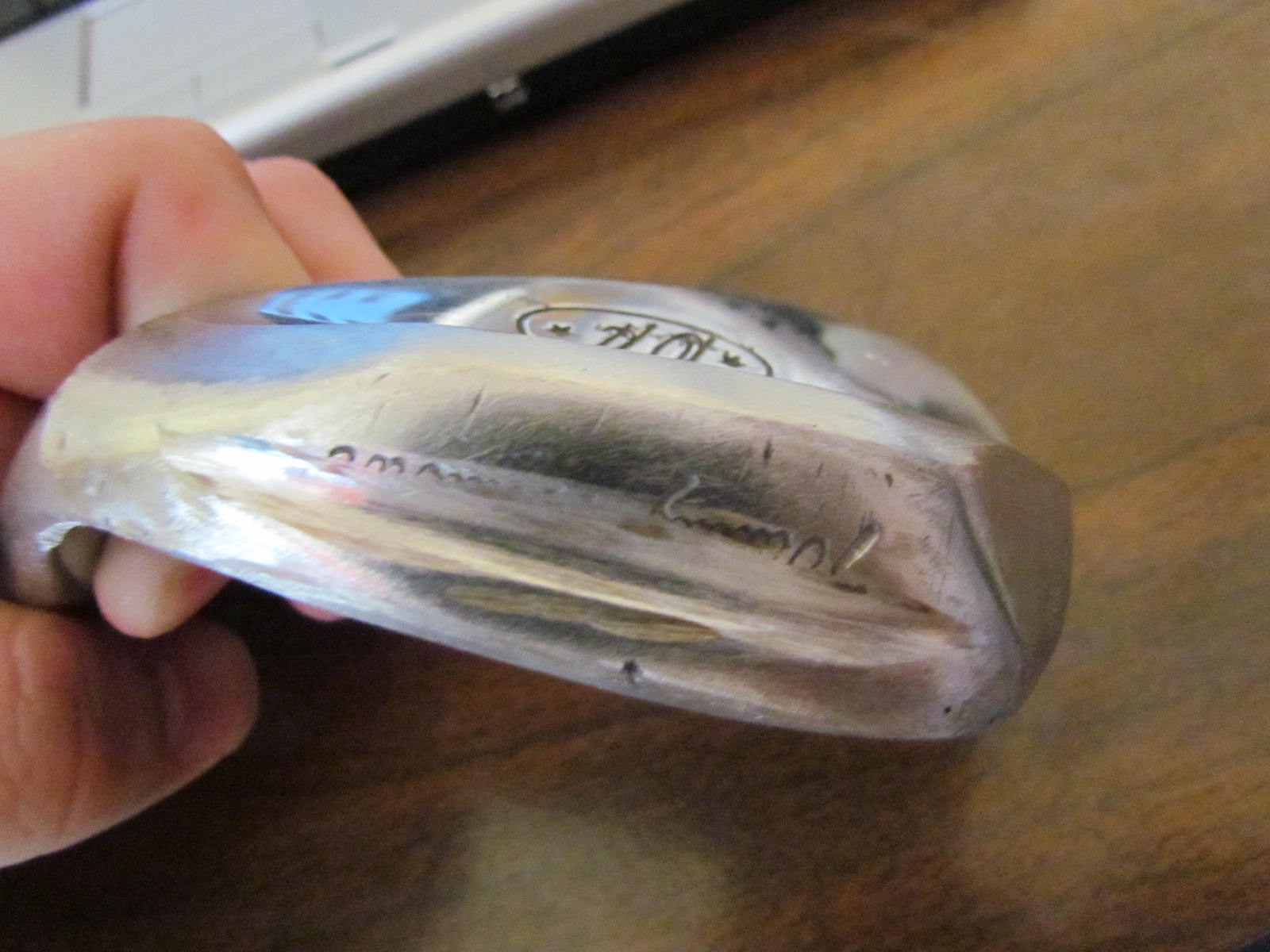
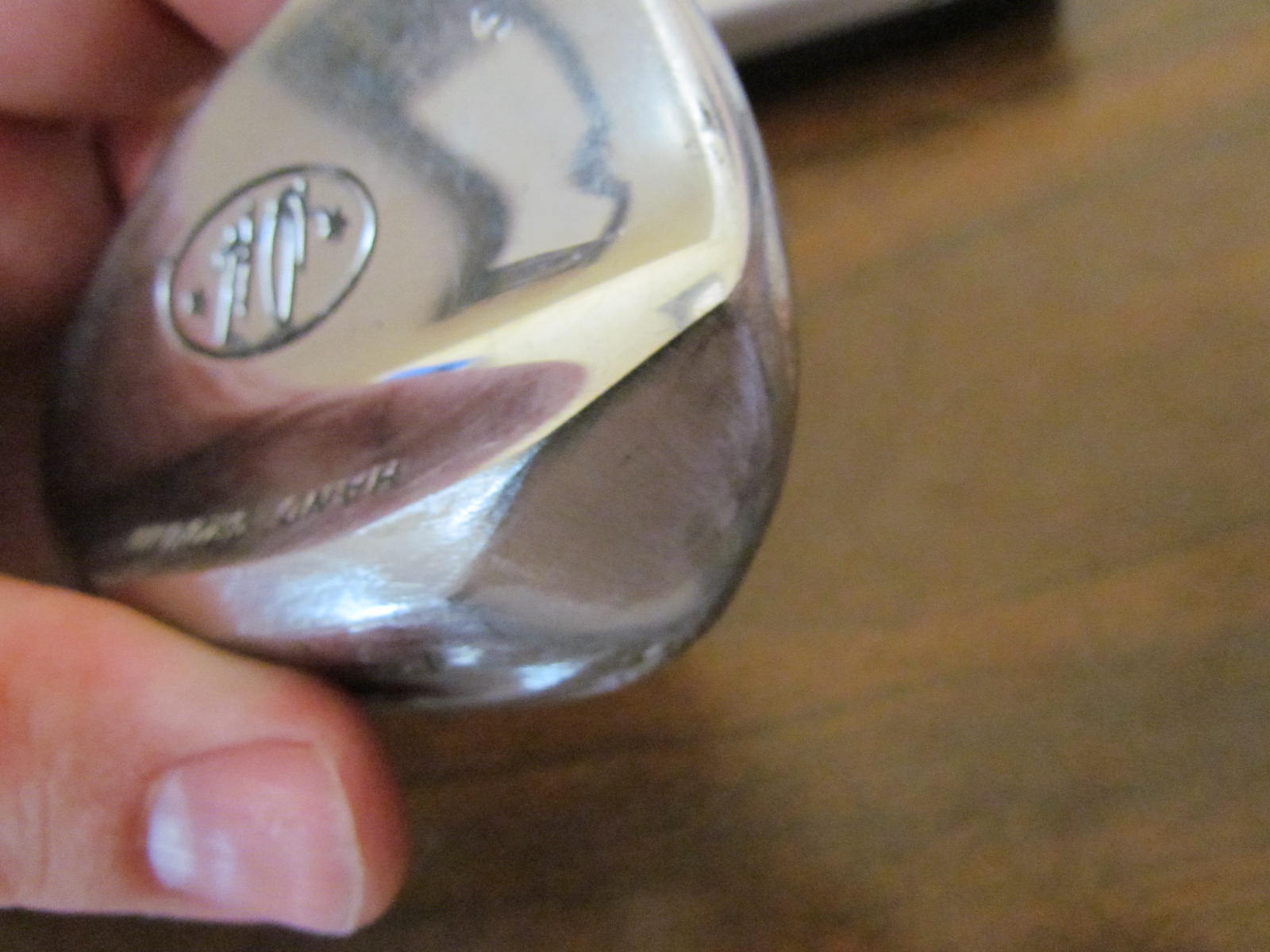
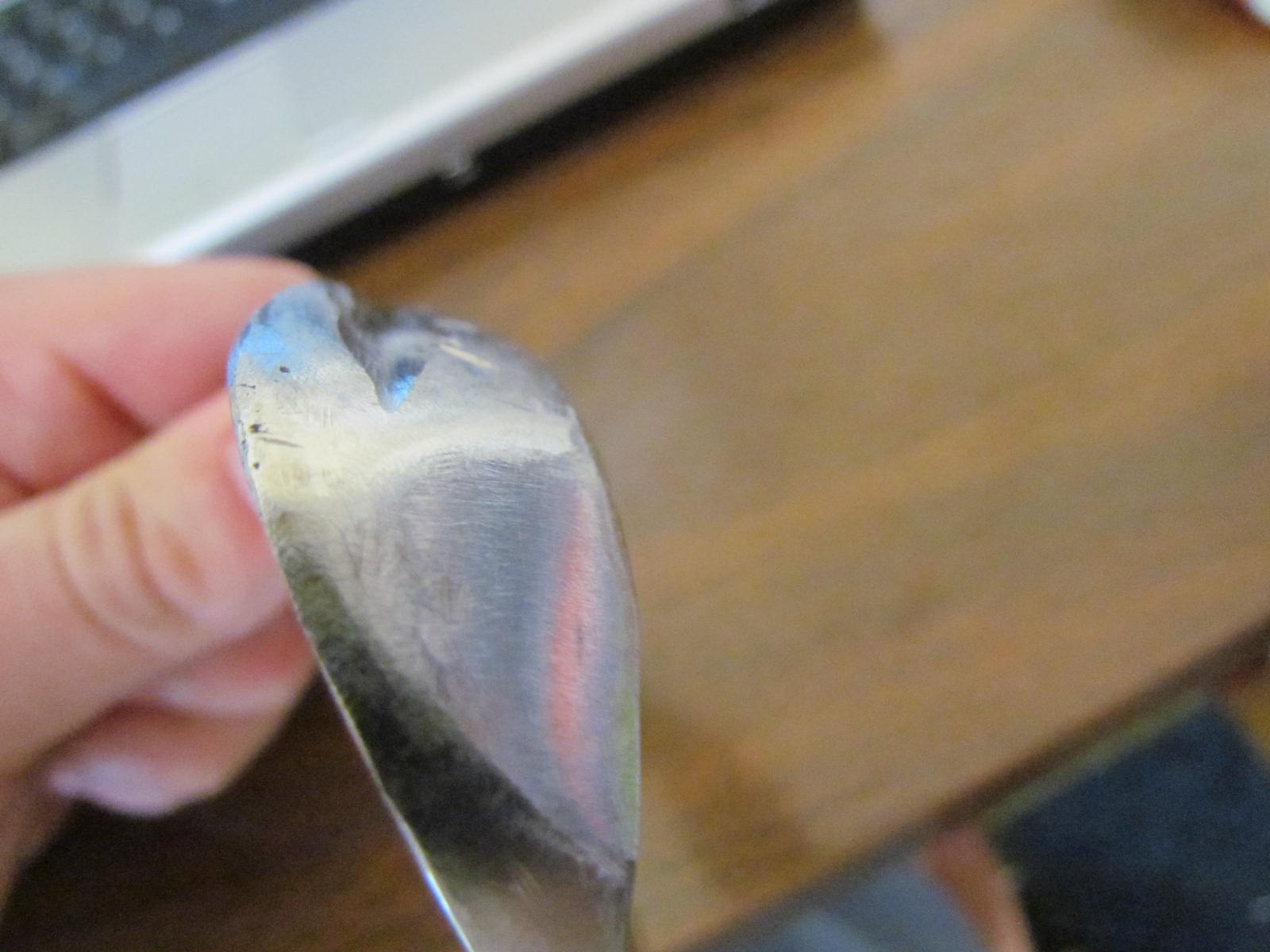


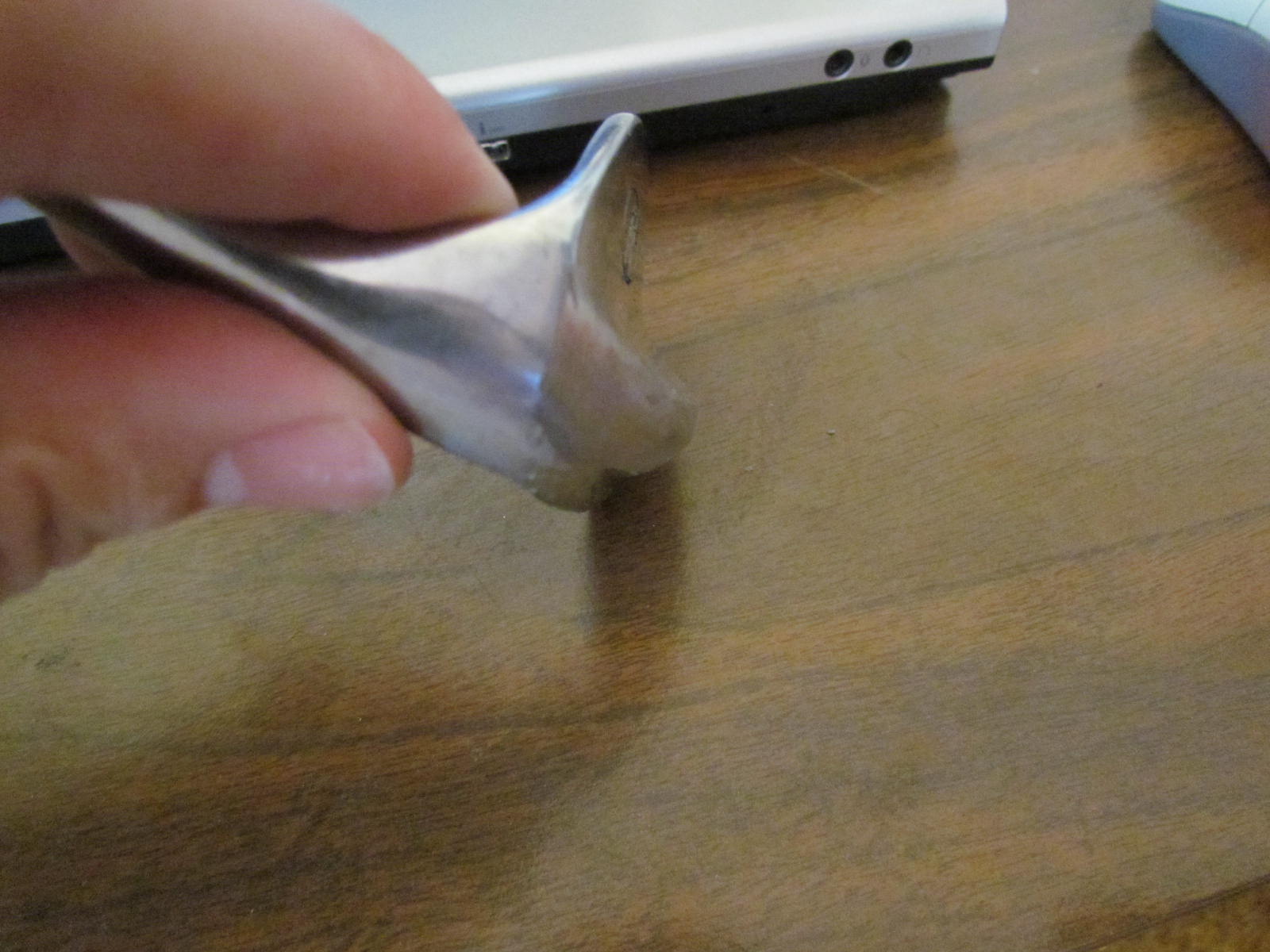
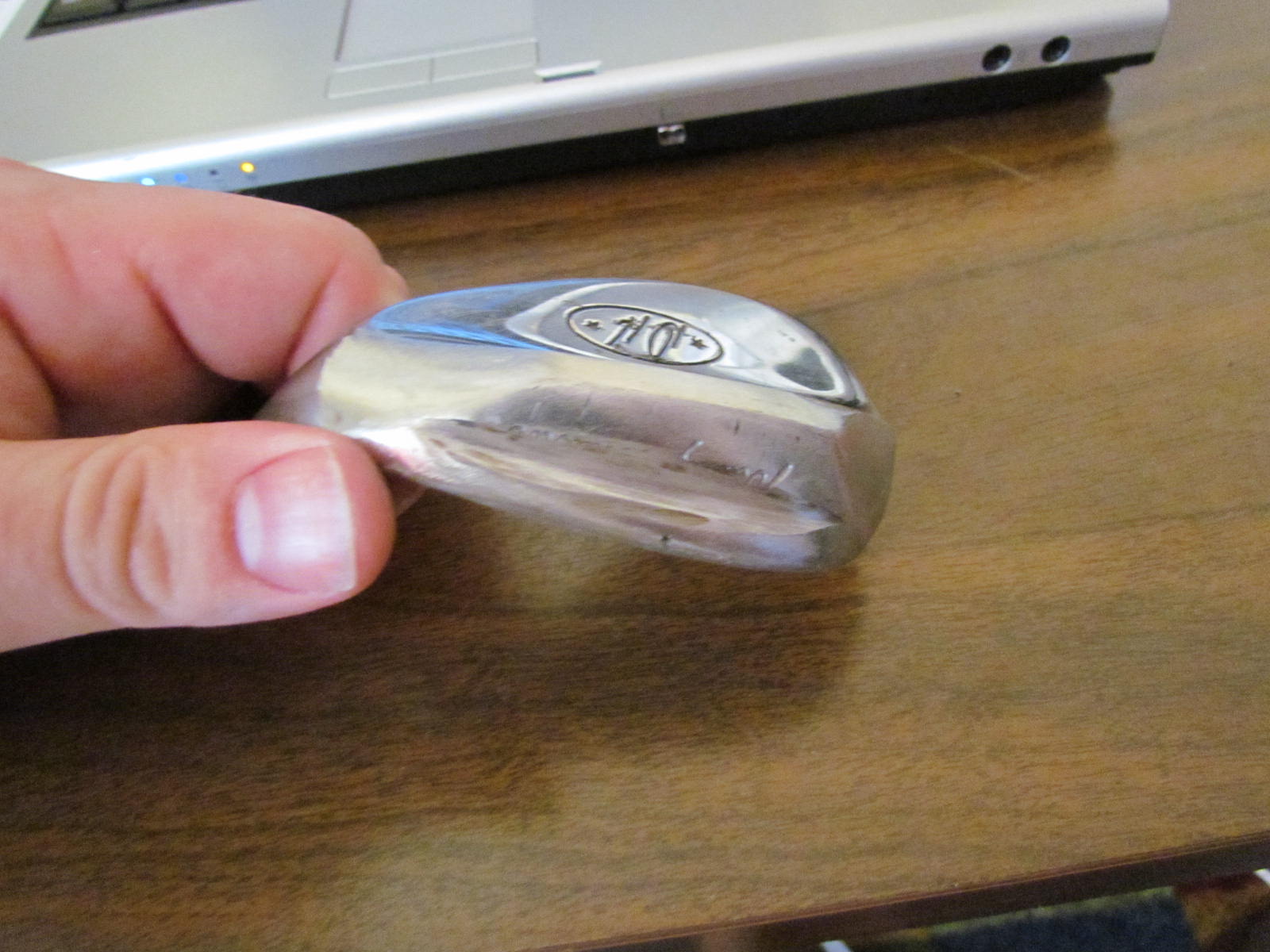
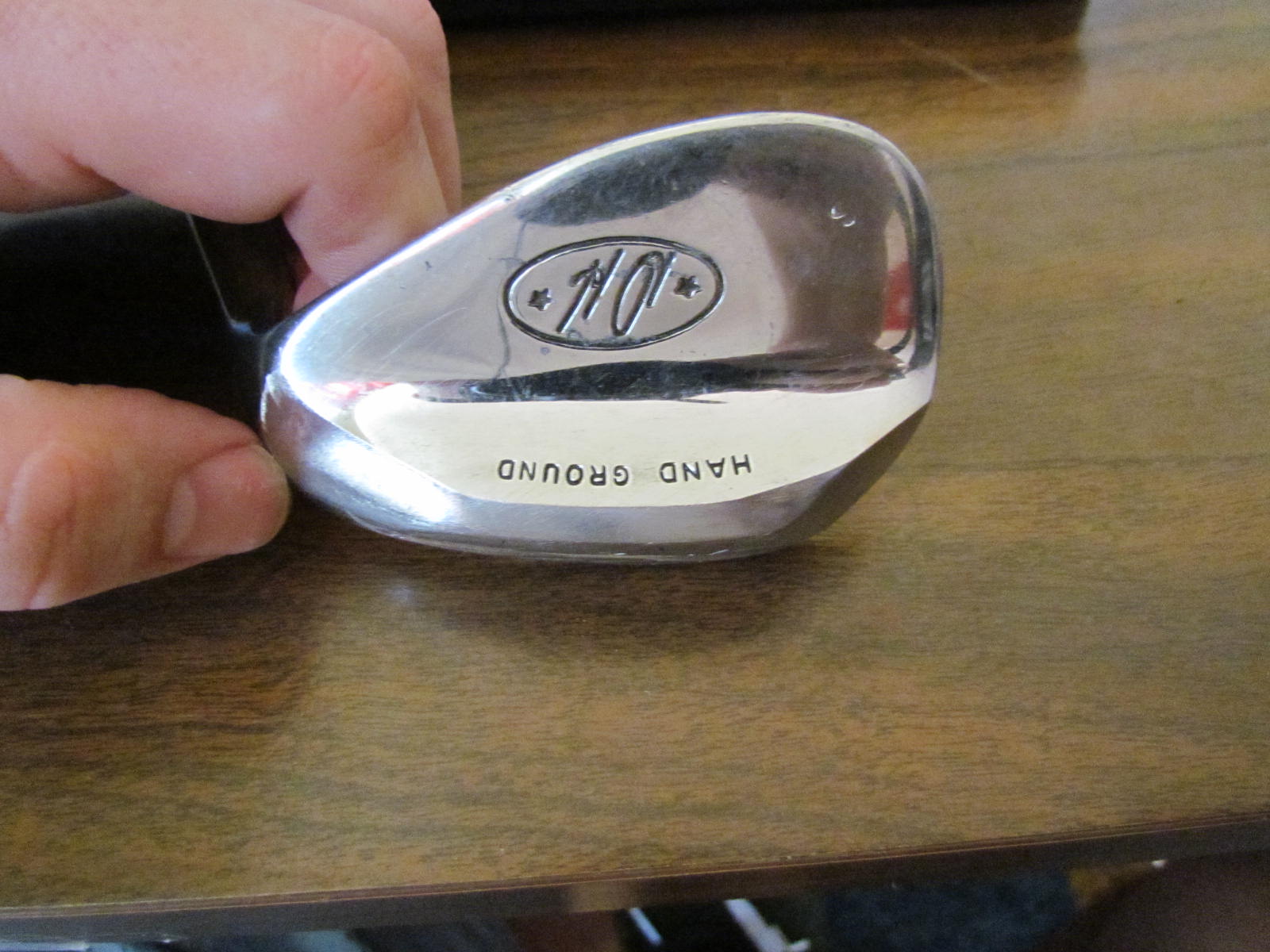
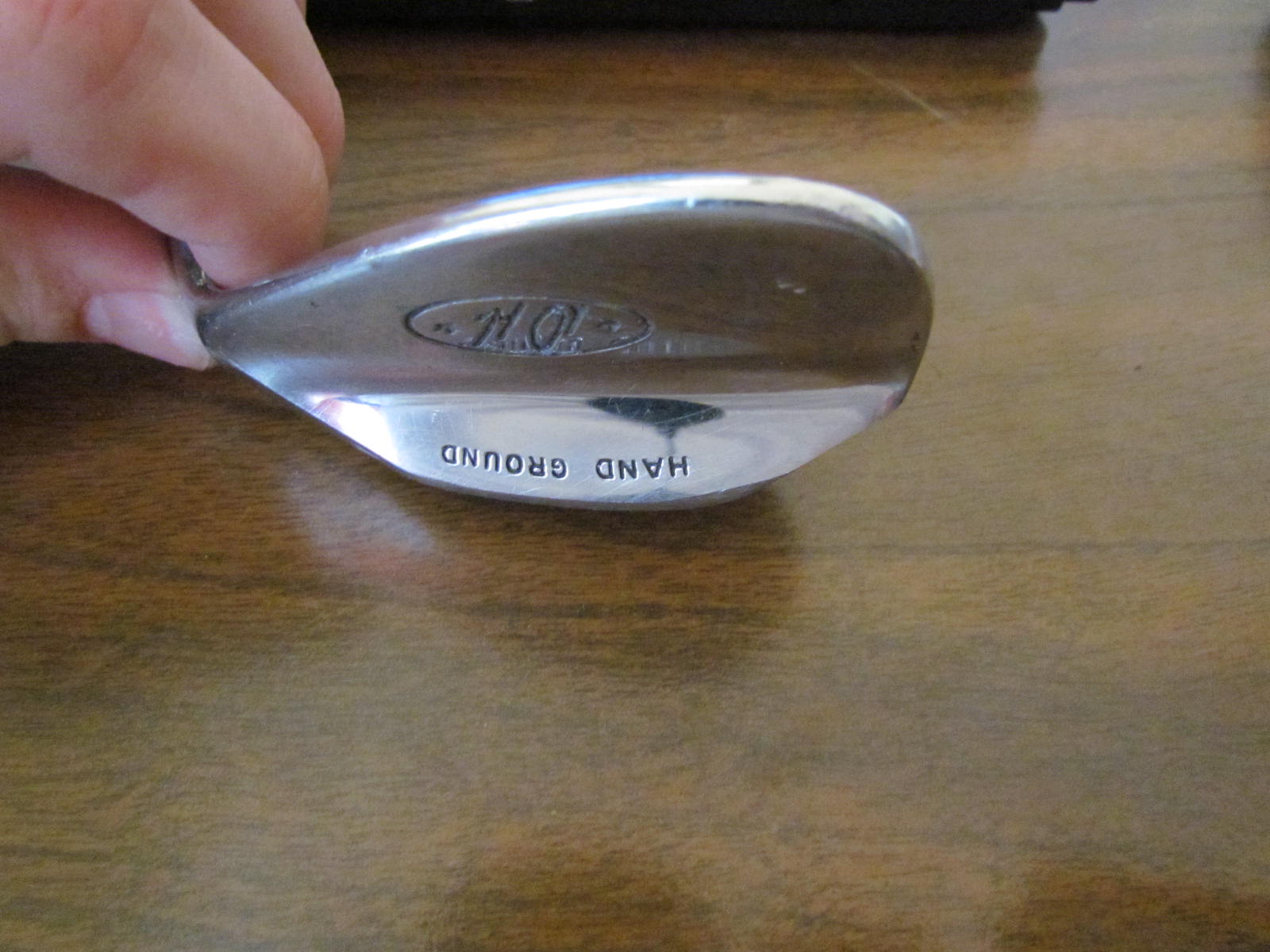
After a bit of sanding, the grind was done.
Altogether, I enjoyed the project. I’m not sure I’m ready to try it on my gamers. I took off A LOT of material, and I think the weight of the head really went down. However, I enjoyed the process, and now I know I COULD do it if I really wanted to.
Happy club work!
Oh, and, BTW, happy Valentine’s Day!


 The Power Fade Golf Blog