Pulling a Shaft: Question from GolfWRX Member
February 7, 2011
A GolfWRX member sent me a message about pulling shafts after viewing the post on replacing a Sonartec shaft, located at https://thepowerfade.wordpress.com/2010/10/17/how-i-do-club-repair-and-you-can-too/. Check out the interaction below:
———————————————————————————————–
Sent 13 January 2011 – 12:36 PM
Hey man. A few quick questions for ya. I live in Pittsburgh PA and since we have 7 inches of snow, there will be no more golf. Time for some DIY golf.
I have some limited experience with golf DIY. I was able to refinish and regroove 2 wedges a few months ago. I did the paintfill and everything.
I’m looking to refinish a set of 695cbs that I have. My questions come in here. The 2 wedges that I did before, I wasn’t worried about keeping the shafts as they were not wedges I planned on playing. So I just heated the s*** out of the shaft and pulled it out. Since these are a set of irons I plan on playing with, I want to take the heads off as carefully as possible.
What is the best way to pull iron shafts that I plan on playing with? They are steel. I assume that I will need new ferrules as well. Can you tell me that best and cheapest place you know to buy new ferrules? Really appreciate the help and great write up. If you have a writeup to link me to or if you have some step-by-step instructions, I would really appreciate it. Thx.
Sent 13 January 2011 – 01:45 PM
Sounds like a pretty easy job. Graphite is a lot harder to deal with.
Since you “heated the s***” out of the two wedges, I assume you already have a blow torch. I would make sure it’s a propane torch, as other types (acetylene, butane, for example) can get too hot and damage your club. I use a Bernz-O-Matic propane torch (about $20 at Home Depot).
Your ferrules will be irreparably damaged, yes. Before you remove the shaft, hit them with the torch for about 2 seconds so they melt a little bit, then let them cool for about 20 seconds and cut them off with a box cutter.
Once the ferrule is off, you don’t need any special equipment to take off an iron shaft (this is where the difference between graphite and steel is really seen). What I do is (1) put a heat-resistant glove on my left hand (I’m right-handed), (2) start the torch, (3) pick up the club in my left hand (held far enough away from the head that I don’t burn my glove), (4) heat the hosel, (5) put the torch down and turn it off, (6) switch hands so that I now hold the (unheated part of the) shaft in my right hand, (7) grip the head with my gloved left hand, and (8) give the club head a twist to see if the head has come loose. I usually start with about 25 seconds or so of heat, then try to twist, then 10s more of heat, then twist, then 10s, then twist, and so on until the epoxy bond breaks. MAKE SURE that you don’t just heat the hosel in one spot–continually move up and down the hosel and around the hosel (face side, crown side, sole side, etc.) so that you’re not focusing in one spot. This can cause overheating of the one spot, leaving marks and, possibly, damage to your club. Plus, it takes a lot longer. Heat loosens the epoxy bond. If you’re staying in one spot with the heat, it has to travel all the way around the shaft to get to the other side. That means that one side will be hotter than the other side. If you circulate around the hosel with the torch, the heat will be even all the way around, so you won’t have any hot spots, and it’ll go faster. As with all things, if you take your time, you should be OK.
As for ferrules, sorry I can’t help much. There are some threads on GolfWRX.com/forums if you want “custom” ferrules (where you can buy custom colors) and I know there are offerings available online. Otherwise, it’s usually best just to buy a pack at Golfsmith or on golfsmith.com (if you don’t have a golfsmith near you). Always make sure you get the right ones for your shaft diameter.
If you need any more help (how to get the ferrule on the shaft, how to clean out the hosel, etc.) let me know. I’m happy to help.
Sent 13 January 2011 – 02:03 PM
Thx for the reply. I really appreciate it.
I have Sensicore high launch shafts in my irons. Do you know how I would tell what diameter the shaft is and what diameter ferrules I would need?
Sent 13 January 2011 – 02:14 PM
Re the “diameter,” Titleist should have material online somewhere about the hosel bore for 695cbs. If you’d rather not waste your time, you can actually call Golfsmith–they have a book where they can look it up. Usually irons are .355, but you need to confirm before buying. Also, don’t do like my friend did and mix up .355 with .335.
Let me know how it goes or if you have more questions.
Sent 13 January 2011 – 02:43 PM
HAHA. Will do. Thx. I will call Golfsmith and find out. My time frame is really whenever I get home from work. I dont have anything to do now that there’s snow on the ground so I’ll be messing around with it at night. I’ll take some pics and if you want to use them great. I’ll shoot you a message if I have any other questions.
Thx again.
Play of the Week 9
February 2, 2011
This week’s POTW goes to Chick-Fil-A. This restaurant never ceases to amaze me. LG visited Atlanta for the first time in awhile, having his first Chick-Fil-A Spicy Chicken Sandwich. I must say, I have about 3-4 of these per week right now.
The concept is unbelievably simple: put a piece of chicken between two buns and add pickles. But in practicality, it’s unbelievably delicious. Along with waffle cut fries and “sweet tea” (a southern tradition), the Chick-Fil-A spicy sandwich is tops.
But then, CFA goes and outdoes themselves again, releasing the Spicy Chicken Biscuit. If I weren’t habitually late for work, I’d probably be 300lbs right now scarfing down 3 or 4 of these per day (only available until 10:30 AM).
So here’s to you Chick-Fil-A. You may be overpriced for fast-food fried chicken, but I am so addicted to your amazing goodness. Keep it coming. Otherwise, I’ll have nowhere to eat lunch!
Review: SMT Golf
January 24, 2011
Today’s post takes a look at one of the great finds of my golfing career: SMT Golf.
I’m not sure exactly how I found SMT. I wish I could remember so I could tell you. However, what I CAN tell you is that I am very happy I found them.

Anyone who has been to a big box store knows the frustration. You go to Golfsmith or PGA Tour Superstore or Edwin Watts; you try a bunch of drivers; most of them feel the same. You like one of them maybe a little more than the others; it’s priced at $399. You try to trade in your old one and get $40 or so on your trade. Two weeks later you see your old driver on the used rack for $150 and the one you just paid $399 is on clearance for $249. You spend the rest of your time with the club avoiding any possibility of scratching it or knicking it because you spent WAY too much money on it. It’s a frustrating experience that you only have to have once to be turned away. Hence, why I was looking for something more. What I found was SMT.
SMT Golf (www.smtgolf.com/) is a component club maker in Oswego, Illinois. SMT makes Read the rest of this entry »
Stamping A Wedge
January 17, 2011
Here at the PF, we try to share both our accomplishments and failures with the community in hopes that we can help someone out there learn from both our successes and out mistakes. With that backdrop in mind, here is my description of stamping my own wedges.
I followed the directions listed at the links in our prior post on stamping/paint filling clubs, located at https://thepowerfade.wordpress.com/2010/12/18/great-link-to-stamppaint-fill-your-irons/.
I trolled eBay for the cheapest stamp set I could find and ended up with one that was $16 shipped. If you go to buy your own stamp set, make sure you check with the sellers to ensure that your stamps can be used on steel. Many of the stamps on eBay are designed for jewelry applications, which involve MUCH softer metals (gold, silver, etc.).
The photo below shows the supplies I needed, including:
1. A work bench of some type (could be just a table)
2. A hammer
3. A stamp set
4. Masking tape
5. Safety glasses (yes, potential shards of hardened steel breaking off and flying is a hazard for your eyes)
6. A golf club to be stamped (duh)
7. A test piece
8. Ibuprofen for when you smash your fingers (just kidding….kind of)

Here is a look at my stamp set. You can also see the test piece with markings in it from where I tested my stamp set on it.
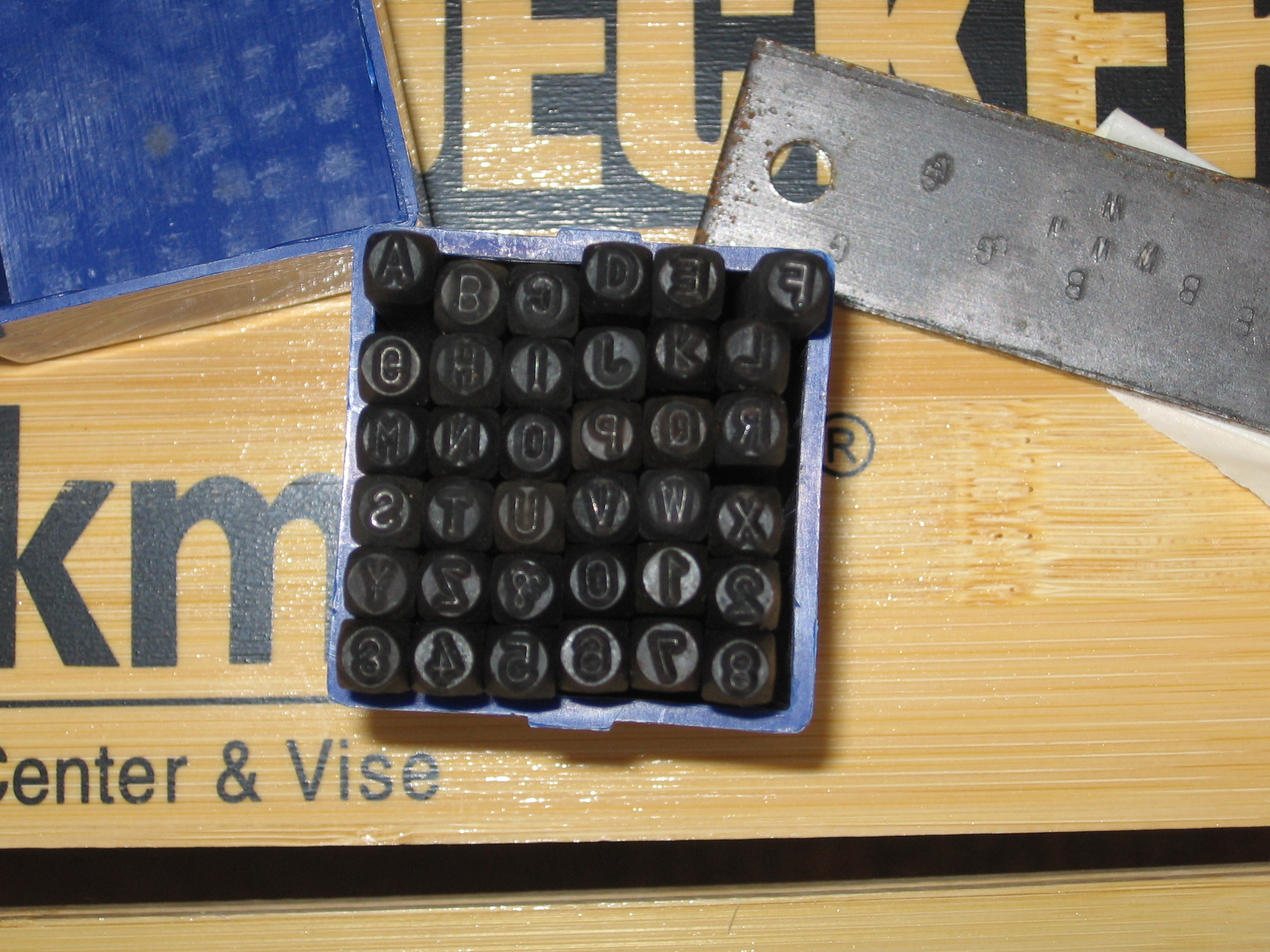
My goal in this first stamping project was to stamp the number “53” on the bottom of my gap wedge, because I regularly grab it instead of the lob wedge or vice versa–they look the same when in the bag. Thus, I clamped the club in by the neck….but….

That was a bad idea. We’ll get to it later on in the post, but, suffice to say, if you’re clamping your work piece, do not try to clamp it on a rounded portion. Hitting the club head with a hammer will cause it to move (duh). This project was a bit difficult because I wanted to stamp the sole of the club. However, I should’ve known this setup wouldn’t work out.
The correct setup is below. Because the blade is actually clamped, the club will not move.
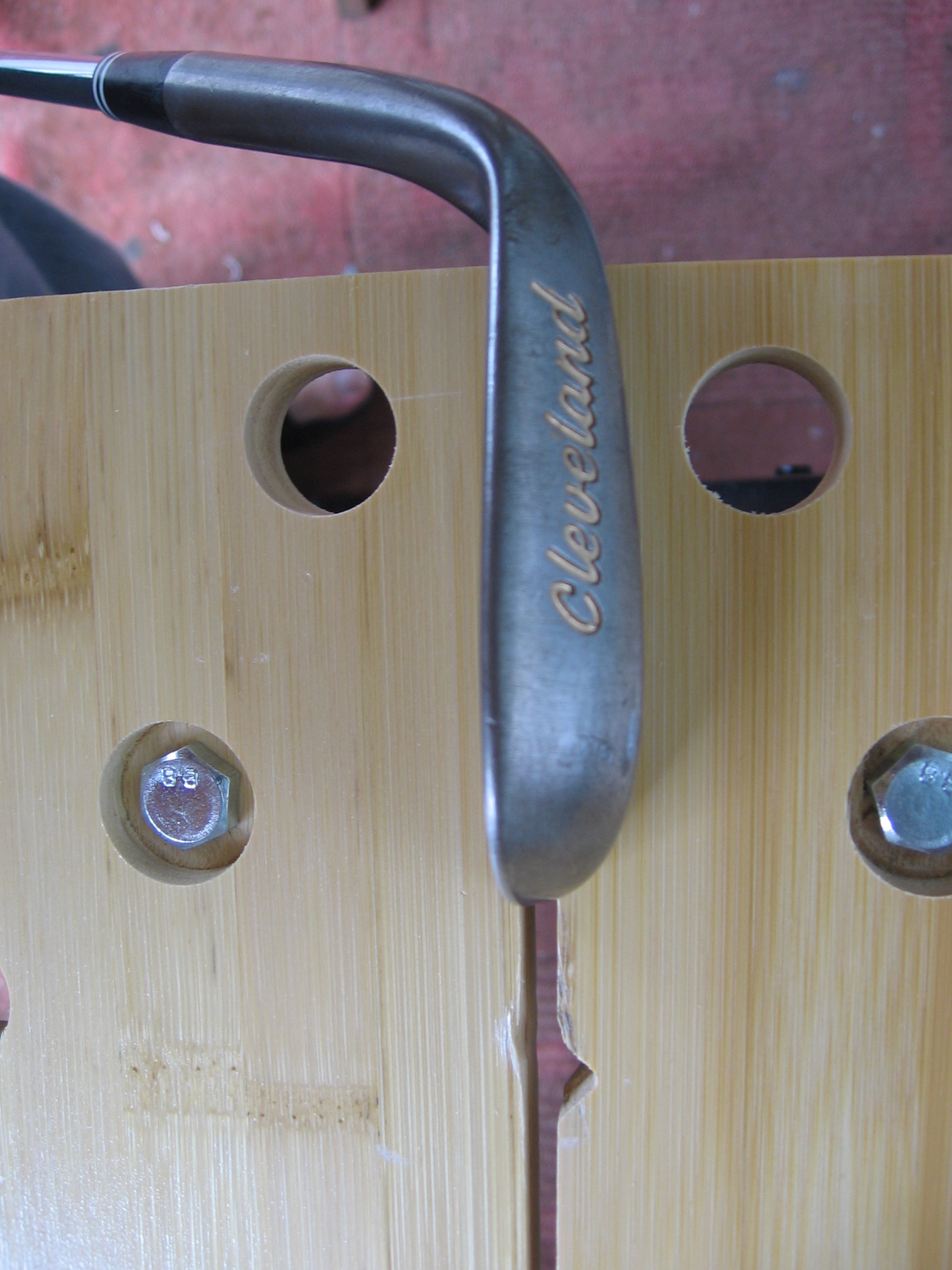
I taped the bottom of the club…
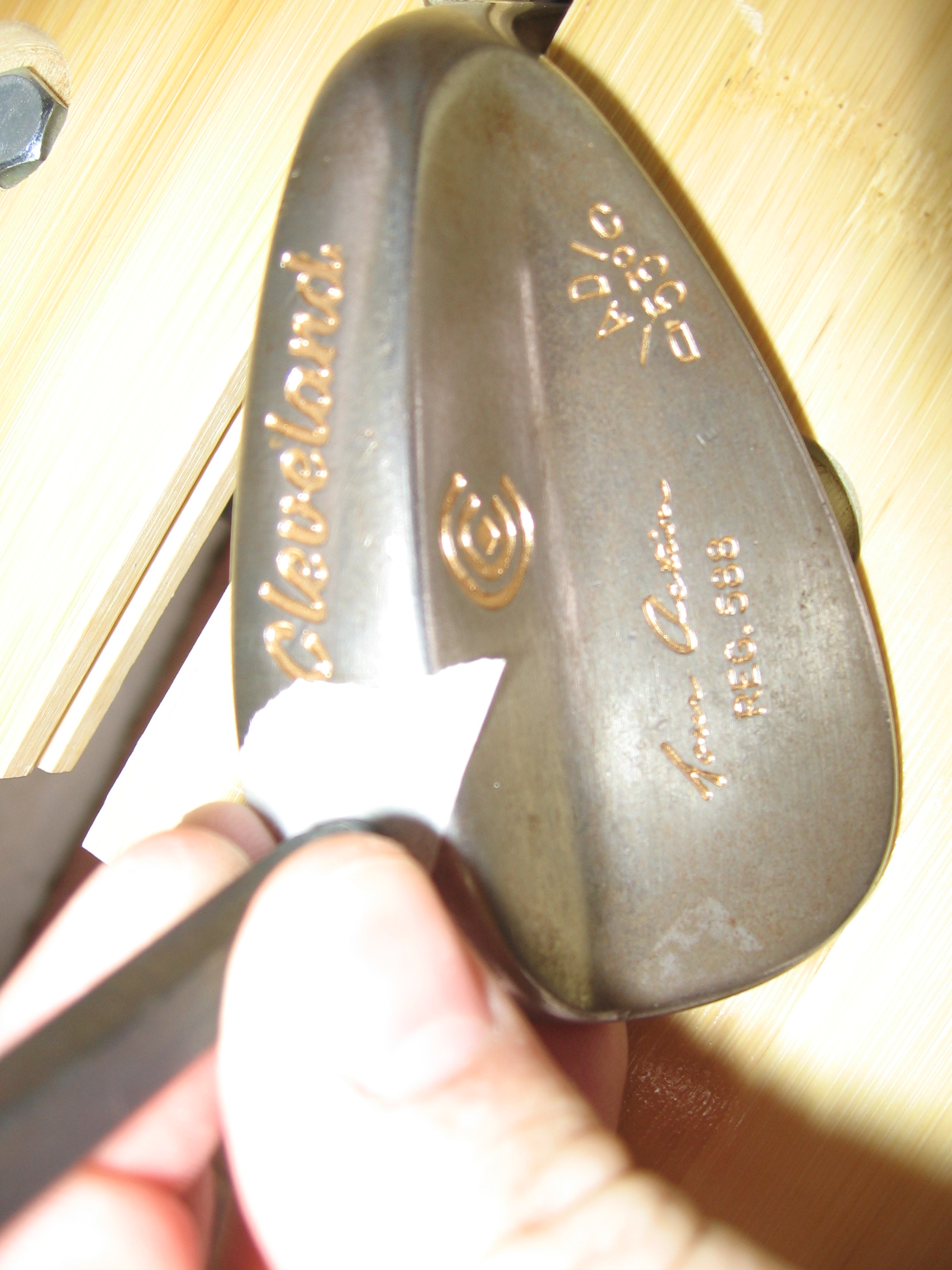
Then I held the stamp and hit it with the hammer. The following is the result.


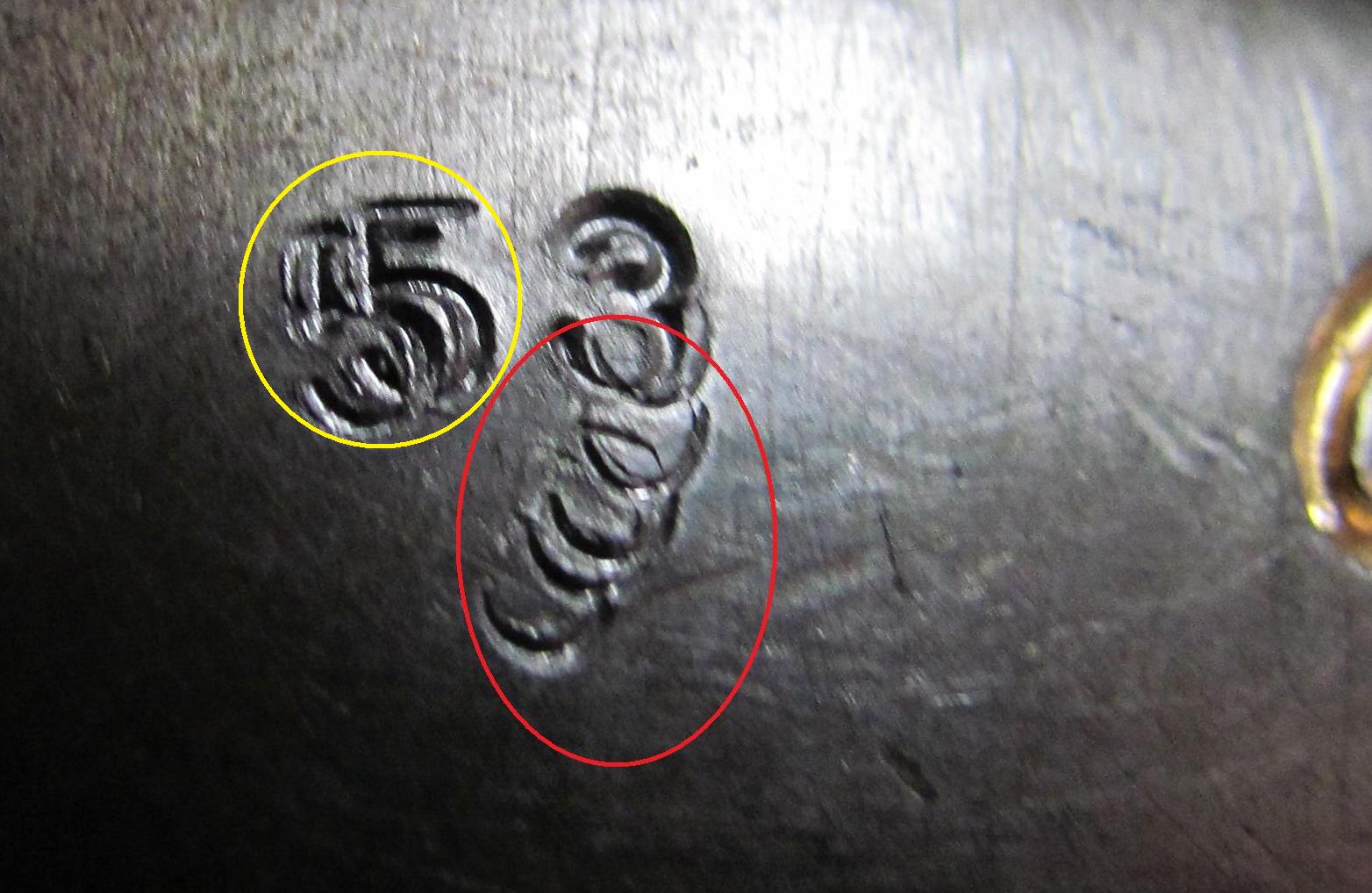
A couple of things I learned from this. As you can see below in the red oval, the bottom of the “3” is moving down the club. This was a result of the bad clamping, which I discussed above. With each hammer strike, the club moved a little. Once I reclamped it on the blade, it was OK, and I was able to get the deep 3 located above the red oval.
A second learning experience was with the 5. Although you don’t need to swing the hammer very hard, you do need to strike the stamp about 15-20 times to get a nice deep stamping (at least on these wedges–it may be different with different metals). With that in mind, you need to be darn sure that the stamp itself doesn’t move. So, what I had to learn how to do was to hold down the stamp in contact with the club head, rather than simply holding it over the club head. In other words, I needed to actually be pushing the stamp into the club head to hold it in the exact place. Otherwise, it’ll move a bit, as you can see in the yellow circle.
But, with renewed enthusiasm, I tried it on the lob wedge, stamping with my initial “J.” I think it looks pretty good, despite a few errors.


One last thing I learned from the experience: don’t just try your technique on a test piece; perfect it on the test piece. Otherwise, you’ll end up with some errors. None of them bother me that much (because I’m just not that serious), but I know some of you out there (LG?) would be extremely bothered by an error on the club.
All in all, it’s not difficult, but it requires patience and absolute accuracy.
Play of the Week 8
January 13, 2011

This week’s POTW goes to DJ–my man! Dustin Johnson is reportedly dating darling of the LPGA Natalie Gulbis. Gulbis followed DJ at the back nine of the Hyundai Tournament of Champions. Gulbis, who apparently leaked the news, stated “I’ll let Dustin handle our PR” with a smile.

Johnson has purportedly denied a relationship with Gulbis. The big question: why! Come on dude! You landed the hottie of the LPGA. Brag about it a little. According to About.com (http://golf.about.com/b/2011/01/09/natalie-gulbis-dustin-johnson-a-couple.htm) “The only thing longer than Dustin Johnson’s drives are Natalie Gulbis’s legs.”
While some would say Paula Creamer is #1 hottie for the LPGA (a lot of people: http://thesandtrap.com/forum/thread/5426/paula-creamer-vs-natalie-gulbis) , DJ certainly could have done worse.
So here’s to you DJ! You may not have won the 2010 US Open at Pebble, which you should have. You may not have won the 2010 PGA Championship at Whistling Straits, which you should have. You may not have landed PF favorite Lauren Thompson. But you certainly didn’t disappoint when it came to landing a hottie. Here’s hoping you find the fairway.

And, just for good measure, let’s not forget about the darling of the PF… Lauren Thompson, official hottie of The Power Fade.
Here’s to you too. 8)

Conversation: Will Tiger Break Jack’s Record?
January 12, 2011
Posted 12/4/2010 by JK:
Here’s an interesting topic. Some have postulated recently that Tiger’s golf regression means he won’t catch Jack Nicklaus for the all-time major championship wins record. Jack Nicklaus won 18 professional major championships in his career. At one time, it seemed like an absolute lock that Tiger would pass Jack. But Tiger hasn’t won a major since the ’08 US Open at Torrey Pines, and with the impressive young talent right now (Bubba Watson, Dustin Johnson, Ricky Fowler, Anthony Kim, Martin Kaymer, etc.), it seems that Tiger will have even fewer chances to win going forward.
For my money, I can’t see any reason how Tiger would not pass Jack, and here’s why: statistics. It used to be that golfers over about 42 years old were generally just biding their time, waiting for the Senior Tour (or, now, the Champion’s Tour). But that has changed, in my opinion, and it will affect Tiger’s ability to challenge Jack.
Tiger is now 35 years old, and many of today’s great golfers are playing well even into their late 40s (Phil Mickelson, Vijay Singh). Even Fred Couples is still competing at 50+. If he follows that trend, Tiger’s got a good 10 years of very competitive golf left in him, and with modern conditioning, weight training, equipment, and medical attention that he has experienced his entire life, he may go even further without a hitch. If he goes 10 more years, he has until 2020 to complete the feat. Even considering he only makes it 10 more years of truly competitive golf (45 years old), he’ll still have 40 more majors to play in. That means he’d have to win only 10% of the majors to tie Jack’s record. If he averaged 2 majors every 3 years–2 wins out of 12 tries, or fewer than one per year–he’d still tie Jack’s record by 2016 and beat it by 2019. In 14 years, he’s won 14 majors (exactly 10%), finishing second or tied for second 6 times, and finishing in the top 10 but outside of 1 or 2 another 14 times. Plus, he was out for half of 2008 with knee surgery and was dealing with “off-the-course” issues during 2010. If he has one more stretch like 00-02 (6 majors) or 05-07 (5 majors), he’ll pass jack over a 2-year span. And, he has 10 years in which to get it done!
Moreover, it has to be considered that Tiger no longer has the stress of keeping up extramarital affairs in the background of his already complicated personal life. The same thing that made him a scumbag to a lot of the world probably hurt his ability to focus on his job. How else would you explain Tiger shooting 75 in the final round of a major to be caught by YE Yang? Moreover, now that he’s “single” again, he doesn’t have the constant need to put his family ahead of his professional endeavors. Many athletes perform better after divorces–sad to say, but it’s true. And Tiger’s swing already looks better, and his competitive drive seems to have returned along with it.
Thus, I can’t see any way that Tiger doesn’t break Jack’s record.
Any thoughts, LG?
——————————————————————————————–
Posted 1/11/11 by LG:
Thanks for the intro, JK. I agree with you that it’s likely (for me, nearly inevitable) that Tiger will one day hold the record for most major championship titles owned by a single golfer. The more interesting questions to me are whether Tiger needs to break this record in order to go down as the greatest golfer that’s ever played the game and whether people want this record to be broken.
As to the first question, I’m sure much debate and defaming would go down if I were to take a firm position on the matter. For me, I’m not honestly sure what entitles someone to call themselves the “greatest golfer in the history of the game.” Bobby Jones championed the cause of the amateur golfer during a time when professional golfers were despised. Arnie brought the game to the people: He is the King. Jack won the most majors and exemplified the true competitor. Tiger has destroyed the field, redefined the game for the next generation, and brought the game to its largest known audience in history. For me, No one besides these four should be considered for the title. Forced to choose between them, I would pick Tiger.
My reasons are selfish. I never once thought I’d play golf while I was growing up. I took lessons for one summer and enjoyed them but never pursued the game. I took up pool in college and thought that golf was what people did after they busted out of a pool tournament (happily mistaken). At the end of the day, when I think about why I play this game, it is because of Tiger. His dominance over the game was something I had to experience to believe. Only after playing golf could I begin to understand the magnitude of his accomplishments.
Sport to me comes down to one thing: competition. Whether it’s putting a ball into a hole, shooting a ball into a basket, or sending a puck into the back of a net, the game is played to decide who wins and who loses. Therefore, the greatest golfer to me must be the greatest competitor. While Jack did win the most majors, Tiger has won more dominantly than any other player in history. If Tiger wins more majors, it seems untenable to argue that Jack is the greatest golfer on this theory, but I’m sure there are those who will try. Before that happens, however, I find it difficult to decide between the greatest number of wins and the dominance in those wins. The question remains, who is the greatest?
As to the second question, I don’t believe there could be any greater stimulus to the game of golf in this nation than for Tiger to break this record. The chase toward the record, and the manner of Tiger’s wins thus far, has been the single reason (like it or not) that golf has achieved the notoriety and cool factor that it has with the international sports community. Tiger’s dominance created an aura of invincibility that has likely not been paralleled in individual competition in modern history. The solitary nature of golf, with one man controlling his fate, renders Tiger’s achievement even more awe inspiring. If and when Tiger wins another major, we will not only find golf ratings shooting through the roof at near 2000 rates, but the game will feel new again. I, for one, am waiting for the day when Tiger begins his run again. Just thinking about Tiger in contention to win the Masters in April with a 12 footer to win on 18 already has the hair standing up on the back of my neck. Kobe held up five fingers at the end of the NBA championship last year to celebrate his 5th title. How do you celebrate your 5th green jacket? A fist pump? a high-five (that, for once, hopefully looks somewhat coordinated) with your caddie? Holding your (Scotty Cameron) putter in the air? I can’t wait to find out this April.
POTW 7: “FORE!!!”
January 7, 2011
The tranquility of golf is something that cannot be denied. A walk through nature; a game of chess with oneself; a game that Bobby Jones described as played on a course “located in the 6-inch space between your ears.” Truly, golf is about focus, patience, and skill. It teaches many lessons, a reason why it such a great game for the youth of America.
Unfortunately, that tranquility is something that is not preserved by the game itself. It’s a special feature of golf that is preserved by the players who respect it. Like the many “unwritten rules” of baseball, golf’s billing as a “gentleman’s game” cannot be enforced as a rule. It simply must be respected. And anyone who has played a public course in a city knows how much the respect has waned with the boom of golf over the past decade. Balls flying into all different fairways; carts driving where they shouldn’t be; bunkers left unraked; beer cans lining fairways. As the masses flock to golf, the tranquility of the game is eroding away.
New York’s highest court recently encountered a case regarding the tranquility of the game–specifically, whether a golfer had to yell “fore” before every swing. Dr. Anoop Kapoor and Dr. Azad Anand were playing on a nine-hole course in October 2002 when Kapoor took the swing without the warning. Anand was hit in the head and sued.

Importantly, the NY Court of Appeals decided that Anand “assumed the risk” by being on the golf course.
A person who chooses to participate in a sport or recreational activity consents to certain risks that “are inherent in and arise out of the nature of the sport generally and flow from such participation” (Morgan v State, 90 NY2d 471, 484 [1997]). A court evaluating the duty of care owed to a plaintiff by a coparticipant in sport must therefore consider the risks that the plaintiff assumed and “how those assumed risks qualified defendant’s duty to him” (Turcotte v Fell, 68 NY2d 432, 438 [1986]). However, a plaintiff “will not be deemed to have assumed the risks of reckless or intentional conduct or concealed or unreasonably increased risks” (Morgan, 90 NY2d at 485 [citations omitted]).
Here, Kapoor’s failure to warn of his intent to strike the ball did not amount to intentional or reckless conduct, and did not unreasonably increase the risks inherent in golf to which Anand consented. Rather, the manner in which Anand was injured–being hit without warning by a “shanked” shot while one searches for one’s own ball–reflects a commonly appreciated risk of golf.
I applaud the Court for preserving one of golf’s sacred rules. There is no need to disturb the tranquility of golf unless the golfer’s actions are reckless or knowingly put someone in danger. Imagine your local course, filled with Sunday golfers, where every golfer by law had to yell “fore” before each shot. If you play golf to relax (like I do), nothing could be more nerve racking.
So here’s to you, NY Court of Appeals. While I haven’t agreed with all of your decisions (Mr. Cardozo), thank you for preserving the game.

Crossing one off the bucket list: Pebble Beach Golf Links
December 25, 2010
I was very fortunate to have the opportunity to play Pebble Beach on Christmas Eve of this year. Though it is our aim to review courses that the average joe will be able to play, this is one that every golfer must play before they leave for the putting green in the sky. I’ll spare you the play-by-play and leave you with a recommendation: go play Pebble. There really are no words to describe this place. JK describes Augusta as a place that makes the hair on the back of your neck stand up. I’d say the same about the Old Course. I can confidently say that Pebble Beach fits that very same description. It truly is one of those “religious experiences” for a golfer. The price tag is daunting, but I assure you that as soon as you step up the first tee, you will not regret it. The course was very playable, even when wet, so don’t fear the winter season (usually with better rates than normal $499). One critical recommendation: take a caddie. The caddie fee at Pebble is $75 with a suggested gratuity between $35-50 depending on service. I was lucky to have one of the most experienced caddies in Pebble’s stable. Larry had just cleared 5,000 rounds in March and has caddied at Pebble for 15 years. He was able to provide some great local knowledge (especially around the greens) that proved invaluable. Larry also knew all the good places to take pictures and made sure to point out all the spots on the course where a memorable moment from the tour took place.
I had a difficult decision to make right at the get-go: which tees to play. My goal going into the round was to have a good time and enjoy myself. After all, this was my present for passing the bar exam. I decided on playing the gold tees rather than the 2010 U.S. Open tees on recommendation from the Starter and my caddie. Though it really doesn’t matter what tees you play at this course, I occasionally found myself wishing I’d played the Open Tees just to be able to say I’d played a U.S. Open course. To this effect, I played the 8th Hole from the U.S Open Tee. What a beautiful hole. Though my first ball cleared the gap (just barely), I hit a couple of extra balls just to re-live the experience in the moment. There may be no greater second shot in golf. The only decision I truly regret about my day is hitting Driver on 1. Hybrid next time. No need for anything longer.
I’ll leave you with one story from my trip. It was a beautiful, sunny day. The wind was blowing between 15-17 mph constantly with gusts between 25-30mph. As we rounded the 16th green to the 17th tee, a slight gust picked up. Larry suggested a full five or knock-down 4 into the front right-hand pin position. I teed the ball and rehearsed a nice smooth knock-down swing. I stepped off the shot because a group of tourists began yelling at their small child who wanted to come see what was going on. I aimed about 3 yards right of the edge of the green and trusted my draw to bring the ball back to the green. I hit the ball a little thin and a rocket took off straight toward the flag. Here’s the resulting second shot that I thankfully holed for a nice tweeter on 17:

I recall there being another not-so-perfect swing that resulted in an important kick-in birdie at 17 during a U.S. Open… One day… (for those of you who are not up on your golf history, click here)
Overall: 10/10.

The signature 7th hole. Shortest hole in U.S. Open history and the site of a beautiful LG par. (knock-down 9-iron to a back right hole location. missed the 14 footer for birdie by the roll of the poa; next time, no taking chances, slam it into the back of the cup.)

View from the 8th Hole vista

A look back up the 18th from the fairway. Rated the best finishing hole in the world by anyone that plays golf.
LG Painting a club: new tips
December 23, 2010
Following JK’s lead, I decided to paint my clubs. Here are the before and after shots, as well as a description of my shortcomings and new tips.

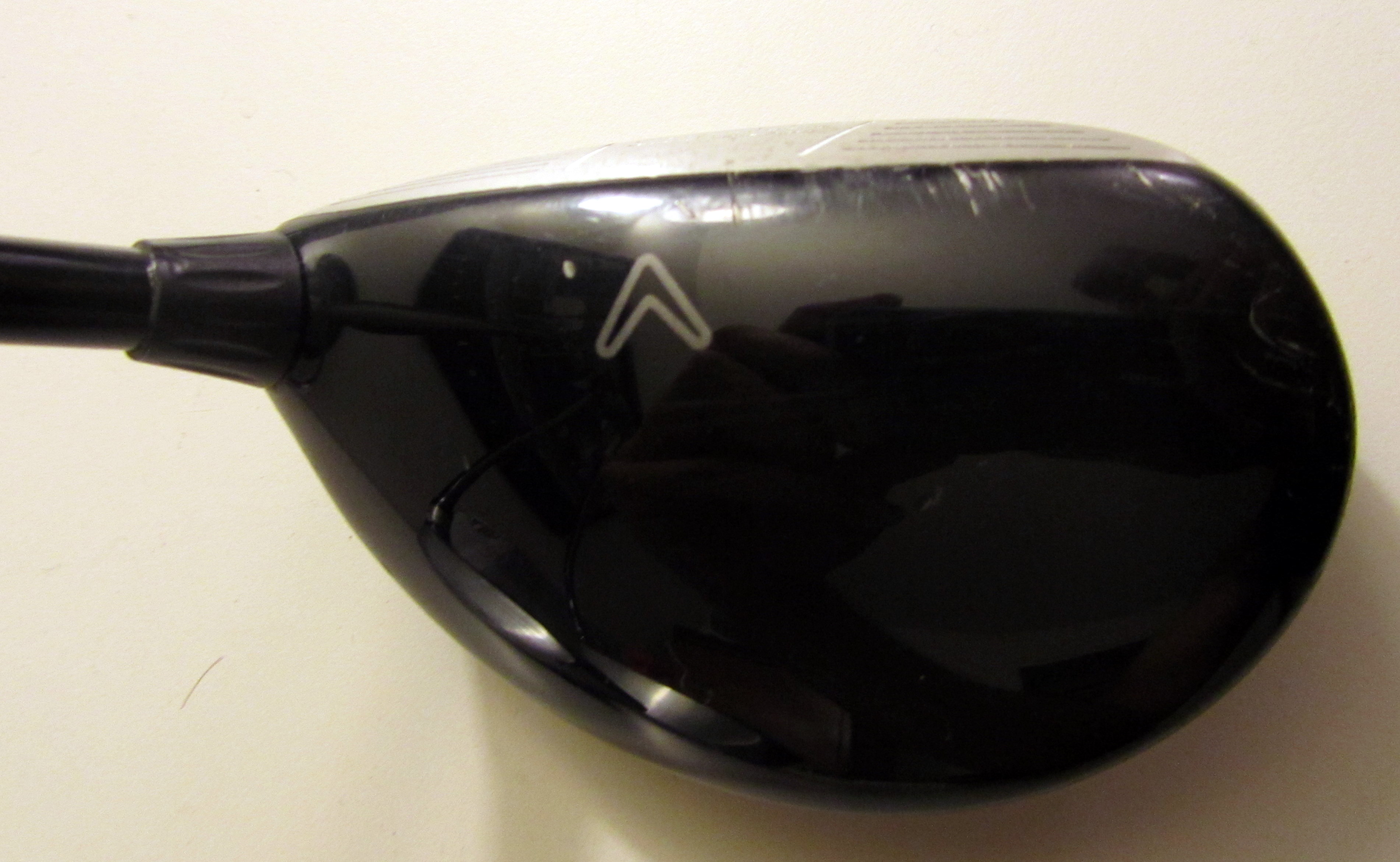

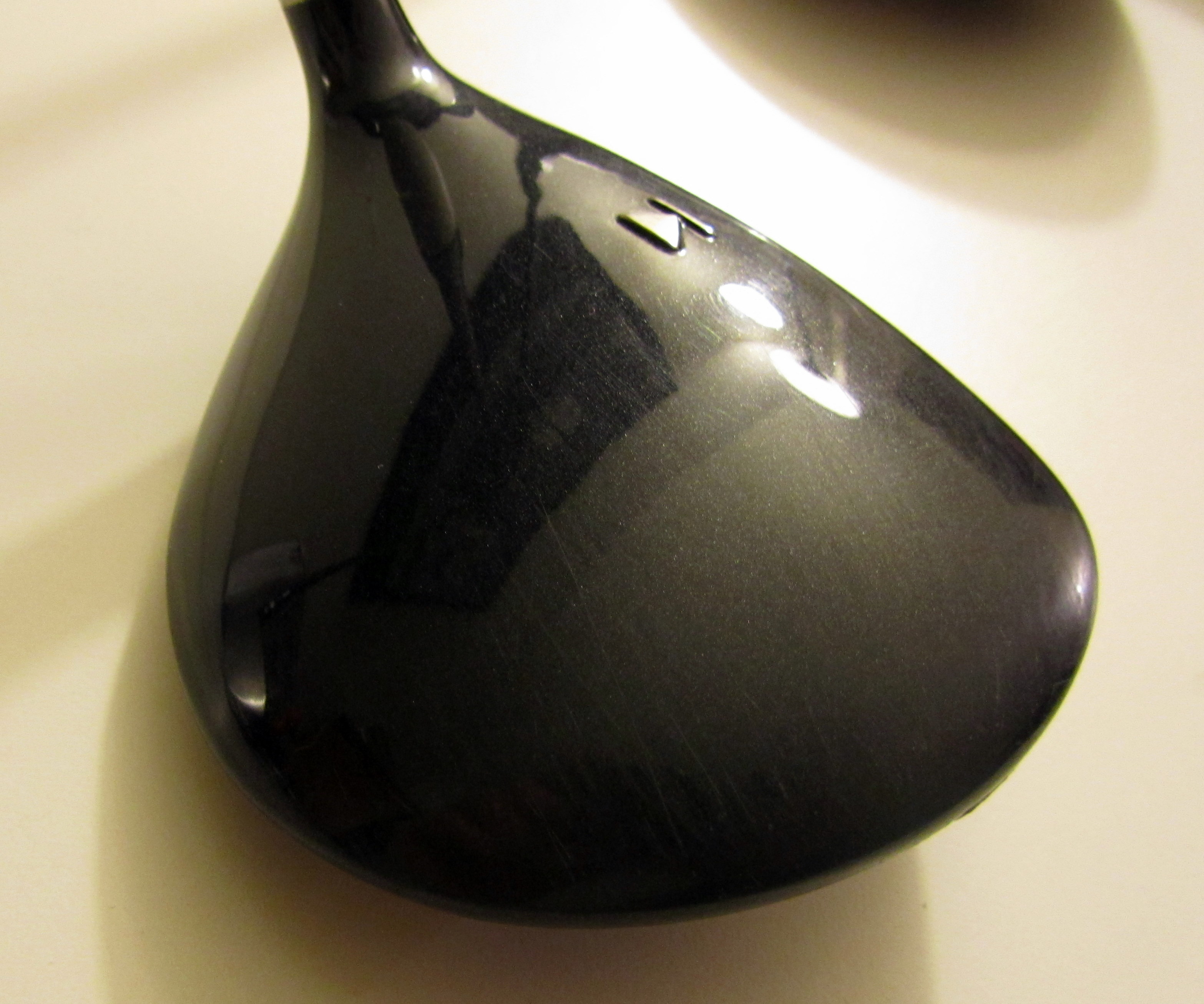
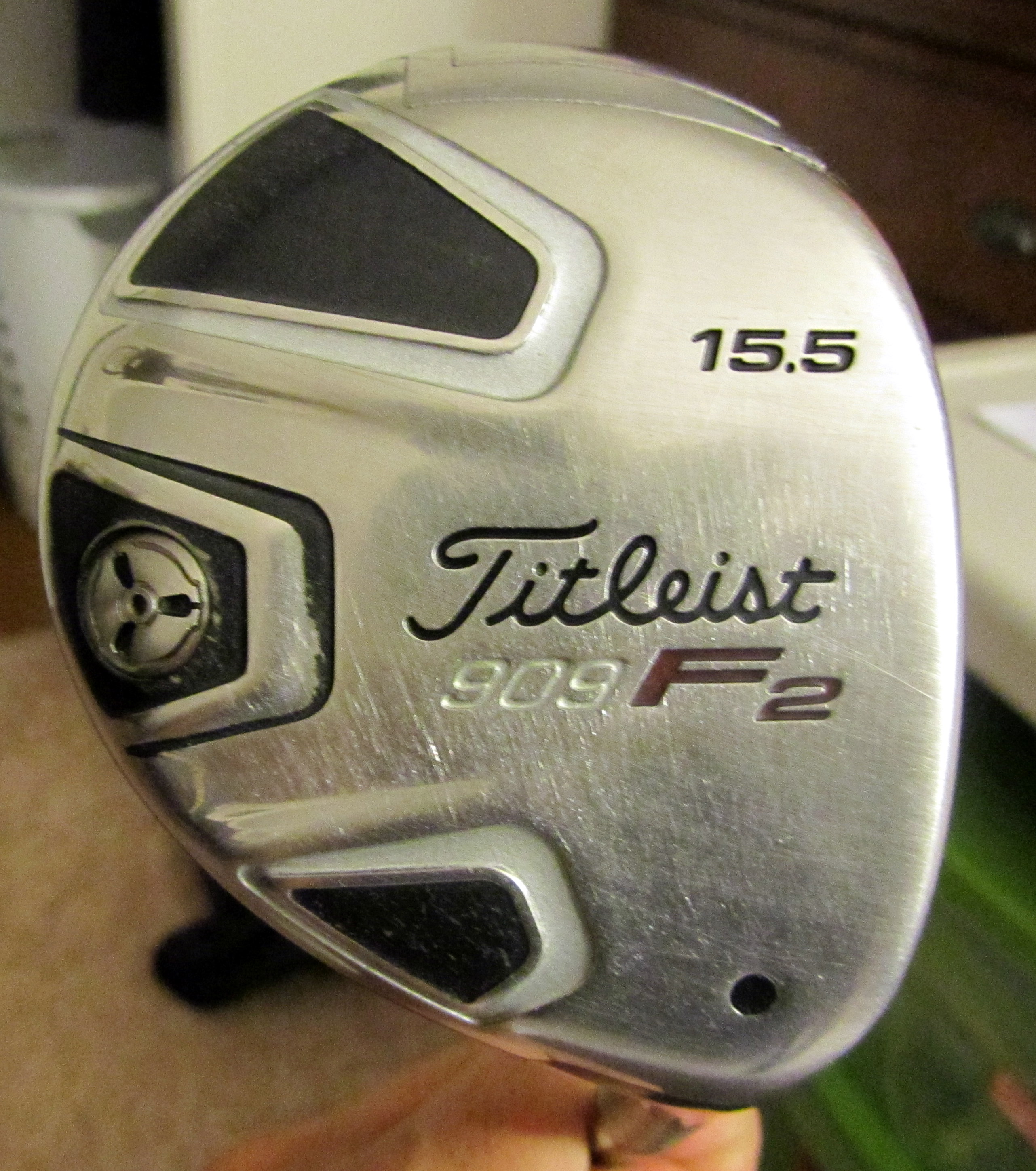


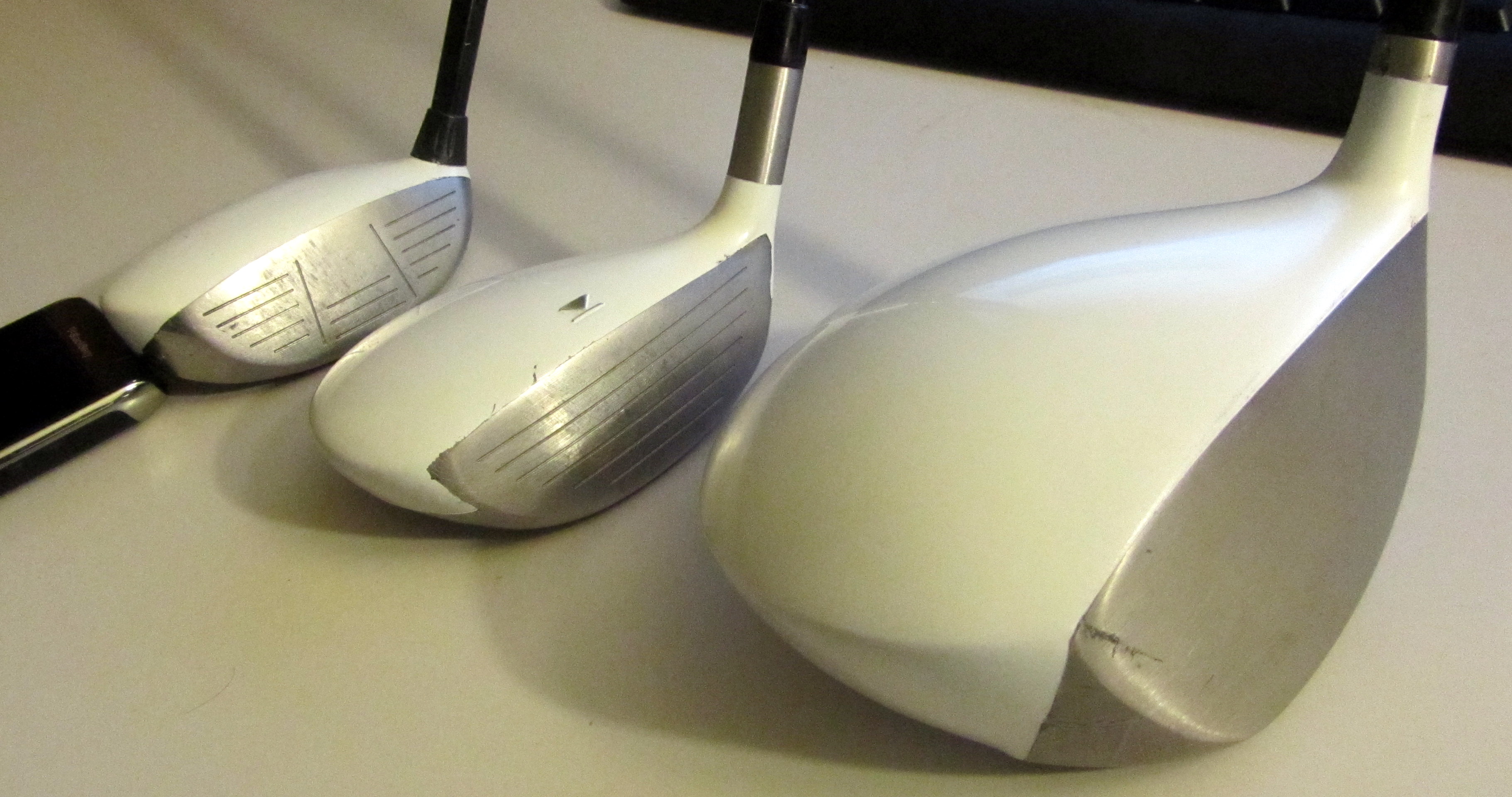


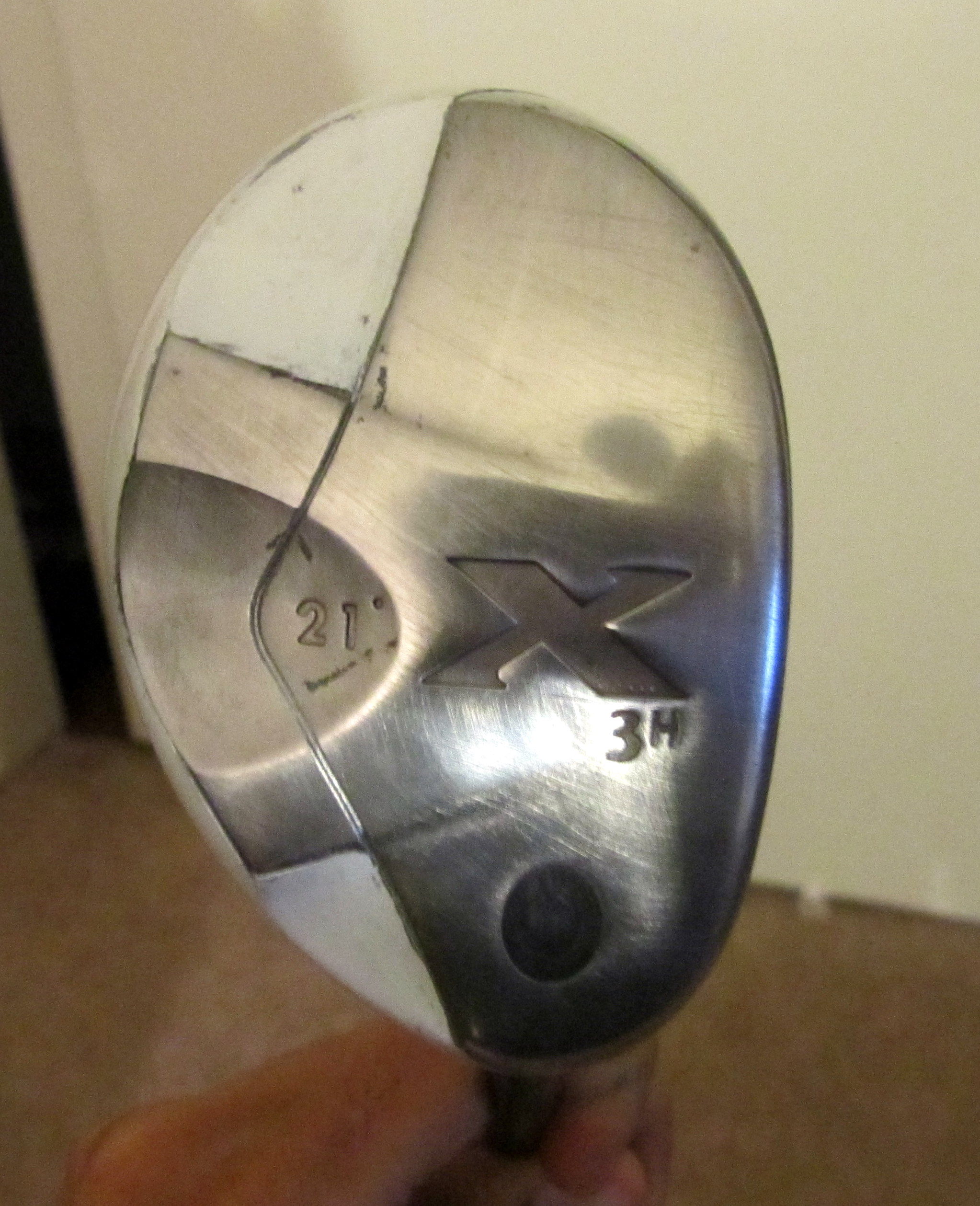
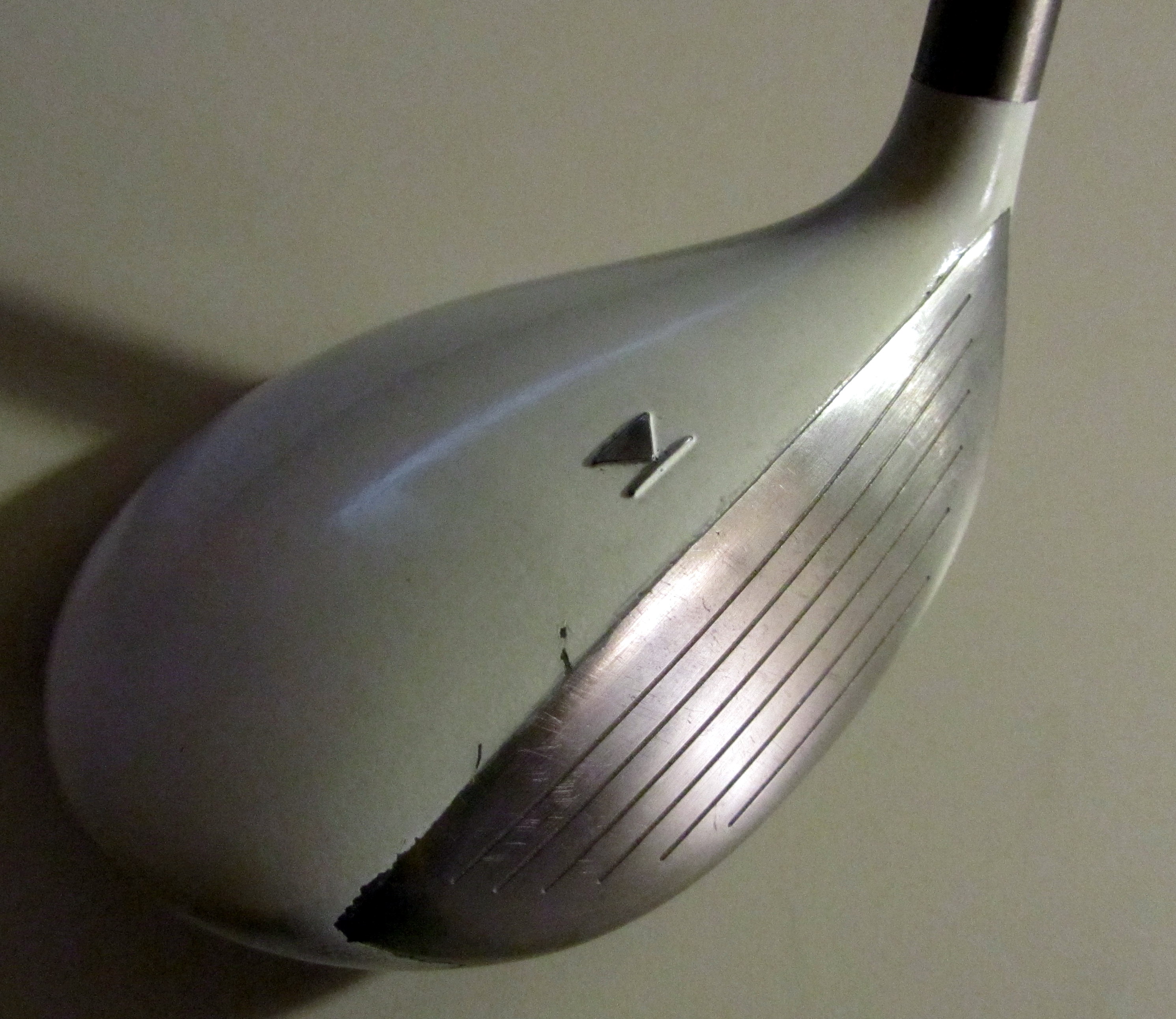

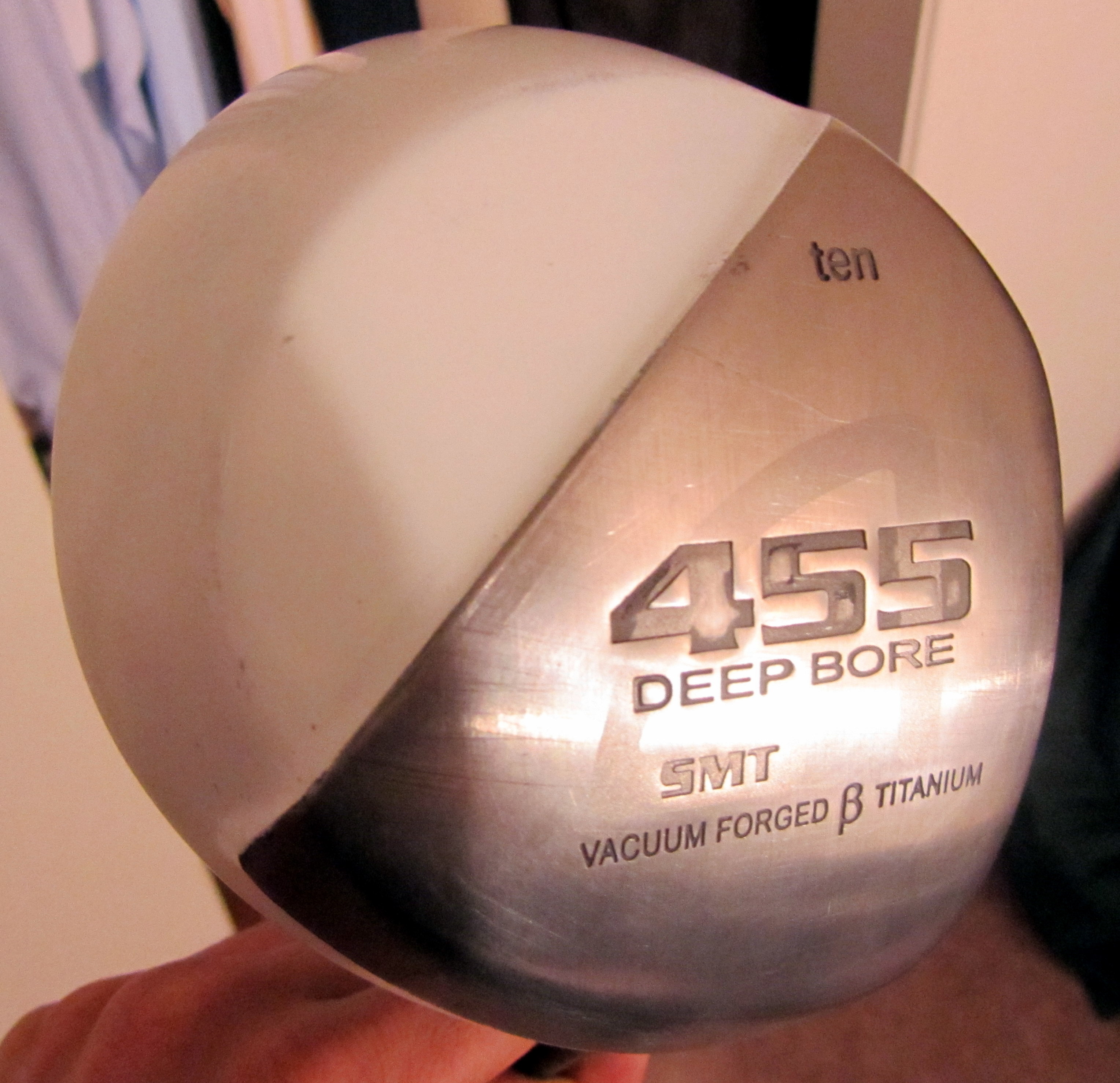
Problems I encountered:
1) White is REALLY hard to get right. Be sure you’re committed to taking the time to do this process correctly if you’re going to go with white. The results (particularly the driver) are pretty amazing when it works though.
2) Electrical tape goo will mess up the paint if you catch any of it on the sandpaper during the polishing phase. Be extra careful, otherwise you’ll get black smudges like i did on the Titleist 3w and the Callaway hybrid.
3) Take as much time as you can with the taping. At no point do you want to have to free hand the edges with a blade. Otherwise you’ll end up with scratches. See, for example, the face of my 3w :(.
4) Don’t use too much paint on any one layer – you’ll end up with something that looks like the Callaway hybrid here.
Tips:
1) Use the paint stripper (Mar-hyde brand Tal-Strip Paint remover) I used in the previous post: Quick Tip: New Life for Old Irons. This stuff works great for getting the paint off the crown of the club too. Rather than the labor of sanding, the paint will simply flake off 10 minutes after you spray it on. WARNING – use proper eye, nose, face, and skin protection when using this substance. I accidentally touched a glove that had some on it with my bare hand and it burned like crazy. This method is MUCH easier than sanding.
2) Be EXTREMELY careful during the sanding process around any edge and any place where paint meets tape. These are the most likely areas for breakage. If you’re particularly worried, don’t sand these areas until the paint cures after 4-5 days.
3) JK recommends waiting 15 minutes between coats. I waited 20 between coats on the driver and really like the results. be your own judge, but don’t tack cloth the club until the paint is dry to the touch. This is a mistake I made with the hybrid and the result was mediocre at best.
4) If you have a lot of scuff marks on the face of your club, you can smooth them down, and in some cases get rid of them all together by giving them a good sanding with the 2000 grit sandpaper you have left over. This really cleaned up the face of my SMT driver and the non-grooved parts of my 3w and hybrid. See for yourself!
5) Raised symbols/alignment markers – I was worried about painting over the arrow/line that are on the crown of the Titleist 3w. I wanted them to stand out even after the new paint job because I like to use them to line up shots. In order to make sure they’d show up, I took a razer and carefully cleaned off all the layers of paint that had built up on them prior to applying the clear coat. I later realized this was probably unnecessary due to the sanding process. JK did not do this and his results turned out just fine. I also recommend the use of a metal needle for really fine clean-up jobs.
All in all, I consider this attempt a good learning step toward the final product that I hope to achieve. Consider the above pictures a decent first attempt, but a promise that better results can be achieved with a little practice. Next up, I will see how long this paint job lasts and hopefully come up with another color that is more forgiving to try next time. Like JK says about this kind of painting, there’s a certain comfort you can take in knowing that if you mess up, all you have to do is spray the paint remover on and start over again.
Happy Painting!


 The Power Fade Golf Blog